Clara’s Verdict
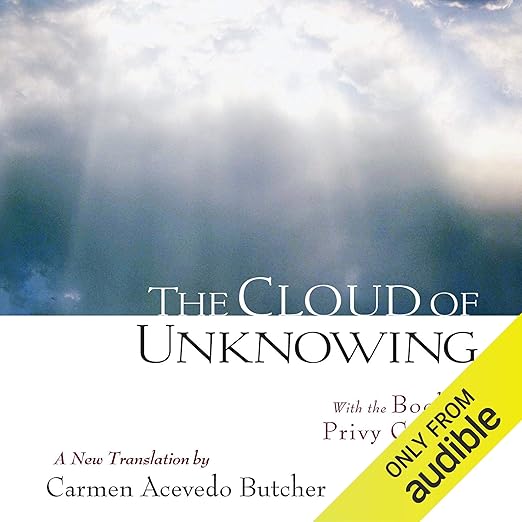
Written by an anonymous English mystic in the fourteenth century, The Cloud of Unknowing is one of the most extraordinary documents in the English spiritual tradition – practical, intimate, and genuinely strange in its central insistence that the surest path to God lies not through knowledge, effort, or theological accumulation, but through a darkness of deliberate not-knowing: a setting aside of the rational mind that makes space for something beyond it. Carmen Acevedo Butcher’s translation is the first to render this text in genuinely modern English without sacrificing the precision or the personality of the original Middle English, and the result is a version that has been returning readers to this anonymous medieval master for two decades. Paired with the companion work The Book of Privy Counsel, this is the essential edition of both texts.
About the Audiobook
The anonymous monk who wrote these texts was engaged in direct pastoral instruction – practical guidance in the way of prayer that leads to union with God, written as letters to a student in the early stages of contemplative practice. His central metaphor is the “cloud of unknowing” that lies between the soul and God: a darkness that cannot be pierced by intellect, learning, or spiritual striving, but only by a naked, focused act of love. The soul must project itself into that cloud and remain there, refusing all thought, all imagery, all concept – even thoughts of God as God is typically conceived.
The theology here is what later traditions would call apophatic or negative theology: approaching the divine not by accumulating true statements about it, but by setting aside all statements and resting in unknowing. It has affinities with Eastern contemplative traditions, with Zen Buddhist practice, and with the nondual spirituality that has attracted so much interest in recent decades – which partly explains why this fourteenth-century English text continues to find new readers across traditions and faiths.
What’s remarkable is how practical the text remains throughout this rarefied territory. The anonymous author is funny, impatient, encouraging, and specific about the obstacles his student will encounter. Previous translations tended to veil this personality under medievalising language; Butcher’s version preserves it entirely. This is not a museum piece but a living voice, addressing genuine difficulties in contemplative practice with the authority of someone who has encountered them all personally.
Butcher’s translation choices are consistently excellent. She renders the Middle English “naked intent” – the technical term for the focused, imageless love the text prescribes – as “bare longing,” which captures both the vulnerability and the directional quality of the original. The anonymous author’s occasional exasperation with his student (“Stop looking inside yourself!”) comes across with a vividness that earlier translations had smoothed away. The Book of Privy Counsel, included in this edition, continues the same teaching with even greater intimacy, addressing questions that arise as practice deepens. The two texts together represent the fullest expression of this anonymous tradition. Running just over five hours, this is a contemplative text that rewards slow, repeated listening – the kind of text you return to at different points in your life and find different things.
The Narration
James Patrick Cronin narrates with a quality of stillness that is perfectly suited to this material. This is not a text to race through, and Cronin doesn’t try. His voice carries a naturally contemplative quality – unhurried, attentive, bringing full weight to the language without heaviness. The practical passages are clear and specific; the more mystical passages are given the breathing room they require. The result is an audiobook that functions almost as a form of contemplative practice in itself.
What Readers Say
Rated 4.7 out of 5 from 476 reviews – remarkable engagement for a medieval mystical text. “Should be read by all Christians who want to know peace with God,” wrote one listener. Others situate it within a broader nondual tradition, noting affinities with contemplative practice across religions: “Be careful, after reading this book, the questions may just stop.” One reader who found previous translations “hard to digest” praised Butcher’s version as finally making the text “enjoyable and worthwhile.” With nearly five hundred reviews, this is clearly a text that continues finding new readers who need it.
Who Should Listen?
Anyone drawn to contemplative spirituality, whether Christian or approaching from another tradition. Those interested in the history of English mysticism, alongside Julian of Norwich and Walter Hilton. Practitioners of meditation or mindfulness who want to encounter the Christian contemplative tradition at its most sophisticated and practical. And anyone who has found that the harder they try to grasp something essential, the further it recedes – the anonymous author understood that experience very well.
The anonymous author’s context – a Benedictine or Carthusian monk writing in fourteenth-century England, in the aftermath of the Black Death, in a world whose theological landscape was being rapidly altered by figures like Wycliffe and the Lollards – is touched on briefly in the introduction. That context matters: the Cloud is in part a response to a particular kind of devotional inflation, a proliferation of vivid spiritual experience and dramatic prayer that the author views with considerable scepticism. His insistence on simplicity, on the stripping away of all imagery, is a deliberate counter-cultural position in its historical moment as well as a timeless contemplative instruction.
Find this extraordinary work on Audible UK. Also available on Kobo and Scribd.