Clara’s Verdict
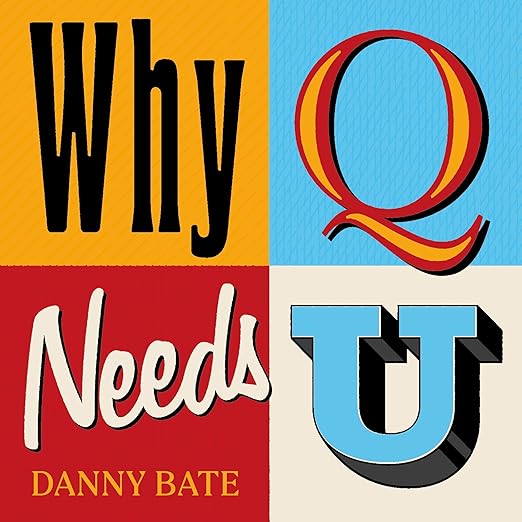
Stephen Fry is not given to endorsing things lightly, so when he calls Why Q Needs U “a breathtaking adventure through the alphabet” and says he “couldn’t recommend it more highly,” that is worth taking seriously. Having now listened to all ten hours of Danny Bate’s linguistic history, I think Fry has it about right. This is a book that manages to be simultaneously very funny, genuinely erudite, and – I say this with full awareness of how unlikely it sounds – gripping. The English alphabet has had a life considerably more dramatic than its current settled appearance suggests, and Bate is an excellent, enthusiastic, and thoroughly reliable guide to the whole remarkable journey.
Susie Dent – the reigning public authority on English vocabulary – called it “an excellent read.” The Sunday Times noted you will never look at a keyboard the same way again. The Economist called it “charming.” All three assessments are accurate, and none of them fully captures how much genuine fun this book is. It is rare to come away from ten hours of linguistic history feeling that the world has become more interesting rather than more complicated, but that is precisely the effect here.
About the Audiobook
The premise is deceptively simple: take each letter of the English alphabet and trace where it came from, how it changed over the centuries, why it sounds the way it does today, and what its presence in modern English tells us about the deep history of language, politics, and culture. In execution, the book becomes something considerably richer than that description implies.
Bate’s key insight is that English’s notorious orthographic oddities – the silent letters, the inconsistent pronunciations, the rules that exist apparently to be broken – are not failures of the language but evidence of its history. They are, in a genuine sense, fossils. The two different “c” sounds in “circus” reflect different periods of cultural borrowing from different languages. The “w” that sounds like “double u” is a literal phonetic memory of the letter’s medieval written form. The “q” that requires a “u” is a Phoenician legacy preserved through Latin, through Norman French, into modern English by a series of political and cultural accidents spanning two thousand years. The second “n” in “Danny” is there for a reason, and Bate explains it with evident delight.
Each letter’s story opens outward into archaeology, politics, trade routes, colonial history, printing press economics, and the practical choices of long-dead scribes trying to solve immediate problems with the tools they had available. The decision that gave us the letter W, for instance, was a workaround. The reason Q and U travel together is a chain of accidents stretching back to Phoenicia. None of it was designed; all of it makes sense once explained.
The cumulative effect is a profound shift in how you perceive written language – not as a neutral system for recording speech, but as a living sediment of everything that happened to English along the way. Every sentence you read after this book is a kind of archaeology.
The Narration
Bate narrates his own work, and his enthusiasm for the subject is evident throughout without tipping into the slightly breathless register that can make popular linguistics feel like a TED talk. He has a natural instinct for the perfectly placed pause and knows when a factual revelation will land better if it’s given a moment’s space rather than immediately followed by the next one. The book’s wit – which is considerable and sometimes very dry – comes through clearly in his delivery. At ten hours the format is well-sustained; there are no longueurs, and the audio format sidesteps the rendering problems that affected the Kindle version for some characters from non-Latin scripts.
What Readers Say
The audiobook holds 4.4 stars from 150 ratings. Holly described it as “accessibly written and endlessly interesting.” Ian Budd, whose fascination with English orthography was sparked by a German teacher sixty years ago, found this book gave it proper substance. Allan Lees, coming to it as an amateur etymologist, specifically noted that the audio version avoids the font rendering problems that marred the Kindle edition – an important practical point for a book whose content requires the display of characters from multiple scripts. WilF confirmed the same: the audiobook is, for this particular subject, the format that works.
Who Should Listen?
Anyone who has ever wondered why English spelling is so baffling, admirers of Susie Dent’s etymological digressions on Countdown, devotees of Stephen Fry’s linguistic observations, and anyone who enjoyed Simon Winchester’s books on the Oxford English Dictionary or Mark Forsyth’s work on etymology. Also warmly recommended for language teachers, amateur etymologists, and curious generalists who derive genuine pleasure from having their assumptions about familiar things completely and thoroughly overturned. This is a book for people who look at a keyboard and think there might be more going on than immediately meets the eye.
Available on Audible UK, Kobo, Scribd, and Storytel. Listen to Why Q Needs U on Audible UK.