Clara’s Verdict
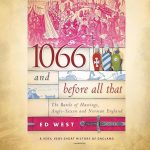
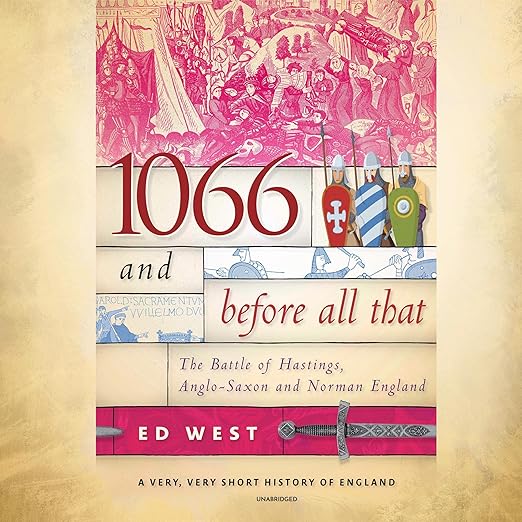
There are moments in my working life, usually on a train back from somewhere, when I want something engaging but not demanding, and Ed West’s A Very, Very Short History of England series is exactly the right thing. 1066 and Before All That is the first entry, covering the most consequential year in English history with the kind of well-aimed wit that makes learning feel like recreation rather than obligation. West knows his material thoroughly enough to carry the jokes without sacrificing accuracy, and that combination is rarer than it should be in popular history. He is not dumbing down; he is translating for an audience that does not have a medieval specialist’s patience for footnotes.
This is pitched explicitly at newcomers, and I think that honesty is part of its charm. It does not pretend to be anything more than an intelligent introduction, and within those limits it is remarkably good. Steven Crossley narrates with the dry confidence that West’s prose requires, and the 5 hours and 28 minutes runtime makes it ideal for a single day’s listening. If you finish it and want more, the series continues, and that is probably the intended outcome.
About the Audiobook
Book 1 in the A Very, Very Short History of England series, 1066 and Before All That covers the pre-Conquest period and the catastrophic events of that year in full. West sets up the Norman context: William the Bastard’s preeminent warrior culture, built entirely around conflict, and his claim to the English throne through his half-Norman cousin Edward the Confessor. The examination of Harold Godwinson’s seizure of the throne on Edward’s death, and the brutal consequences that followed across the remainder of 1066, is handled with clarity and pace. The body count, West notes with characteristic dryness, might give George R.R. Martin pause.
Published by Blackstone Publishing in April 2022, the book introduces the medieval world of chivalry, castles, and mounted knights to listeners who may have learned the date of Hastings at school and little else. The 4.3 rating from 633 Audible UK listeners is a solid signal for popular history at this accessible register: not the 4.7 that a landmark work achieves, but entirely respectable for a short series entry aimed at newcomers. West’s humour is period-appropriate rather than anachronistically imposed, and his modern comparisons are used sparingly and to good effect. The section covering the preceding two centuries, which explains how a duke from northern France came to have a credible claim to the English crown in the first place, is particularly useful for listeners who come to 1066 as a famous date without the contextual understanding that makes it meaningful.
The Narration
Steven Crossley delivers the material with an appropriate lightness of touch that honours West’s comic instincts without overselling the jokes. Popular history narration of this kind requires a consistent tone that signals serious but not solemn, and Crossley finds that register without difficulty. The 5-hour runtime is comfortable territory for a narrator of Crossley’s experience, and the pacing throughout is well-judged. The sections covering the political machinations of the 1060s get the slightly elevated gravity they need, while the comic asides land without interrupting the historical argument. For a book that depends on its narrator maintaining the author’s voice rather than imposing their own, Crossley is an excellent choice.
What Readers Say
Listeners divide fairly neatly into those who came with some existing knowledge and those who arrived as complete novices, and both groups tend to find value in the book. The novices consistently praise the accessibility and the wit; those with some background knowledge note that West’s account is both more accurate and more entertaining than the popular imagination of 1066 usually allows. One reviewer appreciated the modern comparisons as “useful” without being gimmicky; another praised it as “educational, clever, and entertaining” in the same breath. The one consistent caveat across reviews is the absence of a visual timeline, which is a limitation inherent to audio format rather than specific to this production. Listeners who struggle to track multiple characters with similar-sounding Norman names may wish to have a basic reference to hand, though the narrative is generally clear enough that this is not a serious obstacle.
Who Should Listen?
Ideal for anyone who wants to understand 1066 in its full context without committing to a major scholarly account, and for listeners who respond well to humour as a mode of historical explanation. Works well as a palate cleanser between weightier listening: at 5 hours, it demands no particular commitment. Those seeking academic rigour should look elsewhere. West is explicitly a populariser rather than a revisionist, and the book is better for knowing its lane. A strong starting point for the A Very, Very Short History of England series, and an enjoyable way to spend a morning commute or a train journey.