Clara’s Verdict
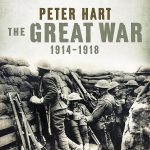
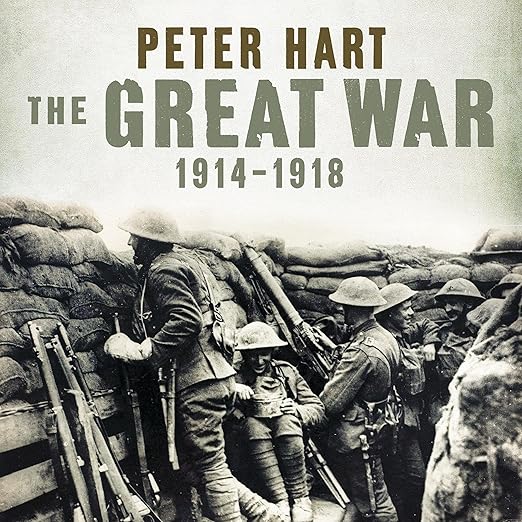
Peter Hart’s The Great War is the kind of history book that genuinely changes how you understand an event you thought you already knew. I came to it having read a fair amount of First World War history – Keegan, Hastings, Macdonald – and found myself repeatedly surprised by the breadth of Hart’s vision and the vividness of the voices he draws on. Nearly twenty-three hours of audio narrated by Roger Davis, with a rating of 4.5 from 900 listeners – numbers that reflect a book that has found a substantial and serious audience. The comparison to Anthony Beevor and Max Hastings, which the publisher makes, is defensible in the best possible sense: this is First World War history at the level the subject deserves, and it will remain the standard one-volume account for some years to come.
About the Audiobook
The Great War was, as Hart argues from the outset, the first truly global conflict – fought not just on the Western Front but in the Middle East, Africa, the Aegean, the South Atlantic, and the air above all of them. One of his central complaints about standard histories is their narrow focus: the trenches in France and Belgium as the entire war. Hart corrects this without losing the Western Front’s central importance; he simply insists that you cannot understand the conflict without understanding Gallipoli, Salonika, Palestine, the war at sea, and the Eastern Front as parts of the same interconnected catastrophe.
What distinguishes this history from comparable one-volume accounts is Hart’s use of eyewitness sources, many drawn from the Imperial War Museum’s vast archive. These are not the famous voices – the poets, the generals, the politicians – but ordinary soldiers, nurses, and civilians whose accounts have often never been widely read. Their testimony gives the narrative a texture and immediacy that purely analytical history cannot provide. Hart weaves them in without sentimentality, which is precisely right: the Great War was not a place for sentimentality.
The analytical core is Hart’s interest in how technology and tactics evolved – the relationship between barbed wire and the machine gun, the development of the tank, the emergence of combined-arms warfare as the dominant form of modern conflict. He is clear-eyed about which battles were decisive and which were costly failures, and he does not spare the high command on either side.
The Narration
Roger Davis brings the right weight to this material – a steady, authoritative voice with enough variation to prevent twenty-three hours from becoming monotonous. The eyewitness passages are handled with particular care; Davis shifts register subtly to mark the transition from Hart’s own prose to the contemporary accounts, which helps the listener navigate the two registers without losing the thread of the argument. The sheer length of this production means narration quality is not a minor consideration, and Davis sustains both the energy and the clarity needed to carry a listener through the full arc of a four-year global war.
What Readers Say
Rated 4.5 from 900 listeners, with reviews that praise both scope and scholarship. One called it a compact, comprehensive chronology that offers overview and personal testimony simultaneously, making it valuable for students and general readers alike. Several note that Hart’s attention to the naval war and the peripheral campaigns gives the book a completeness that most single-volume accounts lack. One listener who described themselves as already well read on the subject found the eyewitness sources genuinely new to them. Another praised it as wonderfully well-written and noted the clarity with which Hart explains how modern technology changed the very nature of warfare. The voices from the trenches, the deserts, and the seas are what make this history live beyond the statistics.
Who Should Listen?
Anyone who wants a single authoritative guide to the First World War as a whole – not just the Western Front, but the full global conflict in all its theatres. History students, armchair historians, and anyone who found the centenary commemorations of 2014-2018 thought-provoking but wanted more analytical depth. This is also an excellent listen for those who have read more narrative accounts – Vera Brittain’s Testament of Youth, for instance – and want to understand the military and technological dimensions that frame those personal stories more clearly.
Hart’s book also functions as an excellent primer before visiting the battlefields of the Western Front, the Gallipoli peninsula, or the cemeteries of Palestine and Mesopotamia. Context transforms what you see in those places. Find it on Audible UK – nearly twenty-three hours of some of the finest First World War scholarship available in audio form.
Whether you access it via Audible UK, Kobo, Scribd, or Storytel, this is a production worthy of the subject it covers and of the listeners who come to it seriously.