Clara’s Verdict
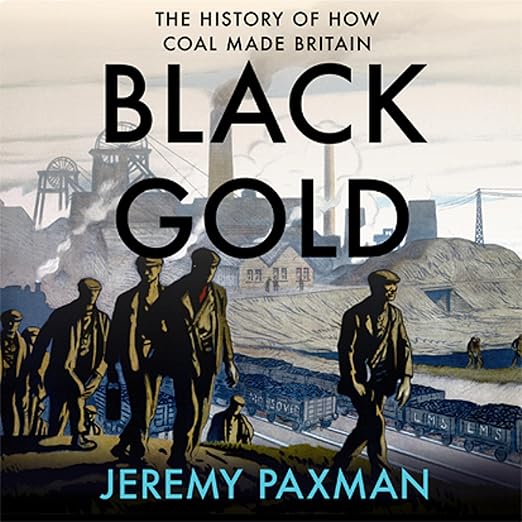
Jeremy Paxman is not a historian by training, but he writes history better than most who are. Black Gold: The History of How Coal Made Britain is a magnificent piece of popular social history – sweeping in scope, beautifully written, and shot through with the moral clarity that Paxman brings to everything he touches. Coal is a subject that tends to attract either hagiography or condemnation; Paxman refuses both. He holds the full complexity of the story – the filth, the industrial genius, the human exploitation, the tight-knit community, the political betrayal – and renders it into a narrative that grips from first to last. The Sunday Times called it “a rich social history.” The Times praised its “fine narrative powers.” Both are right. This is the kind of audiobook that makes a twelve-hour drive feel too short. The fact that Paxman narrates his own work is not merely a bonus – it is essential to the experience.
About the Audiobook
Running at twelve hours and forty-nine minutes, Black Gold traces coal mining in Britain from Roman times through the birth of steam power, the industrial revolution, pea-souper smogs, nationalisation, the Miners’ Strike of the 1980s, and the eventual decimation of the industry. Paxman’s method is characteristic of the best popular history: he moves between the grand sweep of economic and political change and the vivid individual story, spending considerable time in the pit villages of County Durham and Northumberland, the Welsh coalfields, and the Yorkshire collieries.
The book is emphatically a social history rather than a technical one. While Paxman covers the engineering breakthroughs that made deep mining possible and the economic structures that made it profitable, his real interest lies with the people – the miners who spent their working lives underground, the women and children who worked at the surface or below it before legislation intervened, and the pit communities whose culture, solidarity, and identity were bound up entirely in the coal beneath their feet. His scorn for the mine owners who grew wealthy “by an accident of geology” while their workers lived in conditions of squalor and physical danger is barely contained. His treatment of the Miners’ Strike and its aftermath is no less pointed: he understands the political decision to destroy the industry as a choice with human consequences that its architects either did not see or did not care about.
Written in the style of his bestselling The English, Paxman ranges widely across Britain and across time, finding in coal the connective tissue of modern British history – the force that drove the industrial revolution, created the urban working class, powered the empire, and ultimately defined the fault lines of class and geography that still shape the country today.
The Narration
Paxman reads with the practiced ease of a broadcaster who has spent decades communicating complex ideas to large audiences. His pacing is excellent – he knows where to linger and where to drive forward – and his dry, occasionally sardonic tone suits the material perfectly. A former coal industry worker of twenty-one years who reviewed the book noted that Paxman could have given more space to the miners themselves relative to the industrialists and aristocrats – a fair criticism, though the majority of readers felt the balance was right. At nearly thirteen hours, this is a substantial listen, but Paxman’s authoritative, engaged delivery ensures it never becomes a slog. The William Collins audio production is clean and well-balanced throughout.
What Readers Say
With a rating of 4.6 out of 5 from 917 listeners, Black Gold has earned its reputation as one of the better popular history audiobooks of recent years. UK reviewers have been particularly warm, and those with personal or familial connections to mining communities responded with particular feeling. “If you’re from a mining family like me, it’s a great insight into what is now consigned to history,” wrote one. Another described it simply as “a triumph.” The most consistent praise centres on Paxman’s writing style – “very entertaining, opinionated but not overbearing” – and his ability to balance the intimate personal story with the wider political canvas without losing either thread. A small number of listeners wanted a heavier focus on the miners themselves, but this was very much a minority view.
Who Should Listen?
Essential listening for anyone interested in British social and industrial history, especially those with personal or familial connections to mining communities. Equally rewarding for general listeners who want to understand how and why modern Britain looks the way it does – the geography of deprivation, the politics of deindustrialisation, the enduring class fault lines that coal created and that its destruction deepened. Available on Audible UK, Kobo, Scribd, and Storytel. Listen to Black Gold on Audible UK – compelling, intelligent, and long overdue.