Clara’s Verdict
Meal prep is one of those habits that sounds self-evidently sensible until you actually try to implement it on a Sunday afternoon while managing the competing pressures of a real household with a real fridge, real preferences to navigate, and a real absence of the motivated, organised version of yourself that you imagined when you planned this. I have started and abandoned meal prep routines more times than I care to count. The problem has never been understanding the principle: batch cook, store well, eat well all week. The problem has always been system: without a clear, repeatable structure that accounts for how a real person actually shops, stores food, and runs out of energy by Thursday, the whole enterprise collapses reliably by mid-week.
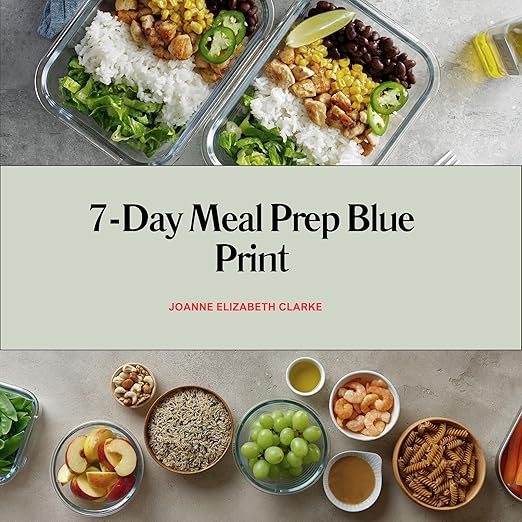
Joanne Elizabeth Clarke’s one-hour guide, 7-Day Meal Prep Blueprint, is positioned as the practical starting point for building that system. Within its modest scope, it does what it sets out to do.
Plan Once, Eat Well All Week
Self-published by the author and released in February 2026, the guide runs one hour. The structure is organised around the week as the fundamental unit of planning: how to think about a full week of eating in advance, how to prepare it in a single focused session, and how to ensure that what comes out of that session remains varied, balanced, and actually enjoyable to eat by the Thursday and Friday it is designed to reach. Clarke covers pantry organisation as a prerequisite, grocery strategy including reducing waste through ingredient overlap, storage methods, reheating guidelines, and the core principle of flexible components that can be combined in different ways across the week to prevent the monotony that kills most meal prep attempts by day three.
The anti-diet framing is explicit throughout and consistently maintained. Clarke is not selling a macros-counting programme, a weight-loss system, or a restrictive eating philosophy. She is selling the reduction of daily decision fatigue around food and the replacement of reactive, expensive, often unhealthy eating with a system that requires effort once and pays out across the whole week. The pitch is sustainability rather than transformation, which is both more honest and, in practice, more likely to result in a habit that persists beyond the initial motivation.
The one-hour format means the coverage is necessarily introductory. Pantry setup, ingredient selection, and batch cooking strategies are each covered at overview level rather than with the granularity a dedicated cookbook or full-length nutrition guide would provide. Listeners who want specific recipes, detailed nutritional breakdowns, or guidance on adapting the approach to specific dietary requirements or family-size cooking will need to supplement this with other resources. What Clarke provides is the planning framework itself, and within that scope, the content is coherent and practically organised.
A Functional Delivery for Functional Information
David Reynolds narrates with a neutral, functional delivery that suits practical non-fiction of this kind. He does not invest the material with personal enthusiasm, but for a guide organised around actionable steps rather than ideas that need to persuade, steady clarity is more useful than warmth. The pacing is appropriate for instructional content, allowing key points to register without padding the already brief runtime unnecessarily. The production is clean and without distraction.
What Readers Say
No listener reviews or ratings have been published at the time of writing, consistent with a self-published title released in February 2026 with limited initial distribution and marketing reach. The absence of a review base makes it impossible to assess how the content has translated into actual listener behaviour change, which is ultimately the only meaningful measure for a practical guide of this kind. For short-format meal planning guides, early listener responses typically focus on whether the system described actually changed something in the kitchen, or whether it provided a pleasant and well-organised hour without changing anything at all. Given the brevity and the scope, the honest expectation is that this is a beginning rather than a complete solution.
Who Should Listen?
This is best suited to listeners who have wanted to start meal prepping but have not yet found an approach that feels manageable, and who want a one-hour orientation before committing to a more detailed resource. It works well for solo cooks, couples, and small households. It is less well suited to larger families with complex and varied dietary requirements, for whom a more comprehensive resource would be a better starting point. The UK listener will find the advice generally applicable across the British food environment without significant translation issues, though the examples and approach are not specifically UK-focused. If you already have an established and working meal prep system, there is nothing here that will extend or challenge what you are doing. If you are at the very beginning of thinking about how to make weekly cooking more manageable, this is a reasonable and unpretentious first listen.