Clara’s Verdict
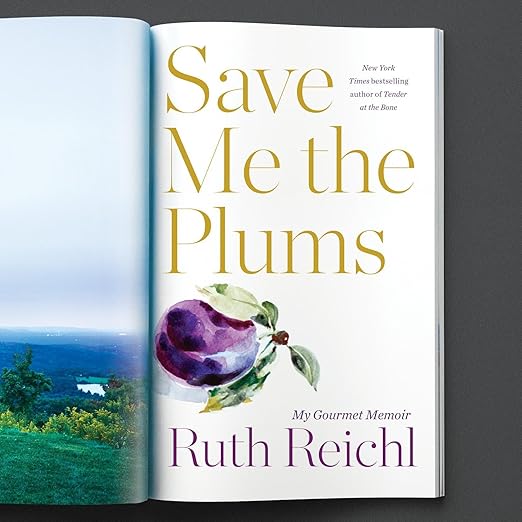
I listened to most of Save Me the Plums on a train journey from London to Edinburgh, and by the time I reached Berwick-upon-Tweed I had already decided that Ruth Reichl reading her own prose is one of the great pleasures of food memoir narration. There is something in Reichl’s voice, warm, slightly conspiratorial, perpetually hungry in the sense of someone who has never stopped wanting to understand the world, that makes you feel you are being told this story privately, over a very good meal you have not had to cook.
This is a book about running Gourmet magazine from 1999 until its abrupt closure by Condé Nast in 2009. It is also a book about what happens to an idealist when they step inside a corporate machine and decide, against all reasonable expectation, to try to make the machine produce something genuinely good. It is sharply observed, occasionally melancholy, and frequently very funny.
About the Audiobook
Reichl was a food writer and restaurant critic before she was persuaded to take on the editorship of Gourmet, America’s oldest epicurean magazine. She had been the New York Times restaurant critic, a role she held with anonymity and considerable cunning, she famously wore disguises and refused to identify herself. She did not want the editorship. She was a writer, not a manager, and she knew the difference. This memoir chronicles what it cost her to do the job anyway, and what it felt like when it was taken away.
What she built at Gourmet in those ten years was genuinely transformative. She brought in writers like David Foster Wallace, whose essay on the Maine Lobster Festival remains a touchstone of food journalism. She championed the farm-to-table movement before it had acquired that slightly tired name. She sent writers to places that glossy food magazines of that type did not usually bother with. She transformed a stately but slightly dusty institution into a publication that stood for something specific about how food intersects with culture, politics, and ethics. And then Condé Nast closed it, abruptly, during the financial crisis, without even a final issue to say goodbye with, and that loss runs through the book like a low current of grief that the narrative’s warmth cannot quite suppress.
The memoir is not an industry exposé. Reichl is too fond of the people she worked with, and too committed to the idea of loyalty, to settle scores publicly. But there are quiet and revealing observations about the machinery of luxury publishing, about the perpetual distance between editorial ambition and commercial pressure, and about how institutions can snuff out the best things about themselves without quite meaning to. The book includes recipes, which punctuate the narrative with a kind of defiant domesticity, a reminder that the point of all the editorial ambition was always, finally, to help people cook something delicious. They work extraordinarily well in audio.
Readers who have followed Reichl’s earlier memoirs, Tender at the Bone, Comfort Me with Apples, Garlic and Sapphires, will find this a worthy continuation. But it also works independently, for anyone who has ever loved a magazine, worked in any creative industry, or simply wants to spend seven hours in the company of someone who writes about food with the care that most people reserve for more obviously serious subjects.
The Narration
Reichl narrates, and this is the only way this memoir should exist in audio form. Her voice has the texture of someone who has thought carefully about every word she has spoken in public for decades, a food critic’s precision applied to autobiography. She reads with restraint in the emotional moments and with clear pleasure in the comic ones. Her account of September 11th, which several UK reviewers have singled out as particularly moving, is handled with a quietness that makes it devastating. She is not performing grief. She is simply recounting it, which is considerably harder to do and far more effective. The total runtime of seven hours and fifty-five minutes feels exactly right, substantial enough to earn its emotional weight, disciplined enough to know when it is finished.
What Readers Say
UK listeners have been consistently enthusiastic. One reviewer describes the book as “a welcome addition to her memoirs” and specifically praises the chapter on 9/11 as “particularly moving,” singling it out for its emotional precision. Another calls it “a quick read and a happy walk down memory lane for Gourmet fans,” noting that Reichl’s food writing consistently achieves five stars even when the editorial memoir occasionally settles for four. A third simply calls it “a most enjoyable read by an informed and talented lady,” which has the ring of someone who had not expected to be quite so charmed. The overall Audible UK rating is 4.5 stars from four reviews.
Who Should Listen?
This audiobook is essential for anyone who has ever loved a magazine that no longer exists, or who has worked in any creative industry and felt the gap between what they wanted to make and what the market would permit. Food lovers will find much to relish in Reichl’s writing about chefs and kitchens and the cultural moment when restaurants became genuinely important to the wider conversation. Publishing people will recognise the institutional dynamics with uncomfortable precision. And anyone who has navigated a career between art and commerce will find Reichl’s particular kind of honesty, clear-eyed, never self-pitying, and always grateful for what was good, a real and lasting comfort.