Clara’s Verdict
I came to The Slow Green Reset sceptically, and I think that scepticism is worth naming because it is probably shared by a significant portion of the potential audience. Sustainability content aimed at the anxious tends to do one of two things: either catastrophise about planetary collapse in ways that produce paralysis rather than action, or offer aggressively cheerful five-step programmes that treat complex systemic problems as personal productivity challenges. Neither approach sits well with me. What Melissa Sreckovic has written instead is something quieter and more honest than either of those defaults – an argument that the relentless urgency of environmental discourse is itself part of the problem, and that the invitation is to slow down rather than to accelerate in a greener direction.
At one hour and twenty-nine minutes, this is a compact listen rather than a comprehensive manual. That brevity is actually appropriate to its central argument: that we do too much, move too fast, and demand too much of ourselves in pursuit of the right way to live. A ninety-minute essay is itself a demonstration of the thesis.
About the Audiobook
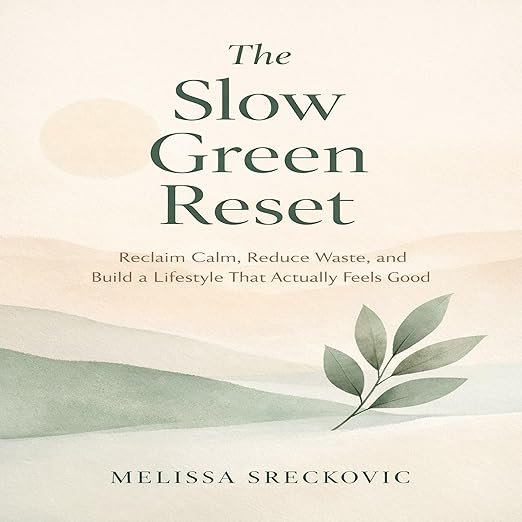
Self-published by Melissa Sreckovic and released on 5 February 2026, The Slow Green Reset is positioned at the intersection of personal development and environmental awareness. The central argument is that speed, stress, and perfectionism quietly drive overconsumption, and that slowing down naturally produces better choices – not through discipline or willpower, but through reconnection with what actually matters to you. The book addresses reducing waste without guilt or burnout, building sustainable habits that actually stick, rethinking consumption without deprivation, creating a home and lifestyle that feels lighter, and letting go of perfectionism as a governing framework for how we engage with environmental responsibility.
The framing is explicitly anti-prescriptive. Sreckovic is not telling you to become zero-waste or to track your carbon footprint against a spreadsheet. She is making a more fundamental claim: that the dominant framing of sustainability as a performance of virtue is itself part of the problem, because it replicates the same perfectionism and pressure that drive the overconsumption it is trying to address. The approach is rooted in values rather than trends, in calm rather than urgency.
This title has no listener reviews at the time of writing. It is a recent self-published release with limited platform visibility, and the absence of ratings reflects timing and discoverability rather than any signal about content quality. Listeners should be aware of the self-published provenance: this is a single author’s perspective, without the editorial apparatus of a publishing house, and the short runtime means there is no room for the evidential depth that longer books in this genre typically offer. What it offers instead is a philosophical reorientation, delivered with care and clarity.
The Narration
Scott LeCote reads with a calm, unhurried delivery that matches the book’s ethos precisely. His voice is pleasant and settled, which proves genuinely useful here: a rushed or performative reading would undermine the entire project. LeCote is an experienced professional narrator whose credits span a wide range of non-fiction and personal development titles, and he brings consistency and care to this material throughout the ninety-minute runtime. The production quality is appropriate for an independent release – clean, well-recorded, with no distracting technical issues. The pace allows each idea to land before the next arrives, which is what this material requires.
What Readers Say
This title has not yet accumulated listener reviews on Audible UK at the time of writing. The absence of ratings reflects its recent release and limited discoverability as a self-published title, rather than any signal about the content itself. Listeners who engage with it early and find it valuable should consider leaving a review, as that visibility is particularly important for self-published work at this stage.
One broader point worth making about this book’s position in the sustainability-content landscape: there is a growing body of writing that argues, as Sreckovic does, that the individualisation of environmental responsibility has been, in part, a strategic deployment by industries with an interest in deflecting systemic critique. The carbon footprint, for instance, was popularised as a concept by BP’s early 2000s marketing campaigns. Sreckovic does not engage with this history directly, but her argument is compatible with it. The book’s value is not in its political analysis but in its psychological one: the observation that guilt-driven and perfectionism-driven environmental behaviour is both unsustainable and counterproductive, and that calm and values-grounded approaches produce more durable change.
Who Should Listen?
Well-suited to listeners who feel worn down by the demands of ecological consciousness – those who want to live more sustainably but find the dominant discourse either overwhelming or guilt-laden. This is not a book for people seeking data, policy analysis, or detailed practical frameworks for behaviour change. It is closer to a philosophical reorientation: a case for a different relationship with consumption and with the idea of doing it right. At under ninety minutes, the investment is minimal and the potential return is a genuine shift in perspective on what sustainable living is actually for. Those looking for substantive engagement with the science of sustainability or the mechanics of reducing specific environmental impacts should look to longer, more evidentially grounded works – but for the listener who needs permission to stop feeling guilty and start slowing down, this is a useful and honest starting point.