Clara’s Verdict
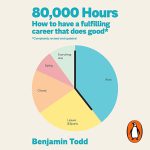
Career advice books tend to divide into two unhelpful camps: the vacuously inspirational (“follow your passion and the money will follow”) and the relentlessly tactical in ways that reduce a working life to a series of optimisable metrics. 80,000 Hours by Benjamin Todd, drawing on a decade of research at Oxford’s Future of Humanity Institute, attempts something more rigorous and more honest than either. The central argument – that most conventional career advice is not just unhelpful but actively misleading, and that the people who create the greatest positive impact on the world rarely do so by the obvious routes – is well-evidenced and genuinely challenging to received wisdom. This new edition, updated for the age of AI, arrives at precisely the right moment.
About the Audiobook
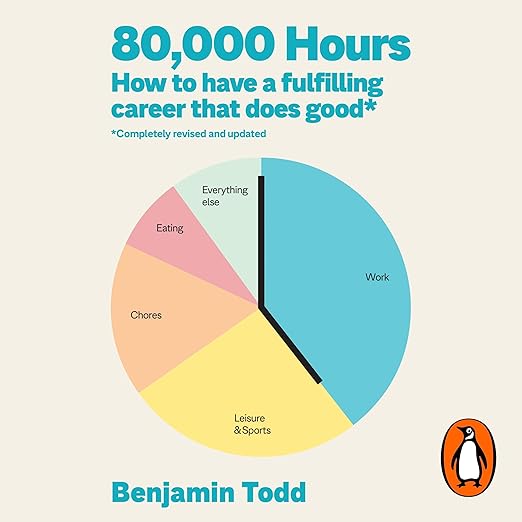
The title’s arithmetic is simple: forty hours a week, fifty weeks a year, forty years – approximately 80,000 hours in which to build a career. The question Todd and the 80,000 Hours organisation address is how to spend those hours well, by which they mean both satisfyingly and in ways that have genuine positive impact on the world. The book argues that most career advice fails on both counts, primarily because it is based on intuition and convention rather than evidence about what actually makes work fulfilling and what kinds of work actually address the world’s most pressing problems.
The book covers considerable ground: why “follow your passion” is both psychologically inaccurate (most people develop passions through engagement rather than finding pre-existing ones) and practically harmful; how to identify what genuinely makes work satisfying versus what we think will satisfy us (often different things); the surprising careers that have historically created the greatest positive impact; how to think about scale, neglectedness, and tractability when choosing where to direct effort; and how to make strategic career decisions under conditions of genuine uncertainty, which describes most people’s situation most of the time. The updated material on AI – both its implications for the job market and its potential as a cause area – is particularly relevant and handled with appropriate seriousness. The approach draws on applied effective altruism, and Todd is transparent about that intellectual tradition throughout.
Whether or not listeners ultimately adopt the entire framework, the core questions – what do I actually value? what am I actually good at? what does the world most need from someone with my particular capabilities? – are ones that benefit from the kind of rigorous interrogation this book provides.
The Narration
The narrator is not specified in the available data for this edition, but Penguin Audio consistently produces high-quality professional audio for its nonfiction titles. Career guidance and self-help material benefit from a confident, measured delivery, and Penguin’s productions in this category are reliably well-executed. The audiobook is listed as forthcoming at time of writing, with a release date of 28 May 2026.
What Readers Say
Earlier editions of 80,000 Hours have built a strong and loyal following, particularly among people at significant decision points in their careers. Reviewers praise the book for answering concrete questions about career choice that conventional advice sidesteps, and for challenging “the trendy advice everyone gives you but never helps.” One reviewer used the book as a resource for mentoring clients directly, which suggests practical utility beyond individual career decisions. The book has clearly found its audience through word of mouth rather than conventional marketing – always a more meaningful signal of value than publisher promotion. The audiobook holds a 4.1 out of 5 rating from 29 listeners on Audible UK.
The framework is particularly valuable for listeners who are genuinely uncertain about where their efforts will be most useful – the book provides not a fixed answer but a rigorous process for generating and testing candidate answers, which is more useful in the long run than any specific recommendation could be.
The book is also worth returning to at different career stages: the questions it asks about comparative advantage, neglectedness, and personal fit yield different answers at twenty-two than at forty-two, and Penguin’s audio edition makes it easy to revisit. A book this substantive benefits from being treated as a resource rather than a one-time read.
Who Should Listen?
Anyone facing a significant career decision – whether starting out, pivoting mid-career, or simply feeling that the path they’re on isn’t quite right. Particularly valuable for high achievers who want their work to matter in some larger sense and are trying to work out how to make that happen systematically. Also essential listening for anyone interested in effective altruism, the strategic deployment of talent toward large-scale problems, or the intersection of individual career decisions and global outcomes. Listen to 80,000 Hours on Audible UK and use some of those hours to think seriously about how to spend all the rest of them.