Clara’s Verdict
By its fourth outing a series has usually settled into a comfortable groove, and A Case of the Meanies shows Stella Batts doing exactly that, in the most reassuring sense. Courtney Sheinmel has her formula, warm, funny and quietly instructive, and she works it with real assurance here.
This time the trouble has a name, and it is Joshua, the class antagonist who decides to hold his birthday party at Stella’s own family candy store and then leaves her off the guest list. It is a wonderfully sharp bit of childhood cruelty, and watching Stella work out how to be a gracious host at a party she has not been invited to is both funny and genuinely useful for young listeners.
What I admire is how unforced the moral is. Sheinmel lets Stella feel the sting, react like a real child, and find her own dignified way through, and the result is a story that models kindness without ever preaching it.
About the Audiobook
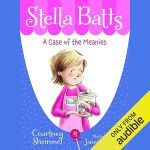
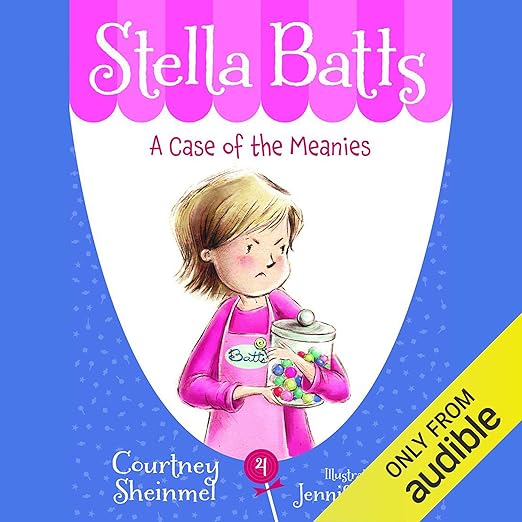
A Case of the Meanies is the fourth book in Courtney Sheinmel’s Stella Batts series, narrated by Cassandra Morris. The mean boy Joshua continues to plague Stella, and this time he decides to throw his birthday party at her parents’ candy store, inviting the entire class except for her.
Stella is left with an awkward and very relatable problem: how do you behave graciously in your own family’s shop when you are the one person not on the guest list? What follows is, as Stella might put it, just another day in her eventful life, full of the small indignities and quiet triumphs that make the series so easy to recognise. It is a story about exclusion, fairness and rising above unkindness, told at a scale that makes complete sense to a child.
The situation Sheinmel chooses is cannily observed. Being deliberately left off a guest list, and at your own family’s shop no less, is exactly the kind of small, stinging injustice that fills a child’s world, and the book takes it seriously rather than waving it away. Watching Stella navigate her hurt feelings, resist the urge to retaliate, and find a way to carry herself with grace gives the story real moral substance. It never lectures, but a young listener comes away with a clear sense of how to meet unkindness without becoming unkind in return.
The Narration
Cassandra Morris gives this one an hour and fifty-one minutes, a touch longer than the earlier books, and she uses the extra time well. Her Stella is now a thoroughly familiar friend, and Morris voices the frustration of being wronged by a classmate with a lightness that keeps the story from curdling.
Joshua could easily become a cartoon villain, but the narration keeps everyone human, which is important in a book about learning to cope with a difficult peer. Morris paces the social comedy nicely and lets Stella’s better instincts shine through in the delivery. At just under two hours, it remains an accessible listen for the young audience the series serves so well.
In a story that turns on a difficult classmate, the narrator’s restraint is important, and Morris keeps Joshua a real, exasperating child rather than a pantomime bully. That balance matters, because it lets the book model a proportionate response instead of a revenge fantasy. Morris also handles the ensemble of classmates cleanly, so a young listener can follow who is who without effort. The slightly longer runtime never drags in her hands, and the social comedy keeps its momentum right through to Stella’s satisfying, level-headed resolution.
What Readers Say
The book carries an average of 4.5 stars across 240 ratings, and the reviews are affectionate and specific. Parents praise the relatable, high-interest situations Sheinmel chooses, the kind of everyday school drama their children recognise at once, and one noted that their eight-year-old preferred this series to another popular one she had also enjoyed.
Several families describe racing through the whole series and pre-ordering the next book the moment it was announced, which tells you plenty about how these stories land at home. Younger reviewers chime in too, with one nine-year-old happily reporting that she had read the earlier books and loved how nice all of Stella’s friends are. It is the sort of loyalty a children’s series earns only by being consistently kind and consistently fun.
Who Should Listen?
A Case of the Meanies is ideal for children of about six to nine, and particularly valuable for any child dealing with a playground antagonist of their own. It works nicely as part of a series binge but is self-contained enough to enjoy on its own, and its runtime keeps it comfortable for a couple of bedtimes.
If you want a gentle, genuinely helpful story about handling unkindness with grace, this one earns its place, and you can Listen to A Case of the Meanies on Audible to add it to your young listener’s shelf.