Clara’s Verdict
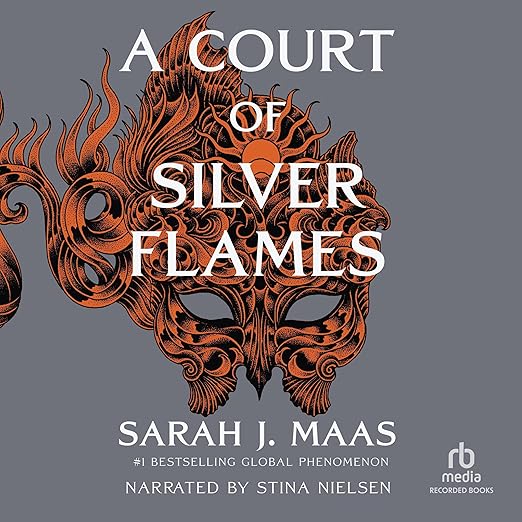
I will be honest: I approached A Court of Silver Flames with some wariness. The first books in Sarah J. Maas’s A Court of Thorns and Roses series have genuine strengths, but Nesta Archeron – prickly, self-destructive, often infuriating – is not obviously the character one would choose to centre a 26-hour book around. I came out with a completely different view. Maas has written something unexpectedly mature here: a character study of depression and rage and the specific difficulty of accepting care when you believe yourself fundamentally undeserving of it. Stina Nielsen’s narration is extraordinary. This is Book 5 in the series, and it stands as the most emotionally intelligent of them all.
About the Audiobook
The narrative follows Nesta Archeron – sister to Feyre, the protagonist of the earlier books – as she struggles to find a purpose and identity in the Night Court following the war with Hybern. She has been made High Fae against her will, carries powers she cannot control, and has spent months in a cycle of self-destruction that has driven away nearly everyone who cares about her. The Court’s solution: house her in the House of Wind and assign Cassian – battle-scarred Illyrian warrior, the one person whose temper matches hers – as her trainer and reluctant companion.
The push-and-pull dynamic between Nesta and Cassian is the engine of the novel, and it works as well as it does because Maas refuses to resolve the tension cheaply. Nesta’s hostility is not wilfulness but armour, and Cassian’s pursuit of her is complicated by his own wounds and uncertainties. The romance is explicit and very present – this is unambiguously an adult fantasy novel – but the psychological depth that surrounds it gives the passion actual stakes. Meanwhile, the broader series plot continues: the treacherous human queens have formed dangerous new alliances, and the key to stopping them may require Nesta to confront the trauma she has been running from.
At twenty-six hours, this is Maas’s longest book in the series, and the pacing reflects that ambition. The middle sections are slower and more introspective than the other volumes, which some readers have found challenging. I found them the most rewarding portions of the novel.
The Narration
Stina Nielsen is exceptional. She has been the voice of the ACOTAR series throughout, and her understanding of these characters – particularly Nesta – is profound. She plays Nesta’s coldness and Nesta’s pain as distinct registers, so that the moments when the armour slips carry genuine weight. Her Cassian is all contained energy and frustrated tenderness. The shift in tone as Nesta begins, slowly and reluctantly, to change is charted with extraordinary precision. For a book of this length, Nielsen’s stamina and consistency are remarkable. One of the finest performances in the genre.
What Readers Say
A Court of Silver Flames holds 4.7 stars from 250 UK listeners, making it one of the strongest-rated entries in the series. Reviewers who approached the book with Nesta-scepticism are consistent in reporting a change of heart: “I went in sure I would not like a story about Nesta. I came out feeling like I’d been punched in the heart.” Another reader described Maas as clearly understanding “both depression and PTSD and also the impact of severe depression on those who love you.” The four-star review in the sample comes from a reader who loved the book but felt the plot’s external conflicts were resolved too quickly relative to the richness of the central relationship – a fair critique of the structural balance. The consensus is that this is the most character-driven entry in the series and, for many, the best.
Who Should Listen?
Essential for existing ACOTAR readers – do not skip this one regardless of your feelings about Nesta in the earlier books. For newcomers to the series, it is strongly recommended to begin with A Court of Thorns and Roses and proceed in order: the emotional payoff here depends on knowing the world Maas has built. Listeners who respond to adult fantasy romance with genuine psychological complexity, or who are drawn to stories about depression and recovery that refuse easy resolution, will find this series – and this book in particular – deeply rewarding.