Clara’s Verdict
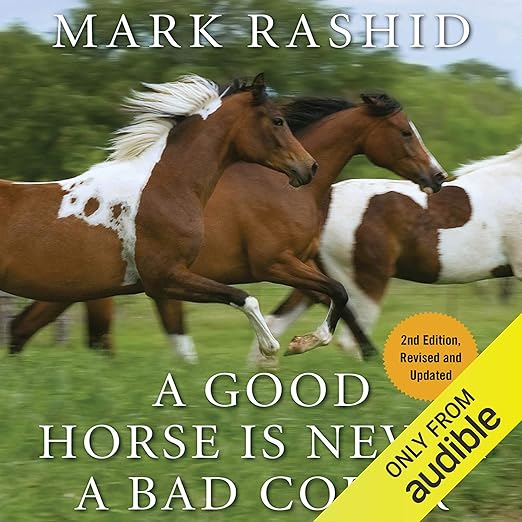
Horsemanship books are, as a category, either practical manuals or philosophical reflections, and very few manage to be both simultaneously. Mark Rashid manages it in every book he writes, and A Good Horse Is Never a Bad Color is among his best. Originally published in 1996 and reissued with updated introductory notes for each chapter, it uses specific horses – Arabs, Appaloosas, paints, all breeds historically mistrusted and mistreated because of stereotype – as the vehicle for a consistent, humane argument about what it means to really listen to an animal.
Rashid trains horses through communication rather than force. That sounds like a platitude, but in practice it means something specific and demanding: learning to read the horse’s perception of the world, adjusting your requests to what the horse can actually understand and respond to, and accepting that the horse’s apparent problem is usually the human’s unexamined assumption. It is, among other things, an excellent argument for the general principle of understanding before judgment.
About the Audiobook
The book is structured as a series of case studies, each centred on a horse that has been written off by its previous handlers – too difficult, too unpredictable, too breed-specific in its perceived flaws. Rashid takes each horse as he finds it: not as a problem to be overcome but as an animal with a particular history of experience that has shaped its responses to humans in entirely logical ways. His job, as he describes it, is to understand that history and provide different experiences.
The updated notes add context that enhances the original material without overwriting it. Rashid reflects on what he understood then, what he understands now, and how his thinking has developed – it’s an unusual addition to a reissue, and it gives the book a quality of intellectual honesty that is characteristic of his writing throughout.
The stories are genuinely funny in places – Rashid has a storyteller’s instinct for the absurd detail that makes a scene vivid – and genuinely moving in others. The horses in these pages are not symbols or metaphors; they are specific animals with specific characters, and Rashid’s affection for them is entirely clear. This is not sentimental anthropomorphism, but it is humane in the fullest sense of the word.
The Narration
Mike Chamberlain narrates, and his delivery is well suited to Rashid’s voice – unhurried, warm, and unaffected. The conversational quality of Rashid’s prose translates well to audio: this is a writer who thinks out loud on the page, and Chamberlain’s reading captures that quality without imposing anything on top of it. At eight hours and ten minutes, the audiobook is substantial enough to feel complete without overstaying its welcome. The production quality is clean throughout.
What Readers Say
UK readers over more than a decade have been consistently enthusiastic. “Really good read – a reissue with update notes, about his education and subsequent work in training horses in a kind and horse-centred way. Really interesting and humane, and the thoughtful updates made it feel like good value rather than just a re-issue,” wrote one UK reviewer. “He puts things across in such a beautiful manner. What a good author. Lots of stories that will make you think about how we treat our horses and what we can do different tomorrow,” wrote another. A third, who has attended Rashid’s clinics in person, described him as “an honest horseman and his books reflect this.” The rating stands at 4.8 from 408 reviewers – a large base that makes the score highly reliable.
Who Should Listen?
Horse owners and equestrian practitioners who want a kinder, more communicative approach to training will find this essential. It is accessible enough for those who are relatively new to horses and substantive enough for experienced handlers who have encountered the limitations of traditional methods. Rashid does not require agreement with every detail of his philosophy – the case studies make the arguments through example rather than assertion, and sceptical readers will find them difficult to dismiss.
The book also speaks clearly to non-horse people who are interested in the broader questions Rashid is exploring: how do we understand creatures whose experience of the world is genuinely different from our own? Available on Audible UK, Kobo, Scribd, and Storytel. Listen to A Good Horse Is Never a Bad Color on Audible UK – honest, funny, and quietly profound.