Clara’s Verdict
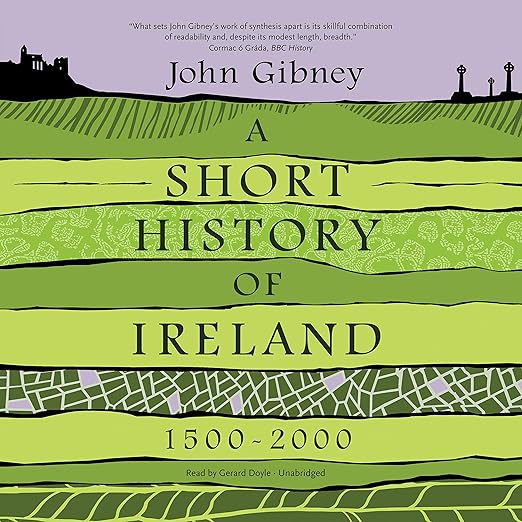
Good introductory history is harder to write than it looks. The temptation is either to oversimplify – producing something so breezy it carries no useful information – or to retain so much scholarly apparatus that the general reader loses the thread within fifty pages. John Gibney’s A Short History of Ireland, 1500-2000 avoids both pitfalls with considerable skill. This is accessible without being patronising, comprehensive without being overwhelming, and – importantly for audio – well-structured enough to follow without a physical page to anchor you. At nine hours and fourteen minutes it represents an excellent introduction to five centuries of Irish history, and Gerard Doyle’s narration is both authoritative and engaging throughout.
This is the book to give someone who wants to understand Ireland before reading further. Start here, and the deeper dives become both comprehensible and compelling.
About the Audiobook
Gibney begins with the Protestant Reformation – Ireland’s entry point into the complex, often catastrophic encounter with England that would shape its entire modern history – and proceeds through to the turn of the twenty-first century. Along the way, he covers the Cromwellian conquest and settlement, the Penal Laws, the United Irishmen and the 1798 rebellion, Daniel O’Connell’s campaign for Catholic emancipation, the Great Famine and its contested historiography, the Land War, the 1916 Rising, the War of Independence, partition, the Irish Free State, the Republic’s gradual emergence from economic and cultural insularity, the Troubles in Northern Ireland, and the Celtic Tiger boom of the 1990s.
What makes the book particularly valuable is its integrated approach. Gibney does not treat political, cultural, economic, and social history as separate streams but weaves them into a coherent narrative in which each strand illuminates the others. The result is a portrait of a society in continuous transformation, shaped by religious tension, colonial relationship, mass emigration, and a sense of national identity that remained contested and actively negotiated across the entire five-hundred-year span. Gibney incorporates the most recent scholarship on controversial questions – famine historiography, the degree of British culpability, the legacy of partition – without turning the text into an academic debate or privileging one interpretation over another.
The Narration
Gerard Doyle is a natural choice for Irish historical material, and he delivers the text with measured authority and genuine engagement. He does not editorialise or colour the narrative with undue emotional weight; he allows the events to speak with clarity and trusts the listener to respond. This is exactly the right approach for a scholarly introduction to a history still capable of generating strong feeling. At just over nine hours, the pacing is consistent without rushing through complex material – Gibney clearly wrote with concision in mind, and the audio format rewards this.
What Readers Say
The audiobook carries a 4.4-star average from 365 listeners – a strong score for narrative history. Reviewers describe it consistently as an accessible and satisfying overview that prompted them to read further and, in one memorable case, made a trip to Ireland significantly more enriching. Several note the volume of names and personalities as both a strength and occasional challenge – one listener found the density of information difficult to retain without visual reference. The consensus is that Gibney has produced exactly the broad, reliable introduction the subject deserves for a general audience approaching it for the first time or seeking to fill gaps in their existing knowledge.
Who Should Listen?
The scope of the book – 1500 to 2000 – is carefully chosen. Gibney is not attempting to cover all of Irish history; he is covering the period during which Ireland’s modern identity was formed and contested. The beginning point, the Protestant Reformation and its consequences for an island under English governance, establishes the foundational tensions that run through every subsequent century. The ending point, approximately the turn of the millennium, leaves the most recent decades – the Good Friday Agreement and its aftermath, the post-Celtic Tiger recession, the social liberalisation of the twenty-first century – for readers to follow through other sources. This is an honest choice that keeps the book’s argument coherent.
Anyone curious about Irish history who wants a structured, scholarly, and accessible starting point. This is the book to absorb before diving into more specialised works on the Famine, the Rising, or the Troubles – it provides the historical context that makes those deeper dives genuinely comprehensible. It is also an ideal recommendation for anyone with Irish heritage who wants to understand the full arc of the island’s modern history beyond the fragments that appear in family stories and cultural memory. The audio format works particularly well: you can take it with you to Ireland and listen as you move through the landscape it describes.
Listen to A Short History of Ireland, 1500-2000 on Audible UK – the essential introduction to five centuries of Irish history.