Clara’s Verdict
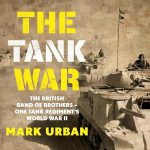
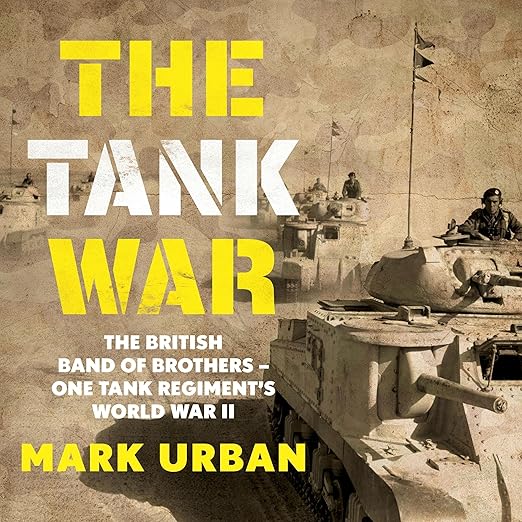
Mark Urban has spent most of his professional life either reporting on conflict for the BBC or writing about the people who fight wars – his biography of Wellington’s riflemen, Rifles, remains one of the finest pieces of regimental history I’ve read. Tank – his account of the 5th Royal Tank Regiment through the full course of the Second World War – sits firmly in that tradition: rigorous in its research, genuinely interested in the human beings inside the machinery, and narrated by Urban himself with the quiet authority of someone who has done the primary source work. With 476 ratings and 4.5 out of 5 on Audible UK, this is clearly a book that has found a large and satisfied audience well beyond the initial military history readership.
About the Audiobook
The 5th Royal Tank Regiment – known throughout the army as the “Filthy Fifth” – had an extraordinarily long war. From the retreat at Dunkirk in 1940, through the North African campaign against Rommel’s Panzer divisions at places like Tobruk and El Alamein, through D-Day and the grinding campaign across north-west Europe, to the final German surrender in Hamburg: few British regiments saw more continuous action, and fewer still suffered the scale of cumulative casualties that the Fifth endured.
Urban’s decision to anchor his narrative in this single unit is the book’s structural masterstroke. Rather than writing a broad operational history of British armour in the Second World War – which would be abstract and impersonal – he follows specific men across the entire five-year campaign. He draws on personal diaries, interviews with veterans, and archival sources that hadn’t been fully exploited before, and the result is a book that manages to be simultaneously a rigorous military history and a series of very human stories about ordinary men placed in extraordinary circumstances.
The central argument that emerges is quietly striking and historically important: that British armour began the war at a significant disadvantage – in doctrine, in tactical thinking, in the fundamental design and reliability of the tanks themselves – and that the path to eventual victory required sustained, painful learning in the field, often at terrible cost to the men inside the machines. The comparison between British and German armoured doctrine in the early years of the war is particularly instructive, and Urban traces the evolution of British tactics across five years of hard lessons with a precision that is genuinely illuminating even for readers who consider themselves fairly knowledgeable about the period.
The resilience and adaptability of the regiment across those five years is, Urban argues, a microcosm of the British war effort more broadly: slow to adapt initially, resistant to doctrine, but possessed of a stubborn persistence and individual initiative that eventually told. It is, within the constraints of military history, an argument about national character – and Urban makes it with appropriate care and scepticism about its own generalisations.
The Narration
Urban’s self-narration brings the authority of genuine expertise to the material. He speaks as someone who has spent considerable time with both the sources and the landscapes where these events happened, and that familiarity gives his reading a quality of assured, informed engagement rather than mere recitation. The technical passages – tank specifications, tactical decisions, the mechanics of armoured warfare – are handled accessibly without condescension. At twelve hours and thirty-seven minutes, this is a substantial listen, but the campaign-structured narrative, which moves from theatre to theatre with a clear sense of momentum, maintains engagement throughout.
What Readers Say
The Audible UK reviews are uniformly strong and occasionally deeply personal. P.T., the grandson of a 5th RTR veteran, gives it five stars and writes with evident emotion about the book allowing him to understand his grandfather’s experience – “he died when I was young and before I could really understand what he had been through.” Scott McPherson, who has read Urban’s other regimental histories, calls this “a fantastic book” that shows “a high human cost paid by real people.” “Dad Flake” – “an ex tankie of the first” – calls Urban’s no-gloss approach to depicting both achievements and failures “a real tribute to the men he writes about.” R.J. Marquis offers a measured four stars, noting that while the operational picture is excellent, the interior experience of tank combat is somewhat harder to convey in this format, which is a fair observation.
Who Should Listen?
This is for anyone interested in the Second World War who wants something beyond the grand strategic level – a view from inside the armour, at the level of the men who actually climbed into those machines each morning. Fans of Antony Beevor, Max Hastings, or Rick Atkinson’s Liberation Trilogy will find it sits very comfortably alongside those works. It’s also – and this is worth saying plainly – a book that has meant something specific to families of veterans, offering a record of what their relatives actually experienced that personal modesty or death may have made impossible to obtain any other way. Available on Audible UK, Kobo, Scribd, and Storytel. Listen on Audible UK: Get Tank on Audible UK