Clara’s Verdict
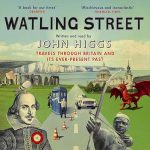
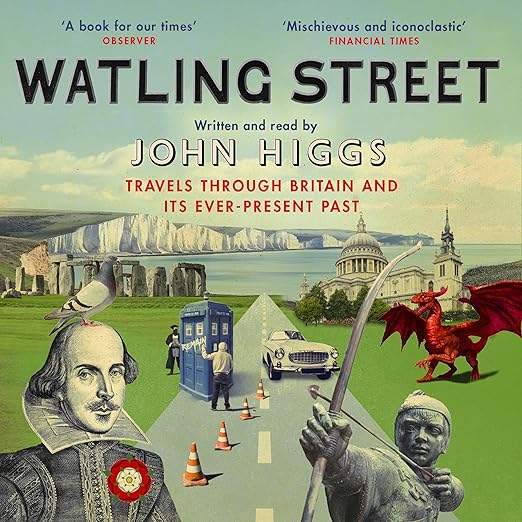
John Higgs writes about Britain the way a good psychoanalyst talks about a difficult patient: with genuine affection, unsentimental precision, and an eye for the detail that other observers would walk past without registering. Watling Street – a journey along one of Britain’s oldest roads, from Dover to Anglesey – is twelve and a half hours of pleasurable eccentricity that is also, beneath the charm and the wit, a serious meditation on identity, memory, and what it actually means to be British at this particular moment in history. Rated 4.0 from 456 listeners, it has its detractors – those who wanted conventional travel writing and found something considerably stranger – but its admirers are passionate and consistent in their enthusiasm. I am firmly among them. This is one of the most unexpectedly moving books about England I have encountered in years.
The book reads – or rather, listens – as something between a road trip narrative, a cultural history, a work of psychogeography, and an extended philosophical meditation on the stories a place tells about itself. Higgs is impossible to categorise, which is one of his principal virtues.
About the Audiobook
Watling Street itself is 444 kilometres of ancient path, tramped into existence by feet in the prehistoric forest, straightened and improved by Roman military engineers, renamed in the Dark Ages, and now dispersed across the A2, the A5, and the M6 Toll. It is the road along which Britain’s history has repeatedly moved: Roman armies, medieval pilgrims, Civil War troops, Victorian freight. Higgs uses the road as a structure on which to hang an extraordinary range of historical and cultural material – Boudicca’s last stand, Chaucer’s pilgrims travelling to Canterbury, the Battle of Bosworth that changed royal history for ever, Bletchley Park’s code-breakers working through the night, Capability Brown remodelling the English landscape, Dickens in Rochester, James Bond on the motorway. The range is vast and the connections Higgs makes between them are frequently surprising and often genuinely illuminating.
The guides he finds along the way are, as one reviewer carefully noted, “distinctly weird and cranky” – occultists, myth enthusiasts, scholars of the esoteric, people who have devoted their lives to understanding the hidden strangeness beneath the surface of ordinary English places. Higgs takes their accounts seriously without endorsing them uncritically, and the result is a portrait of a Britain that is far stranger, richer, and more layered than its reputation for reserved practicality suggests. A PDF of supporting materials is included in the Audible Library alongside the audio.
The Narration
Higgs reads his own book, and this is the definitive version. His voice has the same qualities as his prose: drily amused, quietly authoritative, capable of launching into genuine wonder without self-consciousness, comfortable with the strange. Kizzia Mildmay described the words as “singing on the page,” which translates directly to the audio experience. The reading has the quality of a thoughtful person thinking aloud – following associations, doubling back, arriving at conclusions that feel earned rather than predetermined. At over twelve hours, Higgs sustains his tone and his attention throughout without flagging, and the book ends with a quality of earned resolution that is surprisingly affecting.
The book’s most ambitious passage is its conclusion, where Higgs draws together the various threads of his journey into a meditation on what Britain might mean – not in the nostalgic or nationalist sense, but in the sense of an ongoing negotiation between the many different versions of this island that have existed simultaneously across its history. It is, quietly, a hopeful book, which surprised me. I expected eccentricity and got that, but I also got something with more substance than I was prepared for.
What Readers Say
Four hundred and fifty-six ratings at 4.0 stars, with a split that accurately reflects the book’s unconventional nature. Five-star reviewers – among them Kizzia Mildmay, Annie from the wood, and Linda Evans – describe it as an “absolute gem,” a book that generates a long reading list of its own because every digression opens onto something you want to know more about. Annie from the wood noted that it was “costing me a fortune” in follow-up reading. Linda Evans described laughing out loud on trains and in cafes. The four- and three-star responses come from readers who found the philosophical tangents too extended and wanted more conventional road-trip content – Brian E. Downes described it as “wacky, weird, interesting, unusual” with “ten pages of geek stuff” he skimmed. Both responses are legitimate reactions to the same book; the question is entirely which kind of reader you are.
Who Should Listen?
For readers who loved Robert Macfarlane’s landscape writing, Patrick Wright’s histories of place, or Iain Sinclair’s psychogeography – and who don’t mind, or actively prefer, a book that wanders. Also genuinely excellent for anyone who lives near Watling Street and wants to understand the deep strangeness of what they pass every day. A uniquely, idiosyncratically British listen for anyone who has ever wondered what this island is actually made of. Available on Audible UK.