Clara’s Verdict
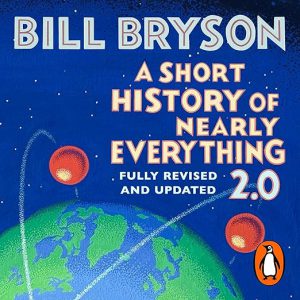
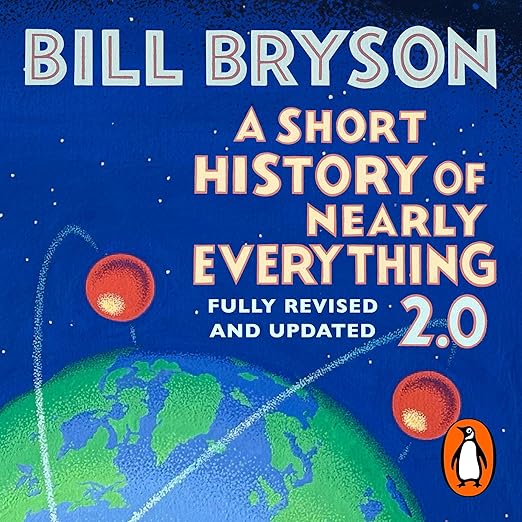
The original A Short History of Nearly Everything sits on a shelf in my parents’ house alongside the books that get passed between family members and discussed at Christmas: Sapiens, The Selfish Gene, a well-thumbed Attenborough biography. It earned that place because it did something genuinely rare: it made the history of scientific knowledge feel like a human story, full of wrong turns and obsessives and magnificent accidents. Twenty years on, Bryson has revised and updated it, and the result is an abridged ten-hour edition that asks a fair question of anyone who loved the first. Is it worth returning?
The answer is yes, with one clear-eyed caveat. This is an abridgement, not a straight revision. Some material has been cut to accommodate the new sections, and readers who want to map precisely what has changed may find themselves frustrated. But for new listeners, or for those who encountered the original in print and want to hear it fresh, A Short History of Nearly Everything 2.0 is a remarkable piece of popular science communication, delivered in a format that has never suited it better than audio.
About the Audiobook
The 2.0 edition addresses the two decades of scientific progress that have elapsed since the original publication. Pluto’s demotion gets its proper reckoning. The extraordinary expansion of known solar system moons, which has more than doubled in twenty years, is folded in with appropriate wonder. Advances in genetics that have revealed previously unknown species of early humans, the Higgs boson and what its discovery actually meant for particle physics, and the continuing mystery of dark matter and dark energy are all given updated treatment.
What remains unchanged is Bryson’s method: the patient explanation of complexity through human story, the willingness to dwell on the wrong ideas people held and how long it took to correct them, and the calibrated wonder at how much remains unknown even after centuries of increasingly sophisticated inquiry. His capacity to make the scale of geological time or the strangeness of quantum mechanics feel genuinely astonishing rather than merely overwhelming is the book’s greatest achievement, and it survives the revision entirely intact.
At ten hours and twenty-six minutes, this is generously sized for what it covers. It is not an exhaustive scientific textbook, and Bryson has never pretended otherwise. But as an invitation to curiosity about the physical world, it remains one of the most effective popular science books ever written. The Guardian’s description of it as a rough guide to science is apt; the Economist’s assessment that it may be the best scientific primer ever published is harder to argue with the more of it you absorb.
Published by Transworld Digital and produced by Penguin Audio in October 2025, the production quality is impeccable and befitting of a landmark title receiving its definitive updated edition.
The Narration
Bryson reads his own work, and the performance is the definitive version of this text. His self-deprecating humour lands best in his own voice. The timing of a joke about scientific naming conventions, or the dry observation about how many important discoveries happened by accident, requires exactly the register he brings. His voice carries the warmth of a man who is genuinely delighted by what he has learned, and that delight is contagious across ten-plus hours in a way that a professional narrator, however skilled, would have found difficult to sustain with the same authenticity.
What Readers Say
A Short History of Nearly Everything 2.0 has built a rating of 4.7 from 306 listeners, a substantial and broadly positive response. UK reviewer AL, who wished the original had existed sixty years earlier during their schooling, called it “the best science primer I’d ever seen” and argued it should be available to every secondary school student with any scientific interest. McDravid wrote that “Bryson’s easy style makes even complicated stuff comprehensible.” The only substantive criticism in the batch came from Steve, who noted that the new material is not flagged distinctly enough to allow readers of the original to identify the updates without re-reading the whole. That is a legitimate structural note, though it is more relevant to returning readers than to newcomers discovering this for the first time.
Who Should Listen?
Anyone who has spent years meaning to read the original and never quite getting round to it should start here rather than seeking out the first edition. The 2.0 update makes this the current version of a genuinely important popular science book. Those who loved the original and want to know what has changed will find value in it too, with the caveat that the abridgement may have trimmed passages they remember fondly. For listeners with a connection to Open University study, to school-age science education, or simply to the habit of wondering how things work, this is as close to essential as popular non-fiction gets.