Clara’s Verdict
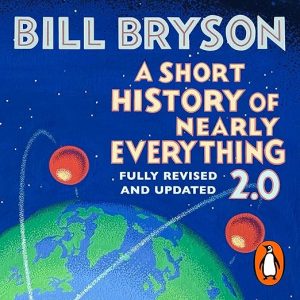
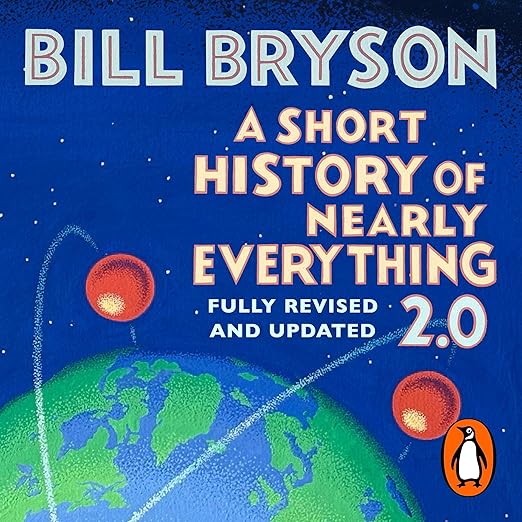
The title is a joke that turns out to be a promise. Bill Bryson really does attempt nearly everything, from the Big Bang to the rise of civilisation, and this audiobook takes eighteen hours and fifty-nine minutes to get there. What holds the whole enterprise together is that Bryson is not a scientist explaining his own field. He is an outsider, and the stated aim is to make all of it comprehensible to readers who never imagined they could find science interesting. That is a far harder brief than writing for the converted, and it shapes every decision in the book.
He takes on geology, chemistry and particle physics, the subjects his own description cheerfully admits bore the pants off most of us, and he does it in the company of what that same description calls some extraordinary scientists. That is the trick of the book, and it is a more durable one than it looks. You come away remembering the people at least as clearly as the findings, which is a slightly inefficient way to teach physics and a remarkably efficient way to make somebody care about it.
About the Audiobook
One detail about this edition deserves flagging up front, because it is very easy to misread. The description opens by advertising a special introduction, written for this audio edition and read by Bryson himself, and that is exactly what it is: an introduction. The book itself is narrated by William Roberts. If you saw the words read by the author and assumed Bryson would be with you for the whole book, that is not what this recording is. The introduction is a genuine addition rather than a marketing line, and it is worth having, but it is the doorway rather than the house.
This edition came from Audible Studios on 26 December 2004, and the copy notes that it was a Radio 4 Book Club selection. The date matters more than it usually would. This is a survey of the sciences as they stood when the recording was made, and although the historical material has aged not at all, the passages describing the current state of play inevitably have. One of the reviewers here says as much, and says it fairly rather than as a complaint. Treat it as a brilliant history of how we came to know things, with a snapshot of the present tacked on the end, and the age of the recording stops being a problem.
One reviewer notes that the chapters are mostly organised by discipline, running through geology, astrophysics, chemistry, biology and palaeontology, and that arrangement gives the audiobook a helpfully modular shape. You can lose the thread for ten minutes and pick it up again a chapter later without feeling stranded. Over a listen this long the flexibility is a real asset, and it makes for an unusually forgiving commute book.
The Narration
William Roberts reads the main text, and the job in front of him is a genuinely awkward one, because this book makes two incompatible demands. Explanatory prose wants a clear, even, unshowy delivery: when a writer is walking you through the scale of an atom or the improbability of your own existence, you do not want a reader competing with the idea. Comedy wants the opposite. It wants timing, and the confidence to leave a gap where the joke is.
Those two demands pull against each other for nineteen hours, and the reviews suggest the explanatory side is what listeners take away: the praise here is for accessibility and clarity, with the humour credited squarely to Bryson’s writing. For a book whose primary job is to make you understand things, that seems to me the right trade. The stretch where Bryson introduces the recording in his own voice is nonetheless a tantalising glimpse of what a fully self-narrated edition might have been, and if you hold a strong preference for author narration, that is the one thing this version cannot give you.
What Readers Say
A score of 4.6 out of 5 across more than 19,000 ratings is a strong result for a survey this broad, and the written responses behind it are unusually consistent. Listeners praise the same two things almost every time: the humour and the human beings. A five-star reviewer, CASSINI24, catches the appeal and its one excess in a single sentence.
It is full of Bryson’s trademark exuberance and wry humour and plenty (perhaps a few too many?) metaphors and analogies to help us understand the inexplicable scale of things – from the very small to the very large.
That parenthesis is the only real reservation anybody raises, and I share it mildly. Another reviewer, Cpt. Tangerine, puts a finger on why the book works where similar surveys do not.
Bill Bryson brings a unique accessibility that come from, in my opinion, the way he brings the human element into the subject.
The same reviewer is also the one who quietly notes the currency question, describing the book as an overview of the sciences from their origins to their current state, or at least the state they were at when the book was published. A third listener, Supaking10dent, credits Bryson with turning complex facts into engaging stories and with balancing education against entertainment, which is as good a description of the method as any.
Who Should Listen?
This is for the curious non-specialist, and particularly for anyone who came out of school convinced that science was something other people were good at. It is also an excellent gift for a teenager who has just been put off physics by a bad term. If you like your non-fiction anecdotal, digressive and funny, and you are happy to trade depth for breadth, a listen of this length will be very pleasant company.
Specialists should look elsewhere, as should anyone who wants current research rather than the story of how the research happened. A reader hoping for a serious treatment of one discipline will find this frustratingly broad by design. For the rest of us, a recording made in 2004 is a small concession in exchange for one of the most companionable science books ever written.
Listen to A Short History of Nearly Everything free with an Audible trial