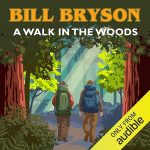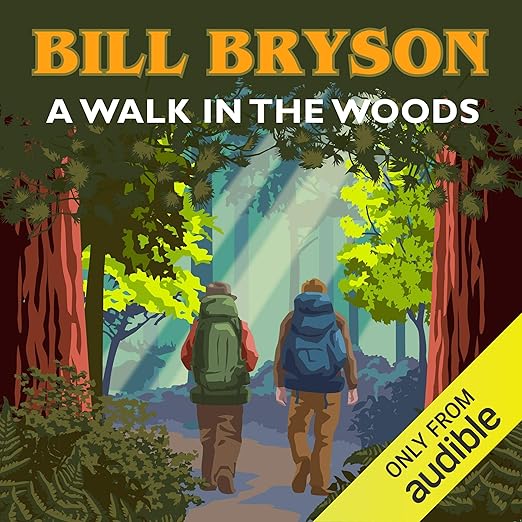
I listened to the latter half of A Walk in the Woods on a damp Wednesday afternoon when I had no business feeling cheerful about anything. By the time two hours had passed, I was laughing out loud at something involving Stephen Katz, a diner, and a quantity of pie that probably violated several conventions of polite behaviour. This is what Bryson does – he situates comedy so precisely in the specific and the physical that it arrives as experience rather than performance, and it works especially well in audio.
The book is Bryson’s account of his attempt to hike the Appalachian Trail – all 2,000-plus miles of it, snaking through 14 states from Georgia to Maine – in the company of an old friend who is, by his own cheerful admission, entirely unsuited to the undertaking. It was published in 1998 and has not dated in any material way, which is a testament to the durability of comic writing about the body’s honest relationship with ambition.
Clara’s Verdict
Bryson’s structural genius as a travel writer is his capacity to treat information as entertainment rather than as a duty to be discharged. He cannot walk past a tree without telling you its complete ecological history and then noting something absurd about how American forestry policy has treated it over the past century. He cannot pass through a town without a digression into its founding, its decline, its single distinguishing fact, and the particular variety of American emptiness or oddness that characterises it. One reviewer describes the book as having ‘substantial amounts of flesh upon a rather feeble skeleton’, which is accurate but misses the point: the flesh is the whole reason for the walk. The trail is the occasion; the digressions are the book.
The emotional centre of the narrative is Katz, Bryson’s childhood friend who shows up overweight, under-prepared, and philosophically resistant to suffering. He is not presented as an embarrassment or as comic relief in the cruel sense – he is presented as someone who refuses to pretend that the Appalachian Trail is a reasonable thing for two middle-aged men to undertake, and whose refusal to perform enthusiasm becomes, paradoxically, the most honest thing about the journey. The friendship between Bryson and Katz – tested, strained, and ultimately genuine – is what gives the book its human weight beneath the comic surface.
Multiple reviewers note the contrast with the 2015 film adaptation (starring Robert Redford and Nick Nolte), and the consensus is consistent: the film is enjoyable but strips away precisely the digressions and peripheral information that make the book what it is. In audio format, narrated well, those digressions are exactly where the pleasure lives – the moments when William Roberts settles into a passage about the history of American wilderness policy and you realise that thirty minutes have passed without your noticing.
About the Audiobook
Published by Audible Studios in December 2005. Runtime of 9 hours and 43 minutes. Rating of 4.4 from 24 reviews spanning from 2012 to 2026, which is an unusually long readership tail and suggests this is a book passed between generations rather than discovered at a single cultural moment. The narrator is William Roberts. This is one of Bryson’s most beloved books, and the audiobook has been available long enough to have accumulated genuine listener history rather than immediate-publication enthusiasm.
The Narration
William Roberts has a slightly donnish quality that suits Bryson’s authorial voice particularly well – the voice of someone who has read extensively and thought carefully but retains the full capacity to be astonished by the actual world. His comic timing is reliable without being showy, which is the right call for Bryson’s deadpan register. The Katz sections – where Bryson reports rather than experiences – require the narrator to hold both the observational voice and the reported chaos of his companion’s presence, and Roberts manages the distinction clearly enough that you always know which register you are in. The longer, more discursive passages about ecology and American history are handled with enough variation in pace and tone to keep them from becoming lectures.
What Readers Say
Reviews span nearly fifteen years and include multiple ‘second read’ accounts, which is a reliable quality indicator. One reviewer who gave it a second listen many years after the first notes it is ‘just as entertaining and laugh out loud funny as it was when I read it for the first time’. Another describes leaving public transport with an undignified expression on their face – one of the more specific testimonials available to outdoor comedy. The reviewer whose nephew recently hiked the same trail describes the particular pleasure of comparing the nephew’s real experience to Bryson’s narrative as a form of reading that the book specifically invites and rewards.
Who Should Listen?
Fans of Bryson who have not yet reached this one, and newcomers to his work for whom this is as good an entry point as any. Those who have spent time on long-distance trails and want a companion who will simultaneously celebrate and gently mock the enterprise from within. Those who have never hiked seriously but are drawn to the idea – Bryson is the ideal guide precisely because he is not a zealot and does not expect you to be one either. The audiobook format suits his digressive style particularly well: the digressions that feel parenthetical in print feel natural and companionable when narrated, as though you are listening to a very well-read friend rather than reading their footnotes.