Clara’s Verdict
I should be honest about my position here: I am not a trader, and I did not come to this audiobook with any prior knowledge of swing trading methodology. What I can evaluate is whether AI Swing Trading Made Simple does what it says it will do – explain, accessibly, how to integrate AI tools like ChatGPT into a structured trading process – and whether it does so with enough honesty about limitation and risk to serve a genuine learner rather than a speculative one. The answer, on both counts, is largely yes. Angel Talamantes writes with the clarity of someone who has taught this material before, and the emphasis on process over prediction is exactly the right framing for an audience that might otherwise approach AI-assisted trading with unrealistic expectations.
This is Book 12 in Talamantes’s Stock Trading series, which tells you something about the scope of the existing catalogue – there is clearly an established audience for this approach, and the author has had eleven prior chances to refine how he explains it.
About the Audiobook
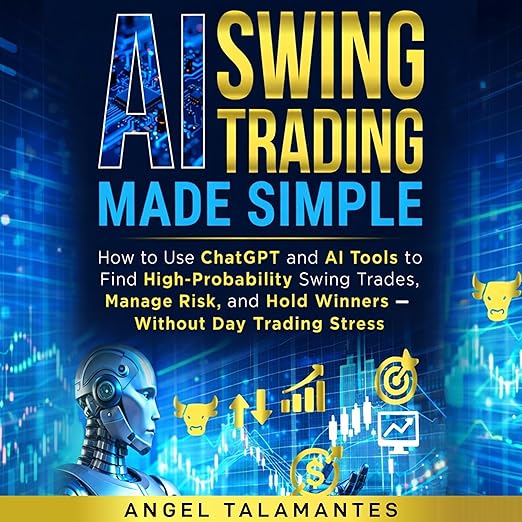
Released in March 2026 and running at 4 hours and 29 minutes, this guide covers the integration of ChatGPT and other AI tools into swing trading workflows with specific, practical focus. Swing trading – holding positions for days to weeks rather than hours or months – presents particular challenges around entry timing, position management, and the psychological discipline required to hold winning trades rather than exiting too early. Talamantes addresses all of these directly and connects them to the AI integration question: how can language models help structure research and decision-making without becoming a crutch that replaces the trader’s own judgement?
The content covers trade idea generation via ChatGPT, entry and exit planning using price structure and market context, risk management and position sizing, building a repeatable trading routine, and the psychological dimension of holding winners and avoiding overtrading. The anti-overtrading emphasis is consistent throughout and welcome – overtrading is the principal failure mode for retail traders at every level, and a book that treats this seriously rather than focusing exclusively on finding good setups is more useful than most of its genre.
The AI component is treated practically rather than evangelistically. ChatGPT appears as a research and structuring tool – useful for generating and pressure-testing trade ideas, filtering candidates, and maintaining analytical discipline – not as an oracle or an automated trading system. This is the honest framing, and it makes the book more credible for it.
The book’s position within Talamantes’s broader Stock Trading series is worth noting. As Book 12, it assumes familiarity with foundational market concepts and does not reteach them. The AI integration content is presented as an addition to an already-functional swing trading methodology rather than a replacement for understanding the underlying market mechanics. This is an important distinction – several recent books in the AI-finance space imply that AI tools can substitute for analytical understanding, and Talamantes does not make that error. The book is explicit that ChatGPT functions as a research and filtering assistant rather than a decision-making agent, and that the trader’s own judgement about risk and market context remains the decisive factor. For readers who have already worked through earlier volumes in the series, this framing will feel like a natural extension; for first-time readers, it is worth knowing that this context exists.
The Narration
Jacob Baird narrates, and his delivery is clear and professional. Financial methodology audio is a demanding narration assignment – the content is often procedural and dense, with lists, frameworks, and conditional logic that require the narrator to maintain listener engagement without the natural drama of narrative prose. Baird manages this competently, and his pacing is appropriately measured for material that listeners may want to process slowly or revisit in sections.
What Readers Say
No reviews are available at time of writing – this is a March 2026 self-published release that has not yet accumulated listener feedback on Audible UK. The rating field returned a cart-capacity error during scraping rather than a score, confirming this is a very new entry. The Stock Trading series’ twelve entries suggest an established audience for Talamantes’s approach, but first-time listeners should approach with appropriate caution given the absence of verified listener response. Independent financial content of this kind is also worth approaching with the standard caveat: no general audiobook constitutes financial advice, and the methods described here carry inherent market risk.
Who Should Listen?
Traders with some foundational market knowledge who want a structured framework for integrating AI tools into their research and decision-making. Not appropriate as a first introduction to investing or trading – the baseline assumption is that the listener already understands what swing trading is and why they might choose it. Those entirely new to financial markets should start elsewhere before returning here. As with all trading content, apply appropriate scepticism and do not risk capital you cannot afford to lose.