Clara’s Verdict
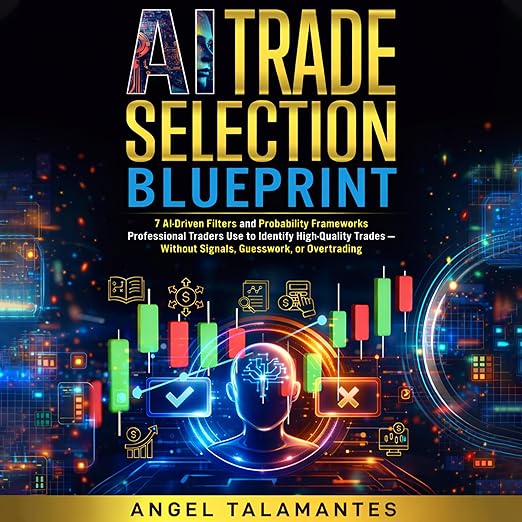
I want to be transparent: I’m not a trader, and finance audiobooks are not usually my domain. But AI Trade Selection Blueprint is interesting for a reason that extends beyond its specific subject matter – it’s not really about AI in the way that most “AI meets finance” titles are. It’s about decision-making under uncertainty, and the specific behavioural patterns that lead otherwise intelligent people to repeatedly make the wrong call. That’s a territory I find compelling regardless of context, because the same failure modes appear everywhere you look: in editorial commissioning, in hiring, in strategic planning, in any situation where humans must choose under conditions of incomplete information and emotional pressure. Angel Talamantes’s central premise – that most traders lose not because they lack execution skill but because they take too many low-quality trades in the first place – is counterintuitive and, once you sit with it, entirely obvious. This is book fifteen in the 7 AI-Driven Filters and Probability Frameworks series, so readers new to Talamantes’s work may want to start earlier in the catalogue to build context.
About the Audiobook
Talamantes is admirably precise about what this book is and isn’t. It is not a coding guide. It is not about building automated systems. It is emphatically not a black-box solution that removes human judgement from the equation – a point he makes clearly and early, which is more intellectually honest than many titles in this space. What he offers instead is a structured, systematic framework for filtering trading opportunities before any capital is at risk. The core argument runs as follows: most traders have more than enough technical knowledge to execute trades competently; what they consistently lack is a calm, unemotional, consistent process for deciding which opportunities are worth entering at all. The book covers how to identify trades that should simply be ignored before they become tempting; the crucial distinction between trade selection and trade execution (which Talamantes argues are the two elements most commonly and expensively conflated); how to apply AI-assisted probability thinking without requiring advanced mathematics or a data science background; how to align multiple timeframes to assess trade quality before committing; how to read your own emotional state before placing a trade; and how to use ChatGPT as a genuinely unbiased sounding board that doesn’t share your confirmation biases or your emotional investment in being right. The final section – building a reusable, personalised pre-trade checklist – is the practical payoff for everything that precedes it. At four and a half hours, this is an efficient and focused listen that respects the listener’s time.
The Narration
John Wilkinson narrates with the clear, measured delivery that instructional material of this kind requires. He handles the framework sections at a pace that allows information to land properly rather than blur past, which matters particularly for content where the listener might want a moment to think through each point before moving forward. It’s a professional, unobtrusive performance that serves the material well – exactly what you want from a practical guide where the content, not the delivery, should be the focus.
The Behavioural Angle
What I find most interesting about Talamantes’s framework – viewed from outside the trading world – is that it’s essentially a behavioural intervention dressed as a technical checklist. The argument that most poor trading outcomes stem from taking too many low-quality trades is fundamentally an argument about overconfidence, loss aversion, and the failure to distinguish between an opportunity and a temptation. These are human cognitive patterns that appear in every domain where decisions are made under uncertainty, and the discipline Talamantes is trying to install – pause, filter, evaluate before acting – is the same discipline that distinguishes effective decision-making in any context. That breadth of relevance makes the book more interesting than its specific subject might initially suggest.
What Readers Say
This title is newly released in early 2026 and does not yet carry Audible ratings or written reviews, which makes evaluation more difficult than usual and requires honesty about the limits of what I can say. Talamantes has built a substantial catalogue under the series name, and a book fifteen implies a readership that has found sufficient value in the preceding entries to keep returning – which is its own form of recommendation. The concepts he writes about – probability-based filtering, pre-trade checklists, emotional bias detection – are consistent with the evidence-based trading literature more broadly, regardless of the AI framing.
Who Should Listen?
Active traders who struggle specifically with overtrading, impulsive decision-making, or maintaining consistency in their approach under the kind of pressure that real markets generate. The book will be most useful for those who already have an established trading methodology and are looking for a structured pre-trade filter rather than a new system to learn from scratch. Complete beginners would benefit more from foundational education before this level of refinement. Find AI Trade Selection Blueprint on Audible UK if disciplined trade selection is the component of your practice that’s currently letting you down.