Clara’s Verdict
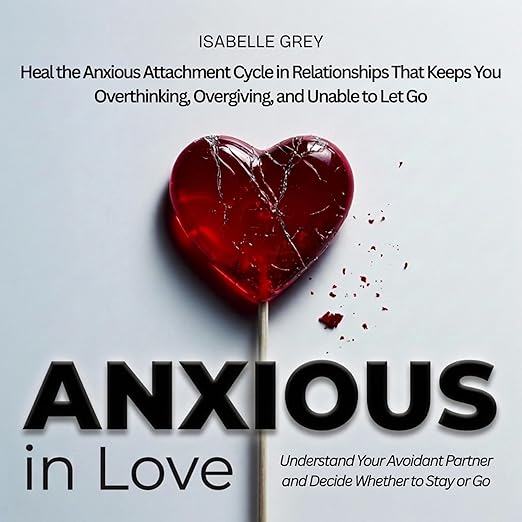
Isabelle Grey’s Anxious in Love arrives from Blackstone Publications in March 2026 with Francesca Harrall narrating, and it is doing something more precise and more useful than most books in the attachment theory space manage. Grey is not interested in giving you a framework and then leaving you to apply it; she is interested in the specific, lived experience of being in an anxious-avoidant relationship – the particular cruelty of the reunion high that follows each withdrawal period, the way hope and dopamine conspire against clear thinking, the exhaustion of knowing the theory perfectly and still finding yourself trapped inside the pattern. At five hours and twenty-six minutes, this is a compact and densely useful listen for anyone who has ever recognised themselves in the description. The premise alone – you already understand attachment theory; here is why it has not helped, and what might – addresses a frustration that a great many people carry quietly.
About the Audiobook
Grey’s central insight is neurological before it is psychological: the anxious-avoidant dynamic produces a reward cycle structurally similar to gambling addiction. The worse the withdrawal period, the more intense the dopamine flood of reunion – which means that the relationship trains you to need the very thing that is causing you pain. Understanding this intellectually is necessary but not sufficient. Your nervous system learned its relationship patterns before you had language, and it runs those programmes without waiting for your conscious mind to object.
The book maps what Grey calls the Four-Stage Trap Cycle: pursuit, withdrawal, reconnection, retrigger. It examines both partners’ nervous systems without flattening either into villain or victim – the avoidant partner’s withdrawal is not malice, any more than the anxious partner’s pursuit is weakness; both are nervous systems doing exactly what they were trained to do in early life. The practical tools are specific and carefully calibrated: a body-level assessment for distinguishing difficult but possible from impossible regardless of effort, conversation scripts for the talk that reveals capacity rather than stated intent, and a seven-question decision framework for the central question of whether to stay or leave.
What distinguishes Grey’s approach from much of the existing literature is her refusal to assume a correct answer. She is not writing for women who need to be told to leave, and she is not writing for women who need to be told to stay. She is writing for women who need to see clearly – and that respect for the reader’s autonomy is evident on every page. The book is written primarily to women in anxious-avoidant pairings, but the nervous system dynamics it describes translate across relationship structures and orientations.
The Narration
Francesca Harrall narrates with a directness that suits the material well. The book is written to a specific reader – someone currently in, or recently out of, an anxious-avoidant relationship – and Harrall’s delivery respects that intimacy without becoming precious about it. The practical sections, where Grey provides scripts and decision frameworks, are read with the clarity of someone who understands that the listener may be returning to these passages repeatedly, at different stages of their own process, and Harrall’s pacing through them is measured and accessible accordingly.
What Readers Say
As a March 2026 release, Anxious in Love is newly arrived and reviews are still accumulating. The book has attracted significant early interest within communities focused on attachment theory and relational psychology, where Grey’s more granular approach to the anxious-avoidant dynamic has been welcomed as a practical advance on more theoretical treatments of the same subject. The premise – you already know the theory; here is why it has not helped, and what to do instead – addresses a frustration that a significant number of readers have expressed about the existing literature in this space.
Early responses indicate that the book’s most valued quality is precisely this: it does not explain the problem to you, it helps you do something about it. I expect the ratings, when they settle, to reflect a book that has genuinely helped people rather than merely informed them.
Who Should Listen?
Anyone currently in, or recovering from, an anxious-avoidant relationship who has already worked through the standard attachment theory material and found it insufficient. Anyone who can describe their own nervous system’s patterns with perfect accuracy and still finds themselves repeating them. This is also an excellent resource for therapists looking for practical frameworks to recommend to clients navigating these dynamics. At five and a half hours, it is a complete and usable tool in a single listen. Available on Audible UK.
Available on Audible UK and through subscription services including Scribd and Storytel. At five and a half hours, it is a complete and usable tool in a single listen, though most readers will find themselves returning to individual sections over time.