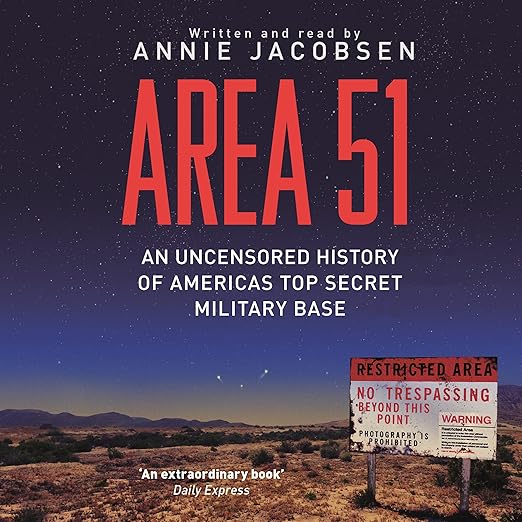
Clara’s Verdict
The phrase “Area 51” has been so thoroughly colonised by alien conspiracy culture that it takes a brave writer to try to tell the real story – which turns out to be, in many ways, more extraordinary than the fiction. Annie Jacobsen spent years interviewing the actual people who worked there: scientists, pilots, engineers, CIA contractors and military personnel, all of them bound by decades of classification agreements and, in many cases, still unwilling to discuss certain topics. The fifty-eight primary sources she interviewed represent an unprecedented level of access to a facility that has shaped American military capability, Cold War history, and popular mythology in roughly equal measure.
The result is a serious, rigorously reported piece of Cold War history that happens to involve one of the most storied addresses on earth. Jacobsen narrates the audiobook herself, and that decision gives it the authority of someone who has spent years earning the trust of reticent sources. This is not tabloid history dressed in serious clothing; it is the real thing, even if one particular chapter remains fiercely disputed.
About the Audiobook
It is the most famous military installation in the world, and no credible insider had ever fully divulged the truth about his time inside it – until Jacobsen’s exhaustive research produced these interviews. The book provides an unprecedented look into the mysterious activities of a top-secret base, from the Cold War to more recent decades. It is also a jaw-dropping examination of how the government simultaneously cultivated and dismissed the most extraordinary rumours in American history.
Jacobsen moves chronologically through the base’s operation with a journalist’s eye for the telling detail: the U-2 and SR-71 Blackbird spy planes whose impossible flight performance gave rise to countless UFO reports, the nuclear tests conducted at nearby sites with a cavalier disregard for civilian safety, the political battles between competing government agencies competing for resources and secrecy. The book’s final chapter – concerning the Roswell incident and a theory so extraordinary that it divides critical opinion sharply – is either its most compelling passage or its least convincing, depending on your tolerance for the speculative and unverified. The audiobook runs to 16 hours and 10 minutes – a substantial, immersive listen.
The Narration
Annie Jacobsen reads Area 51 herself, and the effect is considerable. She brings to the narration the authority of someone who has conducted hundreds of hours of interviews, navigated government classification procedures, and made difficult editorial judgements about what to include and how to frame it. Her delivery is measured and precise – a journalist’s voice rather than a performer’s – and that restraint is exactly right for material that is remarkable enough without embellishment. At sixteen hours, the audiobook requires sustained commitment, and Jacobsen’s narration sustains it: she reads with the confidence of a writer who knows precisely what she is talking about.
What Readers Say
Listener response has been broadly positive with some pointed reservations. One reviewer called it “superbly written, well-structured and informative – contains the facts and the history, thankfully devoid of the fictitious material found in many books in this genre.” Another praised the “pragmatic research-based approach” while acknowledging “areas of grey that make you wonder whether this is truth or disinformation.” The controversial Roswell chapter attracted the most critical attention: one experienced reader felt the narrative “becomes hard to accept” at that point and wished the book had maintained the rigorous evidential standard of its earlier sections. Those who read for the Cold War history rather than the extraterrestrial speculation – the spy planes, the nuclear programme, the political infighting – found it consistently excellent. The audiobook holds a rating of 4.3 out of 5 on Audible.
The book also functions as a compelling meditation on secrecy itself – on what it costs, institutionally and personally, to maintain absolute classification for decades. Several of Jacobsen’s sources are elderly men who spent their careers unable to tell their families what they had spent their lives working on. The relief that some of them clearly feel in finally talking, even partially, gives the interviews a particular emotional texture that pure historical research cannot replicate. It is this human dimension – the people who lived inside the secret – that distinguishes Area 51 from the conspiracy-adjacent literature that otherwise occupies this territory.
Who Should Listen?
History readers with an interest in Cold War intelligence, American military history, or the reality behind one of the world’s great mythologies. Those expecting definitive alien revelations will be disappointed – Jacobsen is scrupulous about what can and cannot be evidenced. Those who want a grounded, deeply reported account of what actually occurred in the Nevada desert for half a century will find this essential. Available on Audible UK, and accessible on Kobo and Scribd for subscribers to those platforms.