Clara’s Verdict
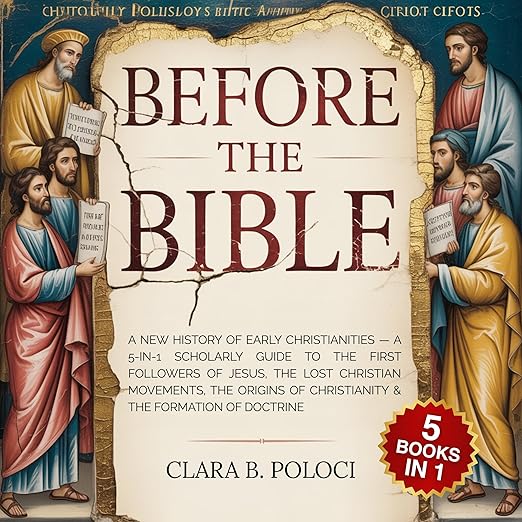
Questions about early Christianity occupy a peculiar space in popular non-fiction: they are genuinely fascinating to almost anyone with a passing curiosity about Western history, but the field is heavily contested and often written either for believers defending a tradition or for sceptics attacking one. Clara B. Poloci’s Before the Bible announces itself from the outset as neither. It is pitched as a work of historical scholarship rather than theological advocacy, and, to a greater extent than one might reasonably expect of a self-published four-hour listen, it largely delivers on that promise.
I listened over two evenings, and what kept me engaged was the book’s central organising question: not what Christianity became, but what it was before it had a Bible, an institutional Church, or agreed creeds. That question opens into a genuinely plural landscape, and Poloci handles its complexity with care. The answer involves not one early Christianity but many competing ones, and this book does not flinch from that conclusion.
About the Audiobook
Structured across five parts and twenty-five chapters, the book maps the journey from a Jewish teacher in Roman Palestine to the formation of orthodox Christianity as a global institution. Poloci examines the early communities that formed around the memory of Jesus, the transformative mission of Paul, the Jewish-Christian groups that were later marginalised as heretical, and the power struggles that determined which texts became scripture and which were lost to history.
The sections on women’s leadership in early communities and on the influence of Constantine on the Church’s institutional character are handled with scholarly balance. Poloci is careful to distinguish between what the historical evidence shows and what later tradition claims, and she is transparent about the limits of the sources available to historians. The chapter on how heresy was defined, and by whom, and for what reasons, is one of the more intellectually satisfying sections of the book, because it treats orthodoxy as the product of historical contingency rather than inevitable theological development.
The writing is accessible throughout, though listeners with a background in early Church history may find some sections cover familiar ground. For those without that background, the twenty-five chapter structure provides a clear scaffold for a genuinely complex history. At four hours, the scope is ambitious, and occasionally the book moves quickly past material that deserves more sustained attention. But the breadth is also the point. This is designed as an orientation to a field rather than a specialist monograph, and it succeeds on those terms.
Poloci’s stated aim is to help listeners understand Christianity using contemporary historical scholarship, and she avoids the devotional tone that would alienate secular readers as much as the dismissive tone that would alienate religious ones. That kind of tonal balance is harder to achieve than it looks.
The Narration
Gerhard Weigelt narrates with the measured clarity that intellectual history of this kind requires. His delivery is unhurried, which helps listeners follow the argument across multiple competing early Christian movements without losing their bearings. He does not dramatise or editorialise, and the material is left to speak for itself. Some listeners may find his tone slightly cool for the more human story elements, but for a book positioning itself as scholarly rather than devotional, the register is appropriate and consistent.
What Readers Say
Before the Bible carries a five-star rating from a single reviewer. Philip M. Gennuso, reviewing from the United States shortly after publication, described it as “an elegant, succinct, respectful overview of Early Christianity, its diversity, contrasts, and orthodoxy,” and recommended it for seekers and the curious alike. The note about respect for the subject matter and the absence of doctrinal agenda matches what the book itself presents. One review is too thin a sample to draw broad conclusions, but the specific language of the response is telling: readers are finding what the book promises.
Who Should Listen?
This is an ideal listen for anyone curious about the historical origins of Christianity who approaches the subject without a prior theological commitment in either direction. Students of religious history, listeners who have enjoyed Bart Ehrman’s popular scholarship, and those who want to understand why a religion with a single founder produced such extraordinary internal diversity in its earliest centuries will all find this worthwhile. It is not a replacement for more rigorous academic texts, but it is a capable and intellectually honest introduction to a field that deserves wider popular attention than it typically receives.