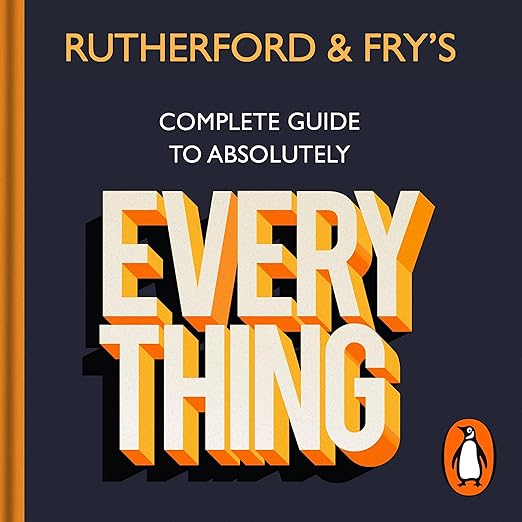
Clara’s Verdict
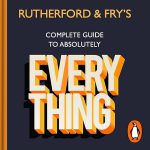
There is a particular pleasure in science writing that refuses to condescend – that trusts you to follow the argument without dumbing it down to the point of uselessness, while still being funny. Hannah Fry and Adam Rutherford have that gift in abundance, and their Complete Guide to Absolutely Everything is the sort of audiobook that makes a seven-hour drive feel far too short. Rated 4.5 stars from 863 listeners on Audible, this is popular science at its most joyfully unruly, from two broadcasters who are genuinely experts in their fields and genuinely entertaining to spend time with. I would press this on anyone who was ever told science was boring at school and never quite recovered from the insult.
About the audiobook
Hannah Fry is a mathematician at University College London; Adam Rutherford is a geneticist and award-winning science broadcaster. Independently, each has produced books and documentaries of considerable quality – together, they are something rarer: a duo who trust each other enough to be honest about what they don’t know as well as what they do. Their Complete Guide to Absolutely Everything sets out to tell the complete story of the universe and absolutely everything in it, “skipping over some of the boring parts.” Published by Penguin Audio in September 2021 and running to 7 hours and 2 minutes, the result covers an extraordinary range of territory.
In the course of its seven hours, the book addresses: the origin of time and space; the formation of planets and solar systems; biological evolution and why animals are the size and shape they are; the sixty-million-year story of the dinosaurs; facial expressions and what they actually communicate; the psychology and neuroscience underlying horoscopes (Spoiler: they work on us because of how our brains are wired, not because of celestial mechanics); whether your dog genuinely loves you; the surprisingly vexed question of whether anything is truly round; and whether you need your eyes to see. The approach throughout is chatty, frank about the limits of current scientific knowledge, and rigorous about what the evidence actually shows.
The book’s central argument – that human brains evolved to tell us things that feel intuitively correct but simply are not true, and that science is the method we have developed to bypass that cognitive limitation – gives the apparent miscellany a unifying intellectual purpose. This is not a random collection of interesting facts. It is a sustained argument for the value of systematic thinking about a deeply strange world.
The narration
Fry and Rutherford have between them decades of broadcasting experience – radio programmes, podcasts, television documentaries, and public lectures – and the audiobook benefits enormously from their natural ease with a microphone. The conversational register of the writing translates beautifully to audio: jokes land, technical passages are paced generously enough to register without being laboured, and the whole enterprise has the warmth and energy of two knowledgeable friends explaining the universe over a long dinner. This is a format that rewards the audio experience specifically: hearing the material spoken aloud adds a dimension that silent reading of science writing cannot always achieve.
What readers say
With 863 ratings averaging 4.5 stars, listeners are unambiguous in their enthusiasm. One UK reviewer described it as “brilliant entertaining – still left me bewildered by space and quantum physics but that is to be expected.” Another praised it as “entertaining and informative, written in easy-to-read English, not Honours-Degree-In-English English – science can be understood by normal people so long as the explanation is clear.” A third offered this pleasingly honest summary: “I couldn’t describe what the book is about to anybody – the subject matter is far too diverse! But nonetheless entertaining and informative.” One listener called it “worth reading, with some occasional humorous asides along the way,” which, given the ambition of the enterprise, rather undersells it. The 4.5-star consensus is well earned.
Who should listen?
It is also worth noting that the book models something philosophically important: a willingness to say ‘we don’t fully know’ without retreating into either false certainty or paralysing scepticism. That intellectual honesty is rarer than it should be in popular science, and Fry and Rutherford wear it lightly enough that you almost miss how significant it is.
This is exactly right for anyone who has ever wished they knew more about the big questions – time, consciousness, evolution, the cosmos – but finds most popular science titles either too dry or too breathlessly reverent of their own importance. It suits curious generalists: people who enjoy QI, Radio 4 science programmes, or books by Brian Cox and Richard Feynman but want something less earnest and more self-aware about the limits of the enterprise. It also works particularly well as a family listen, since the sheer range of subjects means there is always something fresh to catch a new ear. For the science-curious non-specialist, this is a genuinely wonderful 7 hours.
Listen to Rutherford and Fry’s Complete Guide to Absolutely Everything on Audible UK and find out what the universe is actually up to.