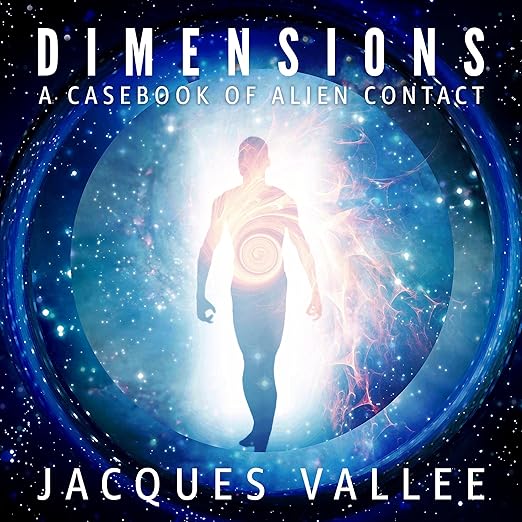
Clara’s Verdict
I’ll be upfront: UFO literature is not my usual territory. But Jacques Vallée is not a UFO enthusiast in the sense that phrase usually implies. He’s a French astrophysicist and computer scientist – the real-life model for the French scientist in Spielberg’s Close Encounters of the Third Kind – and he approaches the subject with the sceptical rigour of someone who finds the prevailing explanations too simple, not someone who finds them too modest. Dimensions is the first book of his Alien Contact Trilogy, and it’s genuinely unlike most things in its genre.
His central argument – that the extraterrestrial hypothesis is “simply not strange enough to explain the facts” – is provocative in exactly the right direction. Rather than insisting we’re being visited by beings from other planets, Vallée argues for something more disquieting: that the phenomenon may be indigenous to our reality in ways we don’t yet have the framework to understand. Whatever you make of his conclusions, the quality of mind on display is formidable.
About the Audiobook
Vallée begins by tracing the historical record of what we now call UFO encounters – not from the 1947 Roswell incident, but from medieval manuscripts, Renaissance woodcuts, and nineteenth-century newspaper accounts of aerial phenomena. His argument is that whatever is happening has been happening for a very long time, and that the specific cultural form it takes – airships in the 1890s, classic flying saucers in the 1950s, sleek triangular craft in the 1980s – mirrors the expectations and technology of its era rather than any fixed physical reality.
From there, he moves into abduction reports, examining their psychological and spiritual dimensions alongside the physical claims. He’s particularly interested in the contact experience as something that shares characteristics with religious vision, shamanic initiation, and folklore about encounters with fairies or demons – a pattern he finds deeply significant and deeply strange.
The final section turns to what he calls the “triple coverup” – the institutional, political, and scientific forces that have made rigorous investigation difficult – and concludes that our current paradigms are simply inadequate to the phenomenon. It’s a book that asks more questions than it answers, which is, Vallée would argue, the correct scientific posture.
The Narration
Michael Hacker narrates, and he brings a measured, intellectually serious tone to the material that serves the text well. Vallée’s writing is dense with references – to Carl Jung, to historical records, to scientific literature – and Hacker handles the varied registers (historical documentation, personal testimony, theoretical argument) without losing clarity. The twelve-hour-plus runtime is substantial, but Vallée’s prose rewards patient attention.
For a subject that attracts breathless presentation in lesser hands, Hacker’s restraint is genuinely refreshing.
What Readers Say
With a rating of 4.5 from 638 listeners, Dimensions has clearly found a devoted audience. The reviews are unusually engaged for the category. One reader called it “a rare book which kept me up half a night” and praised the “massive range of references” and “evident raw enthusiasm.” Another compared it favourably to Carl Jung’s Flying Saucers: A Modern Myth, noting that Vallée “believes something’s going on but his vantage point isn’t necessarily directed towards space.” A third described Vallée as presenting “sceptical openness” that fits well with current moves towards official disclosure discussions.
The most critical notes are really refinements of praise: the book is described as “supplanted by others” published since, which is a reasonable observation for a text originally from the 1980s, but the consensus is that it remains essential reading for anyone seriously interested in the field.
Who Should Listen?
This is not for casual UFO enthusiasts looking for dramatic accounts of alien abductions. It’s for intellectually serious listeners who want to engage with the phenomenon as a genuine puzzle – people who find both credulous belief and dismissive scepticism equally unsatisfying. Readers who enjoy the intersection of science, mythology, psychology, and history will find it particularly rewarding.
It pairs well with John Keel’s The Mothman Prophecies and Jung’s essay on flying saucers – Vallée is in explicit dialogue with both. If you finish Dimensions wanting more, books two and three of the Alien Contact Trilogy continue the investigation.
Listen on Audible UK: Get Dimensions on Audible. Also available on Kobo, Scribd, and Storytel.