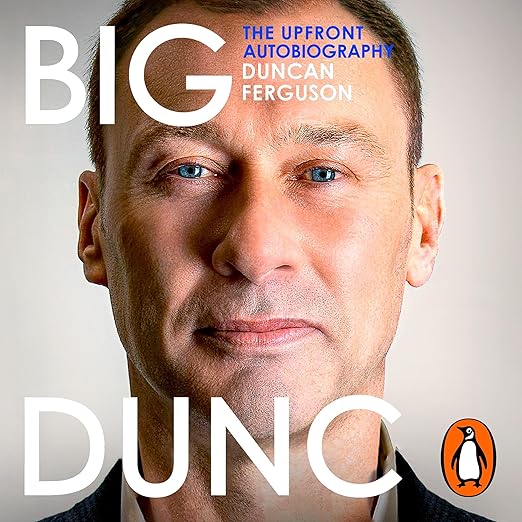
Clara’s Verdict
I am not a football person. I should be transparent about that. But BIG DUNC pulled me in from the opening chapter because Duncan Ferguson turns out to be, quite unexpectedly, a genuinely compelling narrator of his own life – and the life he has lived is genuinely extraordinary. This is the book of someone who became the first professional footballer in Britain to be imprisoned for something done on a pitch, who lost and rebuilt a fortune, who partied with the sort of people that memoir writers usually describe in euphemisms, and who grew into a figure of genuine community significance in Merseyside. He still sounds slightly surprised by all of it, which makes him very good company for eleven hours.
About the Audiobook
Published by Penguin Audio on 8 May 2025, BIG DUNC runs for 11 hours and 11 minutes. Ferguson covers his emergence in British football in the 1990s, the infamous headbutt incident and subsequent three months in Glasgow’s Barlinnie Prison – the first and only time a footballer has been imprisoned for a crime committed during a match – and the aftermath that shaped both his career and his character. He is frank about the partying, about the burglars he reportedly dealt with personally, about the making and losing of money, and about the way his relationship with Everton has functioned as a kind of moral anchor through the chaos. The club is a presence throughout: the thing around which everything else has been organised.
Wayne Rooney and Sir Alex Ferguson are among those who have spoken warmly of the book in advance. Gary Lineker called it a hell of a read. The Times noted its pure charisma. The Sunday Times gave it instant bestseller status. The Audible listing carries 4.6 out of 5 from a very small initial sample – an early signal on a relatively recent release. The print reputation is stronger and broader, and the audio edition benefits from the narrator being the subject himself.
The Narration
Ferguson reads his own book, and it is absolutely the right decision for this material. His Scottish voice carries an unguarded quality that professional narration could not replicate. There is rawness to the way he describes the prison experience – the sound of someone recounting something that still sits uncomfortably – and a genuine warmth in the Everton passages that comes from a man who clearly means it. The self-deprecating humour threading through the more outlandish anecdotes only works because you believe he finds them funny himself. The Daily Mail observed that the honesty is unrestrained, and in audio that honesty is immediate and physical in ways that print cannot quite achieve.
What Readers Say
Derrick (5 stars): “Enjoyed the book from start to finish. Got a full insight into the player and the person. Was a great read.”
Paul Toney (5 stars): “Best football Autobiography out there. Great read a must for any football fan.”
Mr. Wayne W. Meldrum (4 stars): “Duncan is very honest and it makes it all the better for it. As a Dundee United fan I was familiar with that part and how the manager treated him, also his time in jail, but there is so much more to this book.”
Claire shepherd (5 stars): “He built his career up, had it taken away and came back fighting to rebuild it to an even better standard. Great read.”
The book’s treatment of his community work in Merseyside is one of its more quietly affecting sections. Ferguson’s rehabilitation from hardman and liability to something closer to a civic figure, working with children who share aspects of his own tough upbringing, is handled without self-congratulation – which is to say it is handled the way Ferguson seems to handle most things, with a directness and a slight bemusement that he has ended up here. The Daily Mail quoted in the synopsis is accurate: there is humour, there is drama, and there is redemption, but none of it is arranged for effect. It simply happened, and he is telling you about it.
The Everton thread that runs through the book deserves particular attention for non-football readers. Ferguson’s relationship with the club is not the relationship of a professional with an employer. It is the relationship of someone for whom the institution has been, at various points, the primary source of structure, meaning, and identity. The book is honest about this in ways that illuminate rather than sentimentalise it, and it makes the Everton passages some of the most emotionally interesting in a memoir that has no shortage of dramatic incident to draw on.
Who Should Listen?
The obvious audience is Everton supporters and football fans of a certain generation who watched Ferguson’s career unfold and want the full story from the man himself. Beyond that, this has genuine crossover appeal for anyone interested in working-class masculinity, the culture of 1990s British football, redemption, and what it looks like when someone refuses to be defined by their worst moment. Those expecting a conventional football memoir filled with tactical analysis and dressing-room gossip will find something more personal and psychologically honest than they anticipated, which is to say better than they anticipated. The audio format, with Ferguson narrating, is the definitive version of this book.