Clara’s Verdict
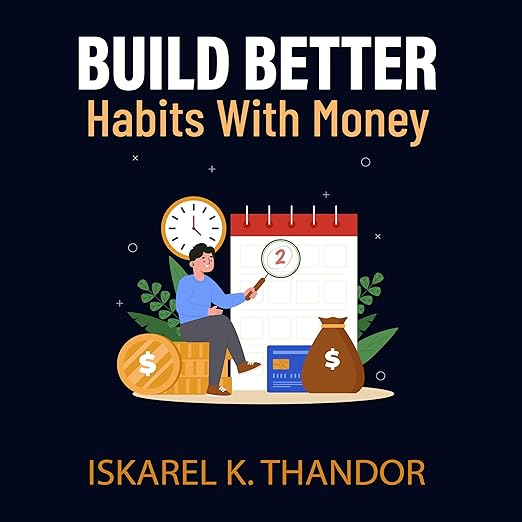
There is a particular kind of personal finance audiobook that treats money primarily as a mathematics problem – as though the reason people overspend, undersave, and avoid looking at their bank statements is simply a lack of information about compound interest. Iskarel K. Thandor’s Build Better Habits with Money takes a different and, I think, more honest approach: the problem is not that we do not know what we should do, it is that we have built automatic patterns of financial behaviour that are very difficult to interrupt with information alone. The book’s strength lies in this framing, and in its willingness to treat the psychological and environmental dimensions of financial behaviour as seriously as the practical mechanics.
At three and a half hours, this is a medium-length listen that manages to cover its ground without padding. The writing is accessible without being reductive, and Thandor’s voice is that of someone who has thought carefully about how financial habits actually form and change, rather than simply cataloguing what good habits look like.
About the Audiobook
The core argument is that financial behaviour is shaped by habit rather than decision, and that most habits are automatic responses to environmental and emotional cues rather than deliberate choices. Thandor draws on behavioural psychology to explain why the standard advice – spend less, save more, make a budget – so frequently fails: it addresses the symptom (the behaviour) without addressing the structure (the triggers and rewards that sustain it).
The practical sections are the book’s strongest. Thandor offers specific frameworks for identifying spending triggers, for building saving routines that do not require sustained motivation to maintain, and for designing environmental defaults that make good financial behaviour the easier option. The distinction between friction-reduction (making good choices automatic) and willpower-dependence (trying to resist bad choices through effort) is a genuinely useful one, and the application to money management is well-executed.
The book also handles the emotional dimension of money with more sensitivity than most in the genre: the relationship between financial behaviour and upbringing, the shame cycle that often surrounds debt and impulsive spending, and the importance of building a system that accommodates bad days rather than assuming perpetual peak performance. For listeners who feel genuine anxiety around money, this is a kinder entry point than more prescriptive alternatives.
The Narration
Bryan Singer reads with a straightforward, confident delivery that suits the instructional content. His pacing is consistent and unhurried, which is right for material that asks listeners to absorb and reflect rather than simply take notes. There is nothing showy about the performance, which is entirely appropriate to the subject matter.
What Readers Say
Published in March 2026 with no current Audible UK ratings, this is a very new title still finding its audience. The publisher credit – Mst Asma Khatun – suggests independent production, and the absence of early reviews is primarily a reflection of timing rather than content quality. The audiobook operates in a well-established and popular genre, and the clarity of its approach should earn it a readership among the significant number of Audible UK listeners who regularly seek out personal finance content.
Who Should Listen?
This is particularly well-suited to listeners who have read financial self-help before and found it intellectually convincing but practically ineffective. If you know what you should do with money and keep not doing it, the behavioural framing here is likely to be useful in a way that more information has not been. Those in or recovering from debt will find the tone supportive rather than judgmental. Listeners looking for investment strategy or detailed budgeting frameworks will need to supplement this with something more technically focused. Listen on Audible UK