Clara’s Verdict
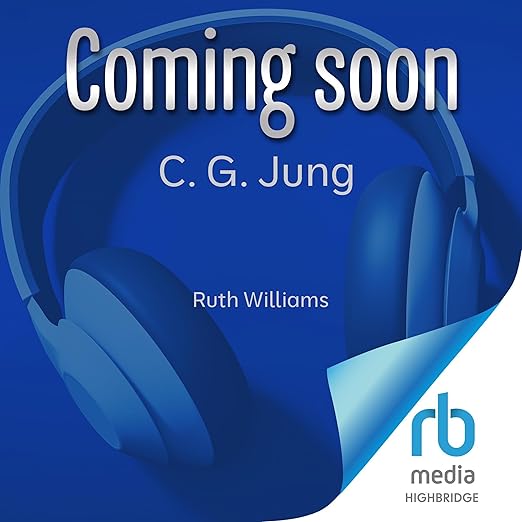
Jung’s ideas have seeped so thoroughly into popular culture – archetypes, the shadow, introversion, synchronicity, the collective unconscious – that most people feel they have a working grasp of them without having engaged with the source material. They don’t. Jung’s actual theories are considerably more subtle and stranger than the meme versions suggest, and finding a genuinely accessible introduction has historically been a challenge: his own writing is dense and uneven in translation; most secondary literature assumes either too much or too little prior knowledge. Ruth Williams’ C. G. Jung: The Basics – part of the Routledge series, narrated by Lisa Coleman over six-plus hours – solves this problem with considerable elegance. It is the introductory text I’d been waiting for.
About the Audiobook
Williams begins with biography: Jung’s remarkable childhood saturated with vivid inner experiences he struggled to interpret, his father’s crumbling faith, and his relationship with and eventual painful split from Freud. This grounding in life gives the subsequent theoretical material necessary context – Jung’s ideas emerged from his own psychological crises and clinical encounters, not from armchair theorising, and understanding that makes the concepts both more credible and more interesting.
The book then moves thematically through his key contributions. The unconscious – personal and collective. The structure of the psyche: ego, personal unconscious, collective unconscious. The archetypes – shadow, anima, animus, persona, the Self – explained with sufficient precision to distinguish them from their popular caricatures. Individuation: Jung’s term for the lifelong process of psychological integration and self-realisation, perhaps his most enduring contribution to how we understand the second half of human life. Psychological types, the origin of the introversion/extraversion distinction now ubiquitous in popular psychology. The role of alchemy as a psychological language. Dreams and their interpretation.
Williams is particularly good on the concepts that tend to get muddled in popular usage. Her explanation of the difference between the personal and collective unconscious is the clearest I’ve encountered anywhere. Her discussion of individuation is both precise and genuinely moving – she understands that this is not a theory about becoming “your best self” in the modern therapeutic sense, but something more austere and more demanding: a confrontation with the totality of who one actually is.
The book handles the uncomfortable aspects of Jung’s legacy with admirable directness. His ambiguous positions during the Nazi period, his theories on race and gender that are now rightly challenged, are discussed critically rather than glossed over. Williams also provides a helpful chronology of Jung’s life and suggestions for further reading – essential appendices for the listener who finishes this introduction wanting to go deeper. For those ready to tackle Jung directly, she offers a clear roadmap: Memories, Dreams, Reflections is typically recommended as the first port of call. The audiobook thus functions not just as an introduction but as a guide to a lifetime of possible engagement.
The Narration
Lisa Coleman narrates with a clean authority that suits academic material well. The philosophical vocabulary is handled with confidence, and the pace is carefully calibrated – unhurried enough to let complex ideas settle, but without the funereal drag that sometimes afflicts audiobooks in this genre. Her voice carries the right combination of intellectual engagement and genuine warmth for a text that is, at its core, about the inner life and its possibilities.
What Readers Say
Rated 4.7 out of 5 from 43 reviews – unusually well received for an academic introductory text. “I found it lyrical, poetic in places,” wrote one reader already familiar with Jung’s autobiography. Others credit Williams with providing the bridge that most people who know Jung’s name but not his thought have been looking for. One dissenting review found it insufficient on psychopathology – a fair academic point, though outside the book’s stated scope. For the purpose it announces – introducing Jungian concepts to newcomers – it succeeds with considerable grace.
Who Should Listen?
Anyone curious about depth psychology, the unconscious, or the psychological traditions that shaped modern therapy, coaching, and self-understanding. Equally valuable for complete beginners and for those who have encountered Jungian ideas piecemeal and want to consolidate their understanding. Therapists, literary scholars, coaches, and anyone trying to make sense of their recurring dreams will find it particularly useful. There is never a wrong moment to encounter Jung, but midlife – when the question “what does my life mean?” becomes urgent – is when his ideas tend to land with the most force.
It’s also worth noting that Jung’s ideas have particular relevance to creative practitioners – writers, visual artists, musicians – who have found that working with the concept of the shadow, or with active imagination (his technique for engaging consciously with unconscious material), generates insights that more conventional self-reflection doesn’t access. Williams touches on this without developing it fully, but it’s a thread worth following if you find yourself interested in Jung as a practitioner rather than purely a theoretical subject.
Begin your Jungian journey on Audible UK.