Clara’s Verdict
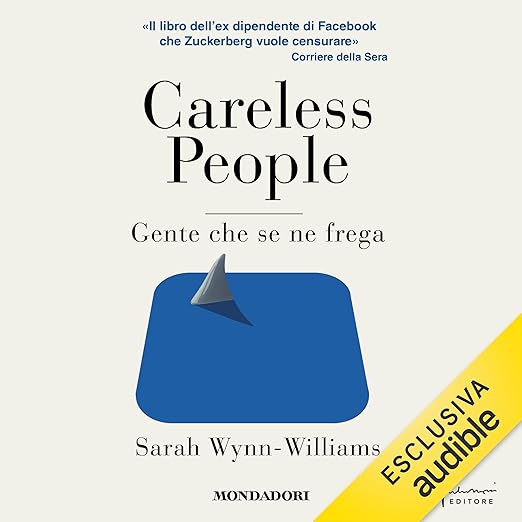
Very occasionally a book’s publication history becomes part of its argument. Careless People is one of those books. Sarah Wynn-Williams spent seven years inside Facebook and wrote about what she saw, and the publisher’s copy states plainly that “Meta obtained a legal order to silence her”. Thirteen hours and twenty-six minutes of audiobook later, the striking thing is not that the account is damning, which you would expect, but how funny and how personal it turns out to be.
I came to it braced for a policy document and got something nearer a picaresque. The Times, quoted in the cover copy, calls it “A Bridget Jones’s Diary-style tale of a young woman thrown into a series of improbable situations”, which sounds like a slight and is not one. What that comparison does not convey is how much of the book is Wynn-Williams being funny at her own expense, and how much of its force comes from her having stayed.
Which is also its weakness, and the weakness of every insider memoir: she was in the room for all of it. One of the reviews here goes straight at that, and fairly.
About the Audiobook
Wynn-Williams went to work at Facebook in the belief that the company might change things for the better. What she encountered over the following seven years was, in the publisher’s account, so shocking that legal action followed to keep her quiet. The book “pulls back the curtain on Mark Zuckerberg, Sheryl Sandberg and the global elite”, and takes in “outrageous schemes cooked up on private jets” as well as the consequences of the company’s aggressive pursuit of global dominance far beyond its home market.
The framing in the publisher’s copy is worth taking seriously. This is described as “an ordinary woman’s gripping and darkly funny memoir”, not as investigative journalism, and that distinction shapes the entire listening experience. You are inside one person’s career, one person’s compromises and one person’s growing alarm, unfolding in sequence, rather than working through a structured indictment with a chapter per allegation.
Macmillan published it on 13 March 2025. It runs thirteen hours and twenty-six minutes and carries a new foreword from Naomi Alderman. It was a number one global bestseller and was named a book of the year for 2025 by several outlets including The Times, The Economist and Cosmopolitan. No series to keep track of, and no prior reading required.
The Narration
A small oddity in the credits first. This edition carries no narrator credit at all. The description, however, states that the book is “Powerfully narrated by the author”. Everything visible points to a self-read memoir, but if the identity of the reader is decisive for you, the audio sample will settle the question in about thirty seconds.
Assuming the copy is accurate, self-narration is the right choice here rather than a marketing convenience. This is a book whose central claim is testimony. Someone was in the room, someone heard what was said, someone was subsequently told to keep quiet about it. When the person making that claim is also the person saying the words aloud, form and content line up in a way no hired reader could replicate, however skilled. The legal history sharpens it further, since you are listening to a voice that was the subject of an order to silence it.
If the copy is right and this is a self-read, the honest counterweight is that authors are not trained performers, and a book of this length is a long stretch to sustain. Memoir is the genre most forgiving of that, because a slightly uneven delivery reads as authenticity rather than as a flaw, but I would not promise you a polished performance. No reader here comments on the delivery, so I cannot report what other listeners made of it.
What Readers Say
Contested books tend to produce better reviews than merely liked ones, and this pool bears that out. The score is 4.5 from 4,746 ratings, and the written responses are unusually substantive. Two of the three state plainly that they read the book, and none mentions the recording.
A five-star review from J. Drew opens by quoting the passage from The Great Gatsby that the book opens with, about people who “smashed up things and creatures and then retreated back into their money”, and goes on to describe the result as “a striking and unsettling insider account”. CrisH, also at five stars, notes that it is “labeled as the book Meta don’t want you to read”, reports “quite a few explosive and eyebrow raising moments”, and recommends it particularly to anyone who uses Facebook or Instagram.
The four-star review from sby is the one I would press on your attention, because it raises the question the book has to answer. Having read it, the reviewer accepts that the material on improper practices and on sexual harassment inside a global business rings true, but cannot shake the feeling that the author stayed for years, actively sought remedies to cover up situations she saw as wrong, and even helped prepare Zuckerberg to field awkward questions. That is the complicity problem, put more directly than most critics have managed.
One discrepancy is worth naming. That same reviewer recalls a five-year tenure, while the publisher’s copy says seven. I cannot reconcile the two from the information in front of me, and I would trust the copy over a recollection, but you should know the pool is not perfectly consistent on the point.
Who Should Listen?
Give it a miss if you want a systematic, sourced analysis of the company. That is a different book, and this one does not pretend to be it. Give it a miss too if you require a narrator with neutral distance from the subject, since proximity is the entire proposition here. Nor will it convert anyone who baulks at spending a working day and a half in the company of one very strong point of view.
For everyone else I would recommend it without hesitation, and particularly to anyone who wants to understand how enormous consequences are decided by a handful of people improvising. It suits readers who like memoir with a comic edge, and anyone who followed the coverage of Meta’s international expansion and wants the version from inside the room. If you work in technology, policy or communications you will recognise a great deal and wince at more.