Clara’s Verdict
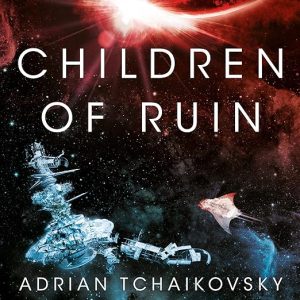
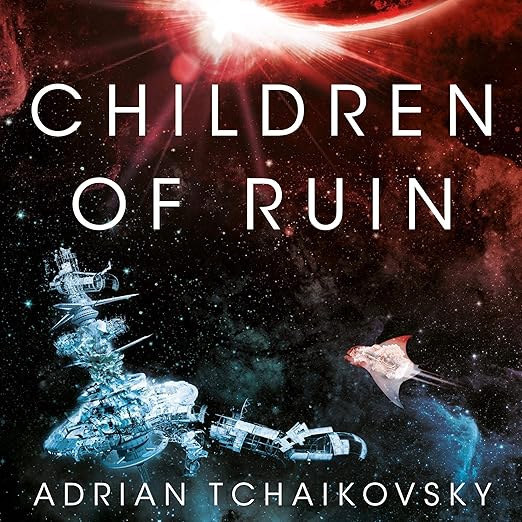
Children of Time was one of the most ambitious science fiction novels I had encountered in years – a genuine successor to the grand tradition of Asimov and Le Guin, with ideas that stayed with me long after I had finished listening. The spider civilisation, the terraformed world, the last remnants of humanity in search of a new home, the collision between incompatible intelligences: these were not just plot elements but philosophical provocations, handled with a seriousness the genre rarely manages at scale. Children of Ruin, the second instalment, had enormous expectations to meet. It largely meets them.
The novel’s greatest achievement is that it does not simply repeat the first book’s structure with new species. Tchaikovsky finds genuinely new territory in the alien intelligence on Nod, which operates along principles so fundamentally different from either human or spider cognition that the encounter becomes genuinely unsettling in ways that are difficult to articulate without revealing too much. Mel Hudson’s narration is superb, sustaining the novel’s considerable structural complexity across fifteen and a half hours.
About the Audiobook
Thousands of years ago, Earth’s terraforming programme took to the stars. On the world they called Nod, scientists discovered alien life – but their mission was to overwrite it with the memory of Earth. Then humanity’s great empire fell, and the programme’s decisions were lost to time. Aeons later, humanity and its new spider allies detected fragmentary radio signals between the stars and dispatched an exploration vessel, hoping to find cousins from old Earth. But those ancient terraformers awoke something on Nod. Something better left undisturbed. And it has been waiting for them.
Children of Ruin follows the extraordinary Children of Time, winner of the Arthur C. Clarke Award. Set in the same universe, with new characters and an original narrative, it continues the story for those who wish to follow it further in Children of Memory. Tchaikovsky’s method – alternating between deep past and near-present timelines, gradually revealing how one produced the other – gives the book the same satisfying structural intelligence as its predecessor. This is book 2 in the Children of Time series. The audiobook runs to 15 hours and 25 minutes.
The Narration
Mel Hudson narrates Children of Ruin, as he did Children of Time, and the continuity is one of the audiobook’s genuine pleasures. Hudson has developed a vocabulary for this fictional universe – the particular vocal register for the spider-human crew, the alien quality he brings to non-human perspectives – that makes the return to this world immediately comfortable. For a novel with multiple species, multiple timelines, and a large cast of characters with varying degrees of humanity, the narration has to function almost as a translation service as well as a performance, and Hudson handles the complexity with impressive fluency. At fifteen and a half hours, this is a substantial listening commitment, but the narration never makes it feel laborious.
What Readers Say
Listener response has been enthusiastic across the seventeen Audible reviews. One called it “a fantastic sequel that expands on everything that made the first book great, while serving a compelling and gorgeous story in its own right.” Another, noting the bar set by Children of Time, described it as “not quite as brilliant as the first one but still very good” – a fair assessment that reflects how extraordinary the original was rather than any significant weakness in the sequel. A third placed it above its predecessor: “Children of Ruin is not just as good as, but even better than its prequel – grand-scale and epic, a feat very few writers can pull off.” The audiobook holds a rating of 4.3 out of 5 on Audible.
A word about the challenge Tchaikovsky sets himself in this series: writing non-human cognition convincingly is among the hardest things a science fiction author can attempt. The easy failure is to make alien minds human minds with cosmetic differences – the same emotional logic, the same linear causality, the same concept of individuality. Tchaikovsky avoids this. The Nod intelligence operates on principles that feel genuinely alien – distributed, recursive, and with a relationship to memory and identity that the human and spider characters struggle to parse. That cognitive difficulty is part of the book’s pleasure, and it requires a reader willing to sit with confusion as the story works towards comprehension.
Who Should Listen?
Anyone who has read or listened to Children of Time should treat this as essential – it expands the universe without diminishing the original. Those new to the series should begin with book one; this is not an entry point, and the emotional payoff depends heavily on knowing the characters and the world. Tchaikovsky demands patience and attention but rewards both generously. Fans of Peter F. Hamilton, Ursula K. Le Guin, or Arthur C. Clarke will find a great deal here to admire. Also available on Kobo and Scribd.