Clara’s Verdict
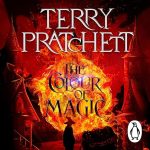
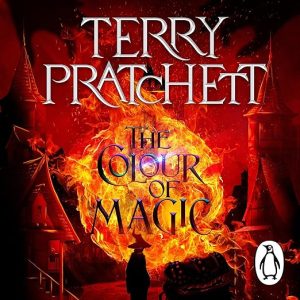
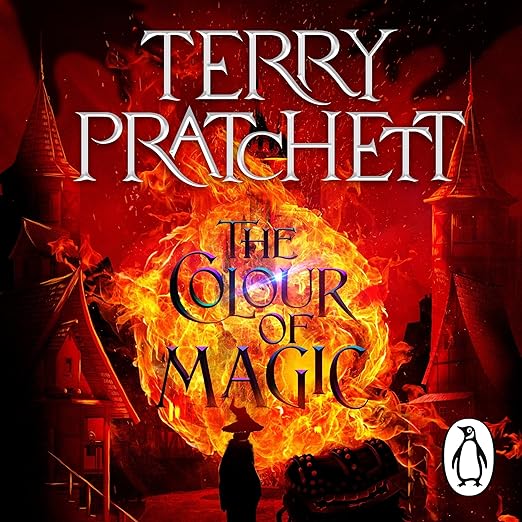
There are books you suspect will reward you and books that simply do – and Terry Pratchett’s The Colour of Magic, the first novel in the Discworld series, belongs firmly in the latter category. I came to Pratchett late, as many literary critics do, with a certain condescension towards comic fantasy that I can only describe as entirely unearned and subsequently embarrassing. The Discworld demolished that position within chapters. This Penguin Audio edition, read by Colin Morgan with Bill Nighy delivering the footnotes and Peter Serafinowicz voicing Death, is something close to definitive – a production that treats the source material with exactly the seriousness it deserves, which is more than it initially appears to require. The 4.4 rating from twenty-seven UK listeners reflects consistent appreciation rather than enthusiasm from a niche audience. If you have not visited the Disc, this is where to begin.
About the Audiobook
The Discworld sits on the backs of four enormous elephants, who stand upon the shell of Great A’Tuin, a star turtle of immeasurable age, drifting through space. This cosmology, which Pratchett delivers with the deadpan certainty of a man reading out a train timetable, is the first indication that you are in the hands of a writer who has thought very carefully about exactly how absurd he is prepared to be, and has decided: completely and without apology.
Rincewind is the world’s worst wizard – a man who has managed to get one spell lodged in his head, driving out everything else, and who has parlayed this spectacular inadequacy into a survival strategy of impressive flexibility. He is assigned, against his considerable better judgement, to look after Twoflower: the Disc’s first tourist, arriving from the Agatean Empire with boundless enthusiasm, a sentient magical chest full of legs, and no understanding whatsoever of how dangerous everywhere on the Disc actually is. The tourist as the person most dangerous to himself and everyone around him is not the most original satirical premise, but Pratchett executes it with such density of invention that the familiarity never becomes a problem.
What follows is a picaresque adventure through robbers, dragons, mercenaries, incompetent heroes, and the gods who watch the Disc as a kind of board game, occasionally cheating with the pieces. The satire cuts in multiple directions simultaneously – at heroic fantasy conventions, at bureaucracy, at the nature of religion and fate and heroism – but it never becomes lecture. Pratchett’s great gift is that the comedy and the philosophy are so thoroughly interwoven that you genuinely cannot separate them. The jokes are the argument.
Published in 1983, this is the beginning of a forty-one-novel sequence. Some elements of the Discworld universe reflect that early vintage and the series deepens considerably as it progresses. But this first entry is essential for understanding the world and the writer’s intentions.
The Narration
Colin Morgan brings a wiry energy to Rincewind that is precisely right – the voice of a man permanently one step ahead of catastrophe and none too pleased about it. Bill Nighy’s reading of the footnotes is, frankly, a separate pleasure; Pratchett’s annotations are often as good as the main text, and having an actor of Nighy’s calibre deliver them with impeccable comic timing elevates an already exceptional production. Peter Serafinowicz as Death – speaking in the flat, factual capitals that the character uses throughout the series – adds genuine menace beneath the comedy. James Hannigan’s composed theme music completes a production that has been assembled with real love for the material. This is what audiobook production looks like when everyone involved cares deeply about the source.
What Readers Say
The Colour of Magic holds a 4.4 out of 5 from twenty-seven UK listeners. Reviewers described it as a page-turner from the beginning, praised Pratchett as “a master of language, analogy and subtle sarcastic humour,” and noted the density and delight of its world-building. One listener who had been reluctant to try fantasy described it as very easy to progress through and immediately recommended. Another wrote at length about the book’s capacity for comedy, philosophy, and genuine heart. A reader who bought it over a decade ago and kept failing to begin it described finally reading it on holiday as a decision that produced one of the great reading experiences of their adult life. The Guardian’s assessment – “If you’ve never read a Discworld novel, what’s the matter with you?” – remains the most efficient possible summary.
Who Should Listen?
Anyone who has been told they would enjoy Pratchett and has been putting it off. Anyone who finds most fantasy too earnest about itself. Anyone who enjoys satire that is also genuinely funny rather than merely clever. Anyone who appreciates the comedy of incompetence rendered at cosmic scale. Anyone, in short, with a functioning imagination and a sense of humour. Forty more Discworld novels await after this one. That is either a promise or a warning, depending on your relationship with your other commitments.
Find The Colour of Magic on Audible UK, and on Kobo, Scribd, and Storytel.