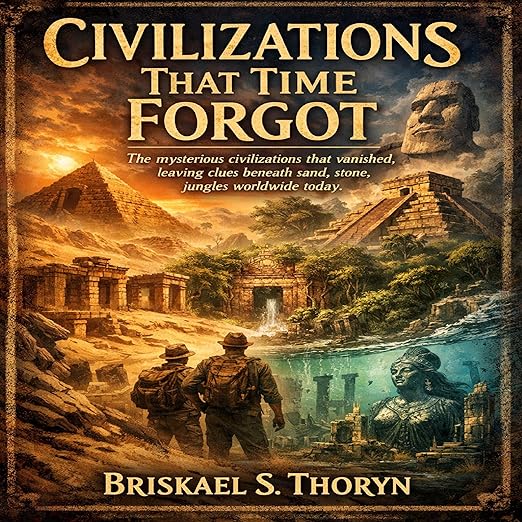
Clara’s Verdict
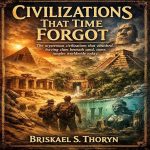
There is something quietly thrilling about a book that promises to restore what history has erased. I came to Civilizations That Time Forgot on a grey Tuesday afternoon, looking for something that would pull me out of the relentlessly present-tense news cycle and into a longer view of human affairs. Briskael S. Thoryn delivers exactly that: a survey of societies that flourished, built, believed, and then vanished from the mainstream record. Not because they were unimportant, but because the victors of subsequent eras had little interest in preserving their memory.
This is popular archaeology and history at its most accessible. It does not pretend to be academic rigour, and that is precisely its strength. The writing is engaged, the structure is episodic enough to suit listening in short bursts, and the underlying argument about the radical incompleteness of conventional civilisational history is one that deserves a wide audience. For a three-hour listen, it carries genuine intellectual weight.
About the Audiobook
Each chapter in Civilizations That Time Forgot functions as a self-contained portrait of a lost society. Thoryn moves through forgotten empires and vanished kingdoms, tracing the arc from rise to disappearance and asking, with evident curiosity, what each society built and why it ultimately ceased to exist. The framing is deliberately humanising: rather than cataloguing ruins and dates, Thoryn reconstructs daily life in these worlds. The farmer, the artisan, the ruler, the family who lived through the same anxieties and celebrations that define any human community, regardless of era or geography.
The book draws on archaeological discoveries and historical analysis rather than speculative reconstruction, which keeps it grounded. Thoryn is particularly interested in civilisations whose contributions to architecture, governance, religious practice, and cultural innovation influenced later societies in ways that have not been properly credited. There is an implicit argument running through the text about how the mainstream story of civilisation has been shaped by the selective survival of sources, and what we lose when we accept that version uncritically.
These are not merely ancient ruins or forgotten names, as the synopsis wisely insists. They are complete worlds that shaped the development of humanity in ways we are still discovering. The book moves from desert empires to hidden valley kingdoms, from advanced urban centres to seafaring cultures whose reach was far wider than later histories acknowledged. At just over three hours, this is not an exhaustive treatment of any single lost civilisation. It is a survey designed to open doors rather than close them. Listeners who find themselves wanting more on any particular society will need to follow up with specialist reading, but as an introduction to the breadth of human achievement beyond the canonical classical civilisations, it is well-constructed and consistently engaging.
One of the book’s recurring pleasures is the way Thoryn handles the mystery of disappearance without retreating into sensationalism. The collapses of these societies are presented as complex, multi-causal events rather than dramatic catastrophes, which is both more historically honest and more intellectually interesting. Climate shifts, trade route changes, internal political fragmentation, external pressure: the causes vary, and Thoryn traces them with the patience they deserve.
The Narration
Eddie Leonard Jr. brings a measured, authoritative quality to the narration that suits the material well. His delivery is clear and unhurried, which is important for a subject that requires listeners to hold unfamiliar names and geographical contexts in mind. He does not over-dramatise, which is the right call: the material is genuinely interesting without needing theatrical embellishment. The pacing allows for absorption rather than performance, and Leonard’s voice carries the quiet sense of discovery that Thoryn’s writing aims for. There is a quality of considered intelligence in the reading that makes this feel like a well-researched documentary rather than an audiobook read against a deadline. A solid, professional performance that serves the text with real intelligence.
What Readers Say
As of its March 2026 release, Civilizations That Time Forgot has not yet accumulated a body of listener reviews on Audible UK, which is not unusual for a newly published independent title. The absence of ratings should not be mistaken for indifference. Titles in the popular history and archaeology space often build their audience gradually through word of mouth and recommendation rather than through front-page chart performance. The quality of the content and the professionalism of the production suggest this will find its readers in time. The subject matter, lost and underrepresented civilisations, has a consistently enthusiastic audience in the UK, as anyone who has watched the popularity of programmes like Time Team and the ongoing public appetite for alternative histories will recognise.
Who Should Listen?
This audiobook will suit listeners who enjoy popular history, particularly those drawn to the ancient world, archaeology, and the edges of the historical record. If you have spent time with titles like Sapiens by Yuval Noah Harari or any of the more accessible Osprey popular history series and find yourself wanting to explore what conventional history tends to overlook, this is a natural next listen. It works well in short sessions during a commute or an afternoon walk. It is not for specialists seeking academic depth, but for the curious generalist with an appetite for the overlooked and the underrepresented, it is a rewarding three hours.