Clara’s Verdict
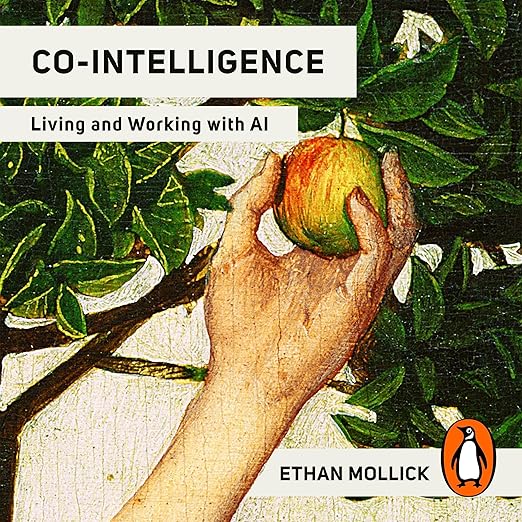
I’ve read more books about artificial intelligence in the past two years than I care to count, and the vast majority fall into one of two camps: breathless evangelism promising that AI will solve everything, or catastrophist hand-wringing insisting it will destroy everything. Ethan Mollick’s Co-Intelligence sits in neither camp, which is its greatest virtue. Mollick, a professor at the Wharton School who has spent years studying how people actually use AI tools in practice, writes with the measured confidence of someone who has done the experiments rather than merely theorised. The result is the most practically useful book about AI I’ve encountered – and at under five hours, it respects your time in a way that many of its rivals do not.
This is the book I’d give to anyone who has heard a lot about AI, isn’t quite sure what to do about it, and is tired of being either excited or frightened on command.
About the Audiobook
Mollick’s central argument is that AI should be treated as a collaborator – a co-worker, co-teacher, and thinking partner – rather than either a threat to be feared or merely a tool to be wielded. He urges active, experimental engagement: bring these systems into your work, learn their capabilities and limitations through practice, treat them as what he calls a “brilliant friend” who has expertise across an enormous range of fields and is available at any hour.
What distinguishes the book is its practical specificity. Mollick doesn’t traffic in abstractions. He shows how AI changes the economics of creative work – collapsing the cost of producing a first draft, a prototype, a plan – and how this disrupts traditional hierarchies of expertise. He addresses how educators can use AI as a personalised tutor rather than treating it as a cheating tool. He examines how managers and knowledge workers can amplify their own capabilities rather than worrying about displacement.
The writing is jargon-free without being simplistic. Mollick trusts his readers to engage with genuine complexity, which is refreshing in a field that often condescends to general audiences. The book also engages seriously with the ethics and genuine uncertainties of the AI moment – risks of overreliance, misinformation, employment disruption – but without allowing those anxieties to overwhelm the practical core. It is balanced in the way that good journalism is balanced: fair to complexity, committed to clarity.
One of the book’s most useful contributions is its treatment of what Mollick calls the “Jagged Frontier” – the counterintuitive observation that AI excels in some areas where humans expect it to struggle and fails in areas where humans expect it to succeed. Understanding this frontier is essential for anyone trying to integrate AI meaningfully into their work rather than deploying it everywhere or dismissing it altogether. Mollick provides a practical framework for mapping your own frontier through experimentation. A limited amount of text-to-speech is used throughout the audio for specific creative effect – a nice meta-touch given the subject matter.
The Narration
Mollick narrates his own book, which is often a gamble but pays off here. He has a natural academic storytelling cadence – conversational and warm, the voice of someone who genuinely enjoys thinking about these questions and wants you to share that enjoyment. He reads at a pace that gives ideas room to land without becoming ponderous. Having the author read creates an intimacy and intellectual authority that a hired narrator would struggle to replicate: you’re getting the thinking, not just the words.
What Readers Say
Rated 4.5 out of 5 from Audible reviews. “Co-Intelligence doesn’t shout. It teaches,” wrote one listener. “With a tone that’s grounded, encouraging, and refreshingly jargon-free, it gives you the context and confidence to step in.” Others call it “one of the best AI books I’ve read,” praising the optimistic framing and accessible prose. One more critical voice found the future scenarios “rushed and trite” – fair for a compact book covering wide ground. Angela Duckworth called it “the very best book I know about the ins, outs, and ethics of generative AI.” That’s a strong endorsement from a credible source.
Who Should Listen?
Essential listening for anyone – creative professional, educator, entrepreneur, knowledge worker, curious bystander – navigating the AI transition and wanting a grounded, evidence-based guide rather than hype or doom. Particularly valuable for those who feel left behind by the pace of change and want to catch up without wading through technical literature.
For those wondering whether the book has dated since its 2024 publication – AI moves fast – the answer is that Mollick’s framework is deliberately principle-based rather than product-specific. He’s not writing about ChatGPT or Claude in particular; he’s writing about how to think about AI-assisted work, how to evaluate AI output, and how to maintain the human skills that AI cannot replicate. That framework remains useful regardless of which specific models are available when you’re reading, and is likely to remain useful for several years yet.
Find it on Audible UK and on Scribd for subscribers.