Clara’s Verdict
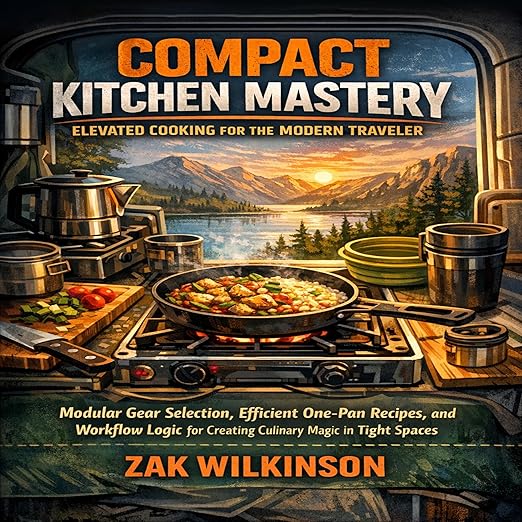
I will be straightforward: this is a short audiobook from a self-published author in a category that has become genuinely crowded on the major platforms. At just over an hour in length, Compact Kitchen Mastery by Zak Wilkinson promises a great deal – an exhaustive, closely reasoned guide to kitchen engineering, no less – while delivering something more modest. But modest is not without value. If you have ever stood in a holiday rental kitchen, or a boat galley, or a bedsit so small the fridge doubles as a counter, and felt the familiar sinking sensation of trying to cook properly with inadequate kit, then the core premise here speaks directly to your experience.
The subtitle mentions the modern traveller, but the content is broader than that: Wilkinson is really addressing anyone who cooks in a constrained space and wants that space to work better. The philosophical framing in the synopsis – kitchen as system, minimalism as strategy rather than aesthetic – is genuinely interesting, and it is present in the audio too. Whether there is enough practical depth in sixty-one minutes to justify the ambition is a fair question, but the intentions are honest and the listening experience is not unpleasant.
About the Audiobook
The book opens with what Wilkinson calls soul-searching and intentionality – an examination of why kitchens accumulate dysfunction, and why most decluttering guides fail to address the underlying psychology of kitchen acquisition. The single-use gadget is his recurring villain: the spiraliser, the popcorn maker, the panini press that has not been used since 2019 but takes up a third of the worktop. His argument is that cooking friction – the sense of resistance that makes you reach for a ready meal instead of actually cooking – is less about skill or motivation than about workspace design. Fix the workspace and you fix the behaviour.
The structure moves from philosophy to practice: identifying which tools genuinely earn their place, organising storage for efficiency rather than appearance, and building cooking habits that mesh with a streamlined environment. For galley-style cooking in particular, the material on spatial sequencing is useful – thinking about where things live in relation to where they are used, rather than where they fit.
The title was published in March 2026 under the HARVEY ETHAN WILSON imprint, and carries no reader reviews at time of writing. That is a limitation for any assessment, and with a runtime of just over an hour the margin for disappointment is low – but so is the investment.
The Narration
Herold James narrates, and does so with a pleasant, conversational ease that suits the tone of the material. This is not a book that requires dramatic range or emotional depth; it requires clarity and a sense that the speaker knows what they are talking about. James brings both. There is an approachability to the delivery that keeps the philosophical sections from feeling ponderous, and the practical passages from feeling like a shopping list read aloud. For a sub-hour listen, the narration more than holds its end.
What Readers Say
No listener reviews are available at time of writing, which is unsurprising given the very recent release date of 27 March 2026. This makes any confident verdict impossible to anchor in community consensus. The personal finance and productivity shelf has conditioned many listeners to expect either a quick-win promise or a radical minimalism manifesto; Wilkinson offers neither, which may actually work in his favour with a more practically minded audience. His framing of the kitchen as an evolving system rather than a static space is a genuinely useful mental model, and one that this listener found sticking around after the listen ended.
What can be said is that the production quality is clean, the argument is coherent for its stated scope, and for a listener with a specific practical problem – cooking better in a smaller space – the ideas are actionable enough to be worth an hour of your time. The absence of reviews is simply a function of newness, not quality.
Who Should Listen?
This is for the boat owner, the van lifer, the flat-sharer with a studio kitchen, or the remote worker who has finally accepted that the Airbnb they booked for a month has approximately two functional hob burners and good intentions. It is also for the compulsive kitchen-gadget buyer who suspects the answer to cooking more is not another appliance, and for anyone who has looked at their kitchen and felt not culinary ambition but something closer to logistical despair.
It is not for experienced cooks looking for technique, and it is not a recipe book. The title does not teach you how to cook – it teaches you how to stop your kitchen from making cooking harder than it needs to be. That is a more modest goal than the subtitle implies, but it is a genuinely useful one. Think of it as a planning tool rather than a cooking guide, and it earns its place. If after an hour you have identified three things currently living on your worktop that have no right to be there, the audiobook has done its job.