Clara’s Verdict
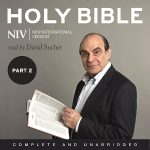
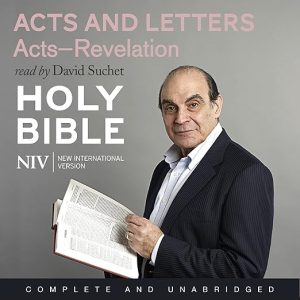
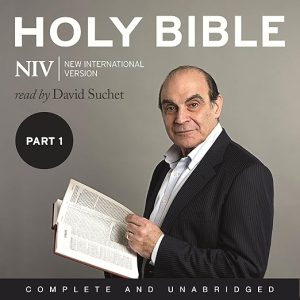
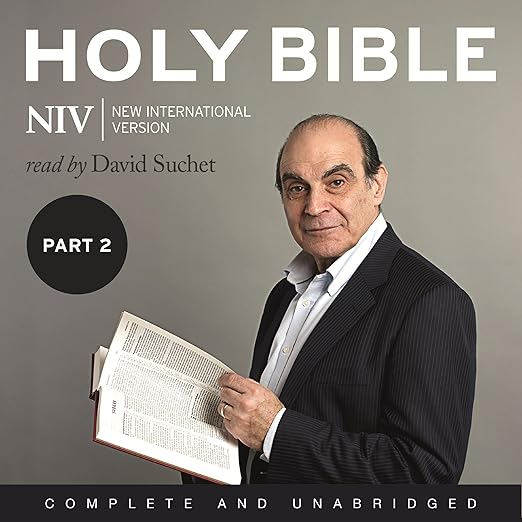
David Suchet spent more than two hundred hours in the recording studio to create this, in between filming the final episodes of Poirot, which is a detail I find quietly extraordinary. The result is the first complete audio version of the NIV Bible spoken by a single British actor, and whether or not the text itself forms part of your reading life, the achievement as a performance project is substantial. Volume 2 covers the Prophets, Gospels, Acts and Letters — from Isaiah through to Revelation — across thirty-seven hours and twenty-two minutes. Suchet, as the recording makes clear, approached this project as a matter of personal faith as much as professional craft; he has spoken elsewhere about how his Christian conversion at the age of forty made this his most meaningful professional undertaking.
About the Audiobook
The New International Version is one of the most widely used modern English translations of the Bible, and its language aims at clarity and accessibility rather than the archaic grandeur of the King James Version. For an audio project, this is the correct choice: NIV reads aloud in a way that KJV, beautiful as it is on the page, does not always sustain across extended listening. The modern syntax and vocabulary give the reading a directness that serves devotional listening particularly well.
Volume 2 is the more varied of the two volumes in terms of literary register. The prophetic books of the Old Testament, with their poetry and their denunciations, make different demands on a reader than the narrative immediacy of the Gospels or the dense argumentative structure of Paul’s letters. Suchet navigates these transitions with the intelligence you would expect from a career in classical performance. He does not flatten the differences between texts; he responds to them.
One practical limitation emerges repeatedly in the listener reviews, and it is worth knowing about before you purchase: the absence of navigable chapter markers makes this a frustrating resource for anyone wanting to use the recording as a study tool. You cannot search for a specific book or chapter; you must listen sequentially, or use the timestamp to approximate a position. For devotional or reflective listening — background listening in the home, long drives, meditative engagement with a familiar text — this matters less. For structured Bible study, it is a significant obstacle, and the lower ratings in the review record reflect specifically this production problem rather than any criticism of Suchet’s performance.
The Narration
Suchet’s voice is, as Paul Campbell writes here with obvious feeling, “like liquid gold.” His approach emphasises clarity and measured emphasis over dramatic performance: he is reading the scripture rather than acting it out, a choice that one reviewer contrasts favourably with American recordings that use background music and character acting. The effect is that Suchet’s reading functions as a transparent medium, allowing the text to carry its own weight. For listeners for whom the Bible carries profound personal significance, this restraint is exactly right. It gives the words space to land.
What Readers Say
The response is genuinely mixed, and the mixture is instructive. W.I.G., who identifies as dyslexic, described the recording as “a brilliant way to study the bible” and praised both the pace and the calming quality of Suchet’s delivery: “Even the tone of his voice is somewhat calming.” Paul Campbell praised the absence of dramatic embellishment, noting that Suchet “could probably read the meter and make it sound interesting.” Himynameis praised the emphasis “without dramatic tendencies” and said it is “great to have on in the house or car.” The critical reviews, however, focus almost entirely on the navigation problem. Sam called it “useless without chapters,” giving it one star. Malc Peirce agreed: “you can’t search for Bible chapters. It’s almost useless as a study resource.” Across fifteen ratings, it holds a 3.2 average — pulled down significantly by a practical production problem rather than any reflection on Suchet’s performance.
Who Should Listen?
This is the recording for devotional listeners who want to experience the scriptures as a sustained, reflective audio presence: for long drives, for background listening at home, for the pleasure of hearing a significant text read with care and intelligence by one of the finest British actors of his generation. It is not the recording for structured Bible study; the chapter navigation limitations are a genuine impediment and worth knowing about before you commit. Suchet’s performance is, within its frame, genuinely moving. If you approach it as a devotional companion rather than a reference tool, it rewards handsomely.