Clara’s Verdict
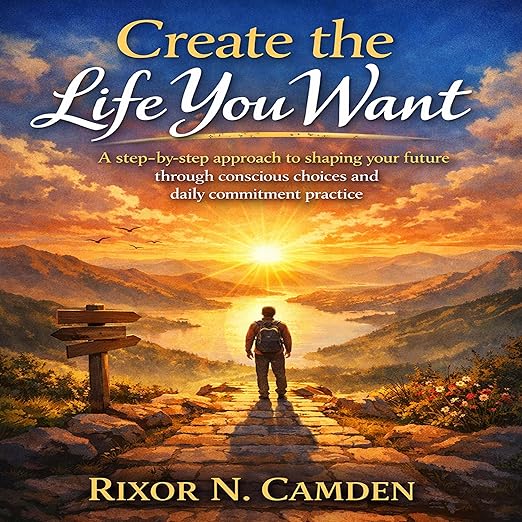
The personal development shelf is crowded with books that promise transformation and deliver platitudes, and I approach new entries in the genre with the wariness of someone who has been disappointed there more times than I can count. Create the Life You Want by Rixor N. Camden is a more honest proposition than most of its neighbours. It does not promise to change your life in a weekend. It does not traffic in the language of epiphany and radical reinvention. What it offers instead is a structured, practical framework for people who are genuinely ready to take stock of where they are, clarify what they actually want, and make deliberate choices about how to get there.
That’s a more modest claim, and the book is better for it. At just over three hours, it is short enough to listen to in a single sitting – which is, I suspect, the right format for this kind of reflective content. The goal is not to accumulate a long book’s worth of inspiration but to work through a structured process, and three hours is a better duration for that than twelve.
About the Audiobook
Published in February 2026, this is a self-directed guide built around three interconnected ideas: clarity, responsibility, and execution. Camden’s central argument is both familiar and useful – most people who are dissatisfied with their circumstances are not short of capability but of clarity, and the gap between intention and outcome is almost always a thinking problem before it’s an action problem. The book’s structured process works through identifying your actual values (rather than the ones you’ve absorbed from your environment), defining goals that genuinely align with those values, and then building daily actions and systems that make progress the path of least resistance rather than a constant act of will.
What distinguishes it from genre peers is the attention Camden pays to the friction points: indecision, fear of failure, the specific mechanics of lack of follow-through. These are not treated as character flaws requiring motivational correction but as predictable, structural obstacles with identifiable responses. The sections on habit formation, mindset under adversity, and the role of healthy boundaries in sustaining progress are practical without being prescriptive – Camden offers frameworks and principles rather than protocols, which makes them more transferable to individual circumstances.
The reflective exercises embedded in each chapter work particularly well in audio format. The instruction to pause, consider a specific question, and then continue creates a listening experience that is more interactive than most non-fiction audio, and Camden seems to have thought carefully about how the material lands differently when heard rather than read. The emphasis throughout is on building systems for sustained progress rather than capitalising on a motivational spike that will fade within a week.
One element I found particularly useful is Camden’s treatment of the relationship between values and decisions. Most people, when asked what they value, will produce a list of approved abstractions – family, health, honesty, creativity – that doesn’t actually match how they spend their time or what they do when under pressure. Camden is careful about this gap: the exercise of identifying your actual values, rather than your aspirational ones, is genuinely uncomfortable and genuinely productive, and the book gives it more space than most comparable works manage.
The Narration
Robyn Green narrates with a warm, measured delivery that suits the material well. This is the kind of book that benefits from a voice that sounds as though it is in genuine conversation with you rather than performing content at you, and Green achieves that quality throughout. The pacing is deliberately calm – giving the more reflective passages room to land, allowing the listener time to process rather than simply accumulate information. At three hours and two minutes, the listen feels complete rather than truncated, which is a harder balance to achieve than it appears when the content is this stripped-back.
What Readers Say
As a February 2026 release, listener reviews are still gathering. The early response suggests that Camden’s direct, unglamorous approach has resonated with readers who have grown tired of the motivational-speaker register that dominates much of the genre. The practical frameworks have been highlighted as the book’s main strength – specific enough to apply in real situations, flexible enough to adapt across different individual circumstances and life stages. Several listeners have noted returning to specific chapters during periods of professional transition, which suggests the content holds up under repeated use rather than simply sounding compelling on first encounter.
Who Should Listen?
Best suited to people at a genuine crossroads – a career change, a post-redundancy reset, a period of reassessment after significant life change, or simply a growing sense that the direction of travel is wrong but the destination isn’t yet clear. Also useful for those who have read plenty of motivational literature and found it energising in the moment but difficult to translate into sustained behaviour change: Camden’s approach is operational rather than inspirational, which will appeal to some listeners and feel insufficiently warm for others. If you want a framework rather than a pep talk, this is three well-spent hours.
Listen to Create the Life You Want on Audible UK – also available on Kobo, Scribd, and Storytel.