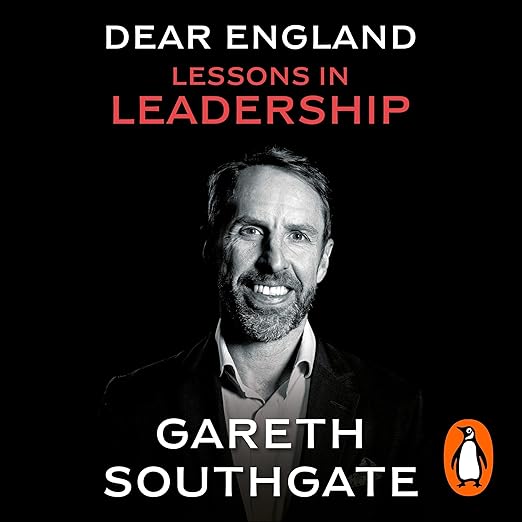
Clara’s Verdict
Leadership books written by sportspeople tend to follow a predictable template: adversity, discipline, teamwork, resilience – the usual nouns arranged in the usual order, with the usual story of how early failure became late triumph. Gareth Southgate’s Dear England: Lessons in Leadership breaks that mould almost immediately, and does so because Southgate is not, at heart, a sporting autobiographer. He is a thoughtful person who has spent decades in some of the highest-pressure public roles available in this country, and who has done the serious inner work of understanding himself – his strengths, his failures, his values, and the ways in which each has shaped his leadership. Read by Southgate himself across nine and a half hours, this is one of the more honest books about leadership I’ve encountered in recent years.
The Guardian called it “compelling, entertaining” and noted that Southgate “articulated a moral vision beyond anything attempted by a generation of British politicians.” That’s not hyperbole. It’s accurate.
About the Audiobook
Published by Penguin in November 2025, Dear England covers Southgate’s full arc: his early career as a Premier League captain, the missed penalty at Euro 96 that became his defining public moment for years, his deliberate work building resilience from that experience, and then his eight years as England manager – guiding the team to four consecutive major tournament deep runs, including two European Championship finals in 2020 and 2024. Along the way, he reflects on his pandemic open letter to young people that inspired a West End play, and on the challenge of leading an increasingly diverse squad in an era of social media intensity, instant public judgement, and relentless scrutiny.
What makes this valuable beyond its football context is Southgate’s willingness to describe the internal landscape of leadership with genuine honesty: the loneliness of decisions that can’t be explained, the difficulty of building collective values in a group of competitive individuals, the need to construct culture rather than simply capability. The chapters on transforming England’s squad – from a collection of talented but divided individuals into something with real collective identity and shared purpose – are particularly instructive. Southgate draws on psychology, on conversations with coaches from other sports and disciplines, and on his own hard-won experience. The result applies far beyond football.
The Narration
Southgate reads his own book, and the effect is both intimate and unexpectedly moving. His voice has a quality of quiet conviction – he’s not performing authority; he’s simply being himself, which turns out to be compelling in its own right. The more vulnerable passages, particularly around Euro 96 and the racially abusive aftermath of Euro 2020, are delivered with a restraint that gives them considerable weight. At nine hours and thirty-one minutes, it never drags, and the authorial narration means you’re always in the presence of the man who actually lived these decisions.
What Readers Say
Holding a 4.5 out of 5 from 116 Audible UK listeners, the response has been warmly enthusiastic across a striking range of audiences. Readers note consistently that this is “much more than a sports book – it is a management book that many can learn from in all walks of life.” One reviewer called it “a masterclass in defining, educating and encouraging leadership, explained through the medium of an intensive role that we only saw from the outside.” Another appreciated the “refreshingly honest reflections” and found “lots of food for thought and actionable insight,” praising in particular the closing emphasis on mentorship. One reader gave it to her son for Christmas and reported he was “delighted” – which is a small but genuine data point about the book’s cross-generational appeal.
Who Should Listen?
This sits at the intersection of sports memoir, leadership writing, and personal development – and it belongs in all three sections. Football fans will find the inside account of England’s recent tournament campaigns fascinating; readers with no interest in football will find Southgate’s framework for leading under sustained pressure entirely transferable to any high-stakes environment. It sits comfortably alongside books by Phil Jackson, Alex Ferguson, or Matthew Syed for anyone building a serious leadership library, and would translate well to book clubs and professional development contexts. One of the year’s more unexpectedly important reads.
Lead with purpose – listen to Dear England on Audible UK.