Clara’s Verdict
I read a great deal about artificial intelligence – it comes with the territory when you’re reviewing audiobooks in 2026 – and most of what I read falls into one of two failure modes. Either it is credulous hype that treats the technology as the inevitable saviour of human potential, or it is reflexive doom-mongering that treats it as the inevitable end of everything. Ronee Hulk’s Dear Future belongs to neither camp. It is genuinely thoughtful, often genuinely unsettling, and – unusually for this genre – it is also genuinely well-written.
At just over five and a half hours it is a lean and purposeful listen. Bill Lancz narrates with a clarity that suits the material perfectly. I came away from it feeling that I had learned something real, and also that I needed to go for a long walk and think. That combination is rather the point.
About the Audiobook
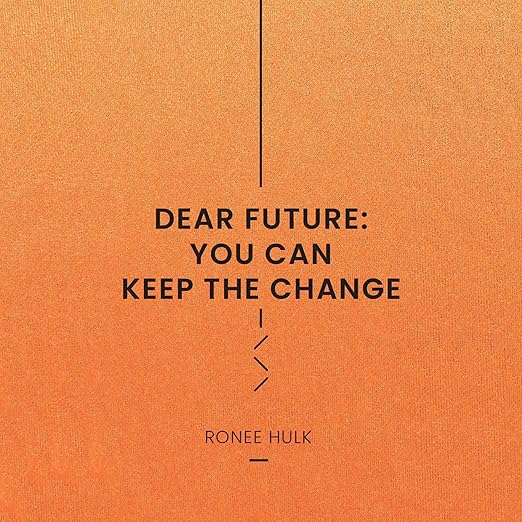
Dear Future: You Can Keep The Change runs to 5 hours and 37 minutes, published by Ronee Hulk in December 2025. Hulk blends philosophy, technology, economics and something approaching literary essay in a sustained examination of what artificial intelligence is doing to the systems – economic, social, cultural, political – that we have built to define human value.
The organising question is stark: what becomes of humanity when value no longer requires human beings? Hulk applies this across domains including medicine, education, art, love and power, returning to it repeatedly rather than resolving it too quickly. Chapters deal with automation’s effect on labour, with algorithms replacing human judgement, with the hollowing-out of creativity, and with the more intimate question of what it means to be a person in a world that can simulate personhood convincingly.
Hulk is not a technologist writing outside her field, nor is she a humanist writing in ignorance of the technical realities. The synthesis is what makes the book valuable: she holds both the how and the why in the same frame, and her prose – poetic in places without ever losing rigour – carries the argument with unusual grace.
The Narration
Bill Lancz reads with an intelligence that matches the text. This is not a book that benefits from performative narration – the ideas carry their own weight, and Lancz understands that his job is clarity and pacing, not dramatisation. He gives each chapter room to breathe without allowing the listener to drift, which is the right call for material that rewards active engagement rather than passive consumption.
At under six hours, the narration is efficiently deployed. There is no padding here.
What Readers Say
Dear Future carries a 5.0-star rating from 11 UK listeners – a small but vocal and clearly impressed readership. Ian Watt called it “one of the best books I’ve read this year” and praised it as “a great distillation of many experts’ thoughts on the current state of AI and the likely future it brings to humanity.” DW called it “the best book on AI I’ve read – insanely readable, brilliantly clear.” Chris Metcalfe admitted to finding it “scary and depressing” but also “gripping.” Ash offered perhaps the most useful framing: “well researched and well written about an extremely important topic… I agree with the broad conclusion: to get on with human life.”
Who Should Listen?
Anyone who thinks about technology and society and wants something more considered than the usual polarised debate. Readers who have enjoyed Kate Crawford’s Atlas of AI, or Kai-Fu Lee and Chen Qiufan’s AI 2041, will find this a useful addition to the conversation. Also, anyone currently working in a field that automation is reshaping – which is, increasingly, most fields.
Listen to Dear Future on Audible UK – and then decide what you’re going to do about it.