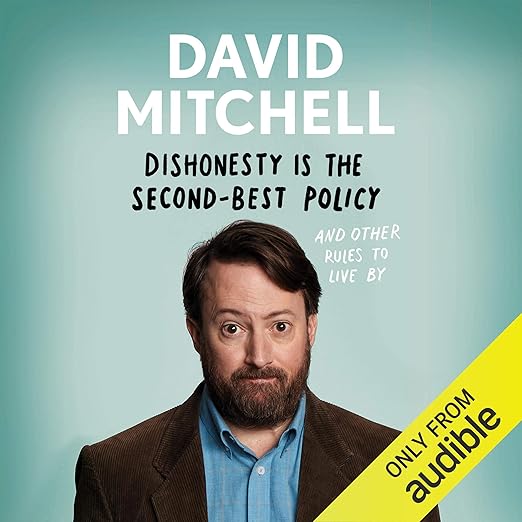
Clara’s Verdict
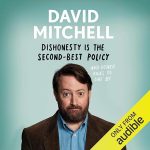
David Mitchell – the comedian, essayist, and professional curmudgeon; emphatically not the novelist – is one of the most distinctive voices in British public life, and his collections of essays translate to audio with ridiculous ease. Dishonesty Is the Second-Best Policy is the follow-up to his 2014 bestseller Thinking About It Only Makes It Worse, and it covers the years of maximum British bewilderment: Brexit, Trump, the slow collapse of various institutions that Mitchell holds dear while also being rather sceptical about. Rated 4.2 stars from Audible listeners, this 8-hour 11-minute collection is the audiobook equivalent of an extended Mitchell monologue – which, if you know what that means and enjoy it, tells you everything you need to know about whether to listen. If you don’t know what that means, Dishonesty is a generous and funny introduction.
About the audiobook
Mitchell has described his own approach to column writing as “chit-chat applied with a laser,” which is a surprisingly accurate self-assessment. The range of subjects in this collection is characteristically eclectic: scampi, the Olympics, terrorism, exercise, rude street names, inheritance tax, salad cream, proportional representation, the commercialisation of Christmas, the spirit of Halloween – and, pervasively, Brexit. The connecting intellectual thread is Mitchell’s particular brand of English sensibility: a deep suspicion of change for its own sake, a genuine attachment to institutions that actually function, and an almost physical discomfort with hypocrisy in public life.
The Brexit material occupies a significant portion of the collection, and several reviewers note that it has acquired additional emotional weight in the years since the 2019 publication. Mitchell was, notoriously, a committed Remainer – but his Remain position was never starry-eyed about the EU or contemptuous of those who voted otherwise, and the essays on the subject are better for that nuance. The collection was published by Audible Studios in November 2019, capturing a particular moment of British exhaustion, and its interest as a cultural document has grown rather than diminished since.
What makes Mitchell worth returning to – and Dishonesty rewards rereading, or re-listening – is the quality of the prose underneath the apparent informality. He writes sentences that unfold in directions you don’t anticipate, that build their comic momentum across several subordinate clauses, that arrive at their conclusions with an almost mathematical satisfaction. This is harder than it looks, and funnier than it sounds described in the abstract.
The narration
Mitchell reads his own essays, and this is the only version of these texts that fully works. His delivery – the slightly too-fast pace, the increasing incredulity as each argument builds towards its conclusion, the theatrical pauses before particularly baroque sentences – is as much part of the experience as the words themselves. Several reviewers note explicitly that his voice is as distinctive in performance as it is in print, but that hearing him read removes any ambiguity about where the emphasis and the irony are meant to fall. As one listener put it: “He’s in the room with you.” The 8 hours and 11 minutes feel, by the end, like a very good evening at the pub with someone you are slightly in awe of.
What readers say
The 4.2-star average from Audible listeners reveals something useful about the book’s specific audience. One UK reviewer called it “hilarious for the over-50s – David rants like the rest of us as though he is down the pub; the writing is intellectual and the results are very funny.” Another described Mitchell as “a bit Marmite – you either like him or you don’t. I do,” adding that the monologue style works as well in print as in his television appearances. A third found it “truthful, poignant at times, with humour – a very enjoyable read.” The single more critical voice noted it “becomes overly pedantic,” which is both fair as a description and entirely beside the point as a criticism: pedantry is Mitchell’s primary raw material, and it is deployed on purpose.
Who should listen?
Mitchell’s ideal listener is someone who remembers when public discourse had slightly better manners and misses it – without being too earnest or nostalgic about it. Probably between 35 and 65, probably a reader of the Observer or the New Statesman, possibly someone who found both sides of the Brexit argument alternately compelling and maddening. If you enjoyed Thinking About It Only Makes It Worse, this is essential. If you enjoy his Would I Lie to You? monologues or his column in the Observer Magazine, this is those monologues in written form at considerable length. Not recommended for anyone who finds considered, formally structured pedantry genuinely unfunny – you will not be converted here, and that’s fine.
Listen to Dishonesty Is the Second-Best Policy on Audible UK – 8 hours in the company of Britain’s most thoughtful and thorough complainer.