Clara’s Verdict
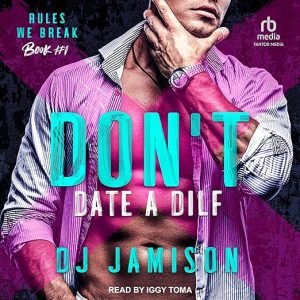
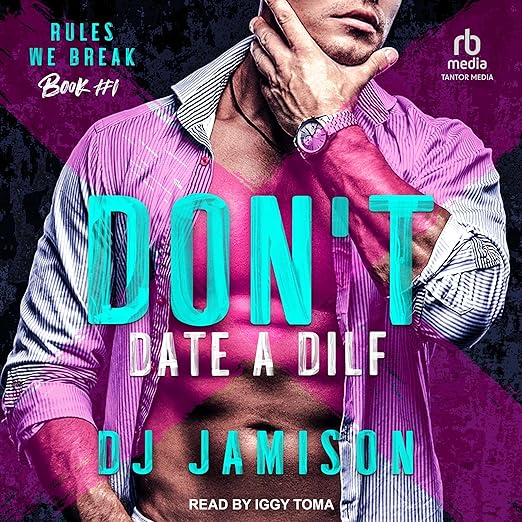
The fake-relationship trope has been worked hard in romance fiction over the past decade, but DJ Jamison brings genuine freshness to it in Don’t Date a DILF – the first book in the Rules We Break in Granville series, a spin-off from the Games We Play series. What elevates this above the average fake-dating setup is the specificity of its emotional stakes. Clarke, the teacher protagonist, has very good reasons for his ironclad rule about keeping professional and personal life separate, and Jamison takes those reasons seriously rather than treating them as mere plot obstacles to be cheerfully dismantled. The result is a romance that earns its happily-ever-after rather than simply arriving at it.
This is warm, funny, and genuinely thoughtful MM romance, and an excellent beginning to what promises to be a strong series.
About the Audiobook
Clarke is a history teacher with one self-imposed rule: never date a DILF. He’s seen the complications of blurring the boundary between professional and personal, and he has no intention of making that mistake. Then Hunter Rhodes walks into his school – broad-shouldered, caring, an apparently straight man recently returned to his hometown with his young son Toby after a marriage breakdown. Clarke doesn’t count on any of this, and he particularly doesn’t count on Hunter deciding that he wants him.
The fake-relationship scheme that develops is engineered partly by Clarke’s enthusiastically matchmaking grandmother – one of the best supporting characters in recent romance fiction – and partly by the social pressure of small-town Granville, where half the single women seem to have Hunter in their sights. The arrangement offers both men a tactical reprieve. The difficulty, naturally, is that separating pretend feelings from real ones turns out to be considerably harder than anticipated.
The small-town setting does what good small-town settings do: it creates the social ecosystem that makes fake relationships necessary, provides a community whose opinion actually matters, and generates the warmth that makes the eventual resolution feel earned rather than merely inevitable. Hunter’s tentative bi awakening is written with sensitivity and patience – Jamison doesn’t rush it or use it as a joke, but develops it as the real and significant discovery it would be for a man who has spent his adult life believing he was straight.
The father-son dynamic between Hunter and young Toby adds emotional texture that lifts the romance beyond the purely romantic. Clarke’s evolving relationship with Toby, built through his professional role as teacher, provides some of the book’s most quietly affecting moments. Jamison also handles the ex-wife with more nuance than the genre typically affords that role: she’s not a villain, just a woman whose relationship with Hunter didn’t work, and her genuine care for Toby complicates any simple romantic opposition. It’s these small acts of characterisation that distinguish good romance from mediocre romance. The book also understands that the DILF designation is about more than aesthetics – Hunter’s identity as a caring father is part of what makes him genuinely attractive to Clarke, as evidence of a man who knows how to show up for someone who needs him.
The Narration
Iggy Toma handles the narration with the light touch the material requires. The book has real comic moments – particularly involving Clarke’s grandmother and her coalition of well-intentioned meddlers – and Toma’s timing is sharp. He also handles the more emotionally vulnerable scenes with appropriate gravity, not allowing the comedy to crowd out the genuine feeling underneath. At just under ten hours, it’s a consistently enjoyable listen.
What Readers Say
Rated 4.4 out of 5, listeners respond warmly to both the central romance and the supporting cast. “Full of humour, wit and steam, with a Nanna who steals every scene she’s in,” wrote one reviewer. Others praise the “gentle, fun” quality of the storytelling and the care taken with Hunter’s arc. Several readers report immediately beginning the second book in the series. One honest review acknowledged getting bored around the seventy percent mark and finding the ensemble cast difficult to track on audio – a fair warning for readers who find large supporting casts cognitively demanding.
Who Should Listen?
Readers who enjoy contemporary MM romance with small-town settings, fake-relationship plots, and a good balance of humour and emotional substance. This works as a complete standalone read, though fans of the Games We Play series will enjoy the returning characters and shared universe. A warm, satisfying listen for evenings when you want something that makes you smile without making you work for it.
The book handles its mature themes with appropriate care. The sexual content is present but not gratuitous – the emotional development of the relationship gets at least as much attention as the physical, which is what makes the payoff satisfying rather than merely titillating. Jamison understands that the best romance novels use the love story to tell a story about identity, growth, and what it means to let someone genuinely know you – and Don’t Date a DILF is stronger for that understanding.
Find it on Audible UK.