Clara’s Verdict
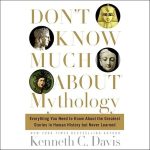
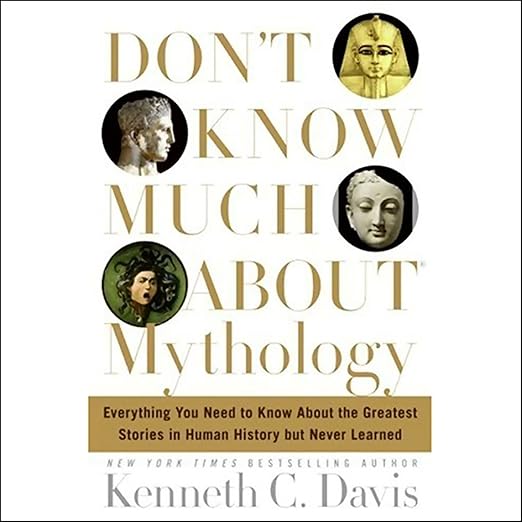
I remember sitting in on a lecture on comparative mythology during my first year at university and being struck by how many of the stories I thought I knew – Greek, Roman, Norse – turned out to be the sanitised, classical-era versions of far stranger, older narratives. Kenneth C. Davis’s Don’t Know Much About Mythology, published in 2005 and released on audio by Random House with John Lee narrating, is a book that captures that same pleasure of first encounter for listeners who did not spend three years studying comparative literature and would, frankly, prefer their mythology without the seminar.
At twenty hours and twenty minutes, this is a commitment, but it is one of those audiobooks that makes twenty hours feel considerably shorter. Davis writes with wit and genuine learning, and John Lee is the ideal narrator for it.
About the Audiobook
Part of the popular Don’t Know Much About series, published by Random House Audio and released in November 2005, this audiobook covers the mythology of world civilisations using the series’ familiar question-and-answer format – a structure that, in Davis’s hands, generates something more like conversation than interrogation. The book opens with a careful examination of what we mean by myth, legend, fable, and folktale – distinctions that matter considerably more than most popular mythology writing acknowledges – before moving through Greek, Roman, Norse, Egyptian, Mesopotamian, Hindu, and East Asian traditions, with additional chapters on African and Indigenous American mythologies (shorter, as more than one reviewer has noted, than the Western material).
Davis’s method is to locate the history inside the mythology and the mythology inside the history. He draws extensively on recent archaeological work to distinguish what can be demonstrated from what has been assumed, and he is alert to the ways in which myths encode social and political realities rather than simply reflecting universal human preoccupations. The tone is never condescending, and the humour – anecdotal, contemporary, occasionally wry – prevents twenty hours from becoming a lecture series. The breadth of the coverage is the book’s primary strength; its depth varies by chapter, and specialists in any given tradition will find the treatment introductory. But as a one-stop survey of the mythological imagination across human civilisations, it is exceptionally well executed.
The enduring relevance of the material is also worth noting. Davis’s observation that mythology is alive in contemporary language – Pandora’s Box, the Golden Fleece, the Wheel of Fortune – and in psychology, art, and literature, gives the book a present-tense energy that pure historical survey writing often lacks.
The Narration
John Lee is one of the most consistently excellent narrators working in English-language audiobooks, and his performance here is exactly what twenty hours of comparative mythology requires. His voice carries authority without pomposity, and he moves between registers – the conversational wit of Davis’s Q&A format and the gravity of creation myths and cosmological narratives – with the fluency of a natural storyteller. The pacing is well judged: Lee understands that mythology has its own rhythms, that some stories need space and others need momentum, and he calibrates accordingly. This is a narrator who genuinely serves the text rather than performing it.
What Readers Say
With a rating of 4.4 from 209 Audible listeners, Don’t Know Much About Mythology has built a loyal readership across nearly two decades. One US reviewer described returning to it three times, each time finding new reasons to appreciate Davis’s integration of humour, history, and genuine scholarship: "Kenneth Davis writes in a way that is easy to read and understand. His humor mingled in with world history makes it a wonderful opportunity to learn about human nature and our beliefs." A more analytical reader singled out Davis’s opening chapter – the taxonomy of myth versus legend versus fable versus folktale – as one of the most valuable things in the book, noting that understanding these distinctions provides a framework for making sense of far more than just mythology. The consistent criticism, raised by multiple reviewers, is the relative thinness of the non-Western material. It is a fair point, and Davis’s own cultural centre of gravity is clearly Western.
Who Should Listen?
This is an excellent choice for anyone who wants a wide-ranging, intelligent survey of world mythology without requiring prior knowledge of classical studies. It works particularly well for those approaching mythology through fiction – readers of Neil Gaiman, Madeline Miller, Pat Barker, or Rick Riordan who want to understand the source material more deeply. The question-and-answer format makes it a natural fit for listening in relatively short sessions, and the variety of traditions covered means that even listeners with some existing knowledge will find new territory. Those with advanced knowledge of specific traditions should adjust their expectations accordingly – this is breadth over depth – but as an introduction and a pleasure, it is hard to fault.