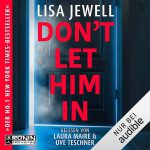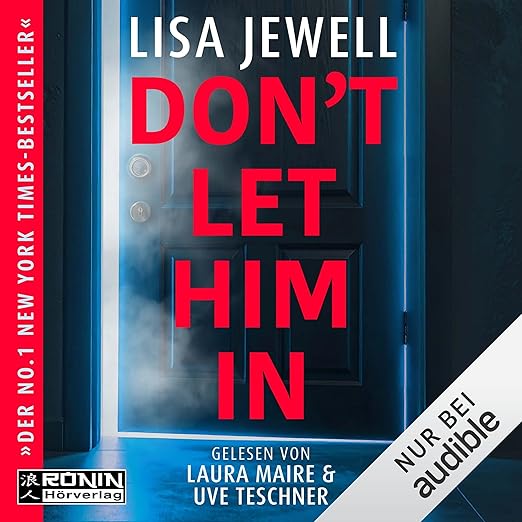
Clara’s Verdict
Lisa Jewell has spent a career perfecting a particular architecture: several strands running at once, each narrator holding a different portion of the truth, and the reader assembling something none of the characters can see. Don’t Let Him In is that architecture applied to the most ordinary horror available, which is the charming man who moves in. Twelve hours and three minutes is exactly the right length for it, and I finished this one convinced it is among the most controlled things she has written.
The marketing copy addresses you in the second person, and for once that is not a gimmick. He says he loves you. He moves into your house and into your heart. Then he leaves for days at a time and you do not know where he has gone. The book is engineered so that you supply the dread yourself, which is a far more efficient mechanism than any amount of on-page violence. It is riding high in the Audible UK charts as I write, and thoroughly deserves the position.
About the Audiobook
The premise resists summary by design, and I am not going to spoil the architecture. What I can tell you is that the central figure is a man whose entire method is being trustworthy, and that the novel is far more interested in the women around him than in him. That is the choice that separates this from a hundred other domestic thrillers with a plausible monster at the centre. Jewell keeps the reader ahead of some characters and behind others, and she rotates that advantage without ever letting you feel managed.
The Times described the arrival of a new multivoiced Jewell mystery in audio as carrying “the standing of a summer blockbuster from Steven Spielberg or Christopher Nolan”, which sounds like hyperbole until you consider how few novelists have a dedicated audio following at all. Gillian McAllister called it “A twisty mosaic of a thriller”, which is the more precise description. Marian Keyes was considerably less restrained. Freida McFadden reduced it to three words: “Gripping. Shocking. Masterful.”
An instant Sunday Times bestseller on publication in July 2025, it is a standalone with no series obligations, so nothing here requires prior reading. Be aware that the subject matter involves coercive behaviour and exploitation within relationships, handled seriously rather than luridly, but handled at length.
The Narration
Richard Armitage is credited on the listing, and the publisher’s own copy confirms that Joanne Froggatt shares the recording with him. That dual credit is not incidental. A book about asymmetric knowledge needs two voices so that the listener can feel the seams between what one strand knows and what another does not, and one of the reviewers below refers to the narrators in the plural for exactly that reason.
Armitage is the casting coup and the casting risk in the same breath. His instrument is warm, low and immediately credible, the sort of voice you would trust with your house keys inside a minute. Handing that voice to a man whose entire operating system is being trustworthy is either a stroke of genius or an unfair advantage, and having listened, I think it is the former. He does not play the character as sinister. He plays him as pleasant, and lets you do the rest.
Froggatt supplies the counterweight, and the pairing solves the format’s oldest problem: in a multi-strand thriller, a listener without page breaks needs to know instantly whose head they are in. Two distinct voices do that work in a syllable.
What Readers Say
At 4.5 from 40,438 ratings, this is one of the better received thrillers of the last two years, and the reviews are unusually specific about why. A five-star reader who has read widely in Jewell’s back catalogue was blunt about where this sits in it:
I have read quite a few Lisa Jewell novels with varying degrees of success, however for me, this was her best yet.
The same reviewer describes the opening as deliberately disorienting, admitting to being unsure at first what was even happening beyond a strong sense that one character was giving off warning signs. That is the intended effect. A four-star listener who followed the recording alongside the text gave the performance the credit directly, writing that the book “grabbed me from the first chapter and one of the main reasons is the narrators”. Another reader described abandoning the ironing, the dishes and the food shop in order to keep going, which is as good a measure of pace as any rating.
The mild dissent comes from readers who classify Jewell as a guilty pleasure rather than serious literary fiction. I would gently push back. Construction this precise is not an accident.
Who Should Listen?
Domestic thriller regulars will find this near the top of the current field, particularly if the appeal for you lies in structure rather than body count. It suits anyone who enjoys knowing more than the characters and being made to sit with that knowledge. The multi-voice production also makes it an unusually good choice for people who normally find thrillers hard to follow by ear, because the strands are audibly separated rather than signposted.
Think twice if coercive control and predatory relationships are subjects you would rather avoid at length. Twelve hours in close proximity to this man is a real commitment of attention, and the discomfort is the point rather than a side effect. Anyone wanting a police procedural or a whodunnit with a tidy investigative spine should also look elsewhere, because Jewell is not writing a puzzle to be solved so much as a trap being built in front of you.