Clara’s Verdict
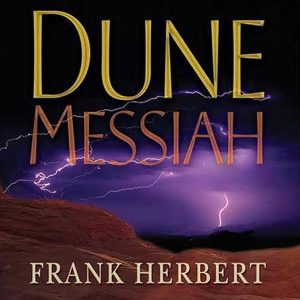
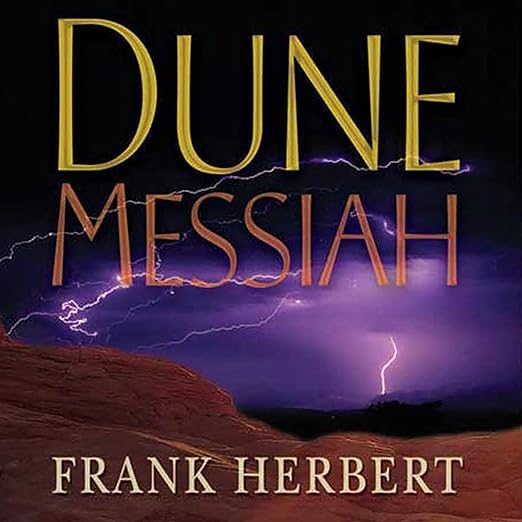
Frank Herbert’s Dune Messiah is one of the most misread sequels in science fiction – and deliberately so. Readers who arrive expecting a second helping of the first novel’s sweeping desert adventure are frequently disappointed, and that disappointment is entirely the point. Herbert is doing something far more daring here: systematically dismantling the heroic mythology he spent an entire novel constructing. Paul Muad’Dib, now Emperor of the Known Universe, is not a conqueror surveying his triumph. He is a man trapped inside his own prescience, watching a civilisational catastrophe he cannot prevent unfold in exquisite slow motion. As someone who has returned to this book many times over the years, I find Dune Messiah grows richer with every visit – a novel about the burden of godhood that has no equivalent in the genre. Scott Brick’s measured narration from Macmillan Audio is the ideal companion for Herbert’s dense, philosophical prose.
This is the second instalment in the Dune series, and it is the book that reveals Herbert’s true subject: not destiny, but the danger of being worshipped.
About the Audiobook
Set twelve years after the fall of Shaddam IV, Dune Messiah opens onto a universe reshaped – and ravaged – by Paul Atreides’ jihad. Billions have died in his name. The desert planet Arrakis is slowly greening under Fremen stewardship, and the spice still flows, but the political ground beneath Paul has been thoroughly mined by those who wish him destroyed.
A conspiracy is gathering its threads: the Bene Gesserit Sisterhood, the Spacing Guild, the Tleilaxu face-dancers, and a Princess named Irulan are working in concert to break Paul’s hold on power. At the heart of their scheme is a ghola – a man grown from the cells of Duncan Idaho, resurrected with alien technology and an uncertain purpose that neither Paul nor the reader can immediately determine. The Tleilaxu are particularly unsettling presences; Herbert uses them to explore the moral horror of biological manipulation in ways that feel prescient.
The novel’s central tension is not military or political so much as existential. Paul sees the future – not as a gift but as a prison. Knowing what will happen does not mean he can alter it; prescience, Herbert suggests, is a trap as much as a power. The Emperor’s sister Alia navigates her own terrible condition as an Abomination, pre-born and haunted by the voices of the dead. These are not action-adventure characters; they are people being consumed by their own exceptional natures, and Herbert renders that condition with extraordinary precision. Running to under nine hours, this is a lean audiobook for the depth of ideas it carries – the most intellectually concentrated entry in the series.
The Narration
Scott Brick is one of the most respected voices in American audiobook narration, and his work on the Dune series has become a gold standard for how epic science fiction sounds. He brings an unhurried gravity to Herbert’s prose that suits the material perfectly – this is not a book to be hurried, and Brick never hurries it. His characterisation of Paul carries a world-weariness that is the correct interpretation: this is an emperor who has seen too much and chosen too little, not a conqueror revelling in victory.
Where Brick particularly excels is in the philosophical passages – the long interior monologues in which Paul wrestles with time, with foreknowledge, with the question of what free will means for a man who can see all possible futures. In lesser hands these sections can feel like lectures appended to a story; Brick makes them feel like confessions extracted under pressure. The Macmillan Audio production quality is excellent throughout the nearly nine-hour runtime.
What Readers Say
Listeners largely agree that Dune Messiah is a fundamentally different beast from its predecessor, but those who engage with it on its own terms are consistently rewarded. Sprootie (★★★★★) was initially apprehensive, having loved the original, but found that “Frank Herbert has managed well with the sequel – succeeded in recreating the feel of the first book very well, as well as the characters,” while astutely noting that the focus shifts entirely to the political conspiracy. Kindle Customer Paula (★★★★) offered a thorough contextual overview, appreciating the novel’s willingness to explore how twelve years of imperial rule have changed Paul and his inner circle. Jamie Dickerson (★★★★★) called it “a great read with some very complex characters and themes to unpick.”
The one dissenting four-star note – from Boydie, who struggled with the extended passages on prescience – is actually illuminating: “it was effective in setting out how confusing it could be, though.” That confusion is intentional. Herbert wants the reader to feel something of Paul’s own disorientation. The audiobook holds a 4.3-star rating across 34 ratings.
Who Should Listen?
If you have finished Dune and are simply looking for another propulsive adventure, this may test your patience in ways you did not anticipate. But if you want science fiction that takes ideas seriously – the corrupting nature of absolute power, the tragedy of prescience as imprisonment, the danger of being worshipped by people who need you to be infallible – then Dune Messiah is exceptional. It pairs inseparably with the broader Dune Chronicles and rewards listeners who are prepared to slow down and think alongside the text rather than simply through it.
Essential for serious Dune readers, and genuinely worthwhile for anyone drawn to literary science fiction that uses the genre’s conventions to explore political and philosophical questions with real rigour. Listen to Dune Messiah on Audible UK – Scott Brick’s performance alone is worth every minute.