Clara’s Verdict
The question of moral accountability in automated systems has migrated, over the past decade, from academic philosophy journals into newsrooms, courtrooms, and parliamentary committees. Algorithms make bail decisions in some American jurisdictions. AI systems flag benefits claimants for potential fraud with minimal human oversight. Automated trading programmes move markets in milliseconds through decisions no individual authorised or fully understood in advance. The ethics of autonomous systems is no longer a speculative concern for philosophers — it is an immediate and practical one, and it is one that most people now encounter in their daily lives without fully recognising what they’re dealing with.
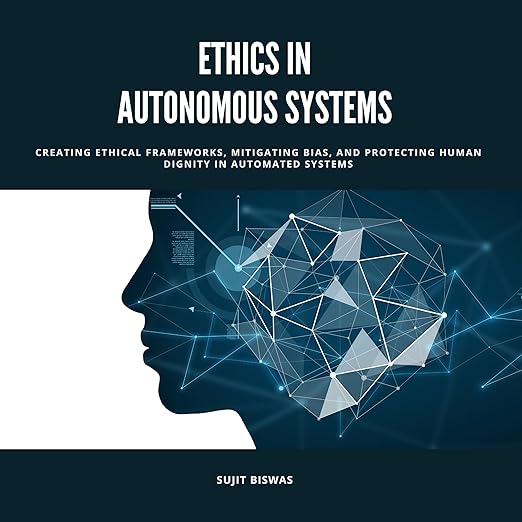
This short audiobook by Sujit Biswas arrives at a genuinely important moment. Even if its sixty-eight-minute runtime necessarily constrains how deeply it can engage with the complexity of its subject, the intellectual framing is serious: it sets out to challenge the illusion of objective automation and to examine delegated agency and algorithmic bias as moral rather than merely technical problems. Whether the text fully delivers on that stated ambition is harder to assess without listener reviews to draw on, but the starting premise is the right one.
About the Audiobook
Biswas frames the central inquiry around the concept of accountability: when a machine makes a decision that harms a person — denies them a loan, misidentifies them as a criminal suspect, recommends an inappropriate medical treatment — who is responsible? The programmer who wrote the code? The organisation that deployed the system without adequate oversight? The data on which the model was trained, which may have encoded historical biases as if they were objective truth? These are precisely the questions that existing legal and ethical frameworks across multiple jurisdictions are struggling to answer, and the book’s framing is well-chosen for a moment when these debates have become genuinely mainstream.
The synopsis promises engagement with algorithmic bias, human dignity, and the ways in which coded systems inevitably reflect the assumptions, blind spots, and values of their creators rather than operating as neutral arbiters. This is foundational territory for AI ethics, but it is territory that deserves serious treatment at every level of accessibility, from academic to popular. At under seventy minutes, this is better understood as an introduction to these debates than as a comprehensive treatment of them. Listeners looking for detailed case studies, rigorous legal analysis, or technical depth will need to supplement this with longer texts — but as an accessible entry point into the moral architecture of automated decision-making, the conceptual framing is solid.
The Narration
Myriam Berger narrates, bringing a clear and composed delivery to the material. The subject matter — moral philosophy applied to technology systems — benefits from a narrator who doesn’t sensationalise or reach for easy drama, and Berger’s tone is measured and precise without becoming dry or clinical. For a text dealing primarily in abstraction and ethical argument rather than narrative case study, the performance prioritises clarity over affect, which is the right choice. The short runtime means there’s little opportunity for the listening experience to drag, and Berger maintains attention throughout without resorting to artificial dramatic emphasis where the text doesn’t support it.
What Readers Say
There are no listener reviews on Audible UK at the time of writing. This is a very recent March 2026 release from an independent publisher, and the absence of reviews is simply a function of timing rather than quality. The academic and professional audience for AI ethics audiobooks is real but relatively small and specialist, and early-adopter reviews tend to accumulate slowly for titles in this space. The book’s positioning in the technology and ethics section of the Audible catalogue is appropriate in terms of subject matter, even if the audience for it takes time to find it. Sampling the opening chapter before purchasing is the sensible approach here.
Who Should Listen?
Ethics in Autonomous Systems is suited to technology professionals who want a philosophical framework for thinking about the systems they build and deploy; to policy and legal practitioners grappling with AI regulation at a time when that regulation is still being actively written and contested; to students approaching AI ethics for the first time as part of academic or professional study; and to general readers who follow debates about algorithmic decision-making in the news and want a more structured context for understanding what’s actually at stake. It is not a deeply technical text, which is part of its accessibility. Those already well-versed in AI ethics philosophy — familiar with the work of Floridi, Mittelstadt, or the publications of institutions like the Alan Turing Institute — will find this introductory rather than revelatory, and will need to look elsewhere for the rigour they’re used to finding in specialist literature.
The timeliness of this audiobook is worth underlining. Regulation of autonomous systems is actively being written and contested across multiple jurisdictions right now, and the philosophical vocabulary that Biswas introduces — delegated agency, moral architecture, the illusion of objectivity — is the vocabulary that these debates genuinely require. Coming to them with a clearer conceptual framework, even a brief one, is a meaningful advantage.