Clara’s Verdict
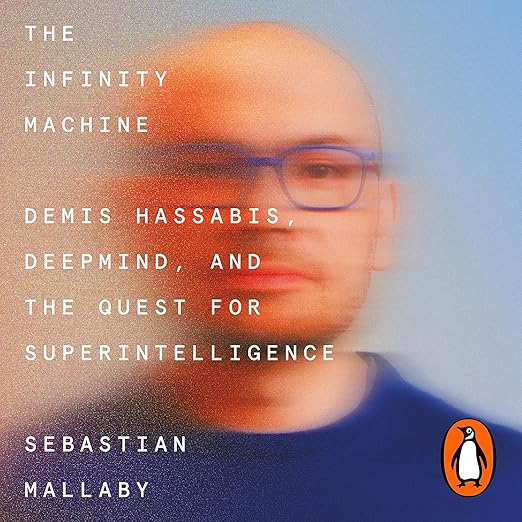
Books about artificial intelligence have multiplied so rapidly in the past few years that a kind of reader fatigue has set in. Most of them cover the same ground: the history of the technology, the arguments for and against acceleration, the obligatory chapter on existential risk, and a conclusion that is either cautiously optimistic or carefully hedged. Sebastian Mallaby is doing something different. The Infinity Machine is primarily a biography of Demis Hassabis, the founder of DeepMind, and it is built on three years of unprecedented access to its subject. The result is something closer in spirit to Robert Caro’s long biographical investigations than to the genre of tech explainer non-fiction that usually fills this space.
Mallaby is best known for The Power Law, his account of Silicon Valley venture capital, and for More Money Than God, his portrait of the hedge fund industry. He is a financial and business writer of the first rank, capable of making complex institutional dynamics readable without simplifying them. Applying that approach to Hassabis and DeepMind, and to the question of what artificial superintelligence might actually mean for humanity, produces a book of considerable ambition.
About the Audiobook
Hassabis is an extraordinary biographical subject. Born to immigrant parents in North London, he was a chess prodigy at five, a professional games designer in his teens, and turned down a seven-figure offer from a video-game studio to study neuroscience at Cambridge. He founded DeepMind in 2010 with the explicit aim of building artificial superintelligence, not as a product or a tool but as a scientific project for solving humanity’s hardest problems. Google acquired DeepMind in 2014. Hassabis won the Nobel Prize in Chemistry in 2024 for AlphaFold, the protein-structure prediction system that may ultimately prove more significant to human health than any pharmaceutical breakthrough of the past century.
Mallaby has conducted hundreds of hours of interviews with Hassabis and his inner circle, as well as with rivals at competing AI companies. The book therefore offers something unusual: a portrait of DeepMind from the inside, covering both the scientific achievements and the ethical anxieties that have accompanied them. The Oppenheimer parallel that Mallaby draws is not gratuitous. Hassabis is genuinely haunted by the question of whether the technology he is building can be controlled, and the book engages seriously with that question rather than treating it as a rhetorical flourish. Published by Penguin in March 2026, this is one of the most significant non-fiction releases of the year.
The Narration
Vidish Athavale narrates this 15-hour audiobook, and his delivery suits the material well. The tone is measured and authoritative, appropriate for a work of serious intellectual biography that requires the listener to track complex scientific ideas alongside narrative biography. Athavale handles both registers, the biographical storytelling and the more analytically demanding passages about AI architecture and competitive dynamics, without dropping the thread. At fifteen hours, the audiobook is substantial but not exhausting. Penguin Audio has produced this with care, and the listening experience reflects that investment.
What Readers Say
As a March 2026 release, The Infinity Machine does not yet have a substantial public review record on Audible UK. The advance praise is significant: Rory Stewart has described it as extraordinary, beautifully written, clear-eyed and engaged in the deepest ethical questions of our day, which is not a blurb to be dismissed lightly. Mallaby’s previous work has consistently attracted serious critical attention, and the access he secured for this project, hundreds of hours with Hassabis over three years, gives it an authority that journalistic accounts of AI cannot match. This is a book that will matter to how we understand the AI moment we are living through.
Who Should Listen?
This is essential listening for anyone trying to understand artificial intelligence not as a collection of products and capabilities, but as a human project with specific people, specific motivations, and specific anxieties driving it. Readers of Mallaby’s previous books will find this his most ambitious undertaking. Those with an interest in the intersection of science, biography, and the ethics of transformative technology will find it rewarding. Pure technical readers who want a deep dive into AI architectures should look elsewhere; this is intellectual biography and reportage rather than engineering literature. Listen on Audible UK