Clara’s Verdict
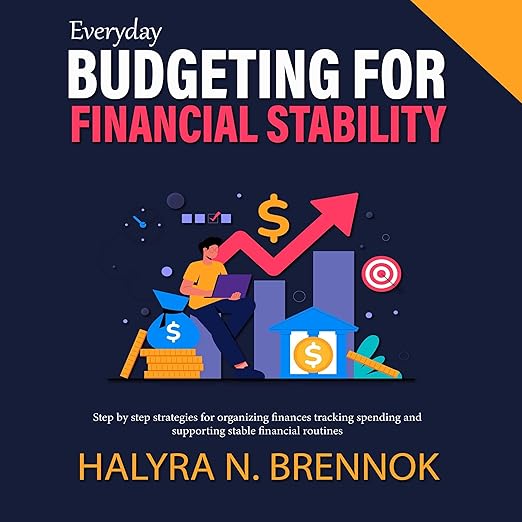
The personal finance genre has a problem, and Halyra N. Brennok seems aware of it: most budgeting books begin from the assumption that you simply have not been disciplined enough, and proceed to offer systems of rules designed to impose discipline from the outside. Everyday Budgeting for Financial Stability takes a different approach, and the difference is audible within the first few minutes. Brennok is not interested in making you feel guilty about your spending. She is interested in helping you understand it, which is a more respectful and, frankly, more effective starting point.
I listened to this during a long weekend walk, which turned out to be an appropriate context: the material rewards unhurried attention without requiring you to sit at a desk taking notes. It is practical, accessible, and honest about the limits of what any generic budgeting framework can achieve for any individual listener. The approach will not suit everyone, and Brennok does not pretend otherwise.
About the Audiobook
Brennok’s core argument is that financial instability is less often a problem of insufficient income than of insufficient planning. Specifically, the absence of a budgeting system that accommodates the actual texture of real life rather than the idealised version of it. The audiobook walks through the fundamentals: tracking expenditure without creating anxiety, organising expenses clearly, building a budget framework that can flex when circumstances change rather than collapsing at the first deviation from the plan.
Particular attention is paid to goal-setting: how to establish realistic financial targets and prioritise both essentials and, crucially, enjoyment within the same framework. Brennok is firm that a budget which eliminates pleasure is a budget that will not survive contact with reality. This is a point that deserves making repeatedly in a genre that sometimes treats spending on anything non-essential as a moral failure. She also addresses the psychological dimensions of money management, including emotional spending, the guilt that often accompanies financial missteps, and the importance of approaching budgeting as a practice of self-awareness rather than self-punishment.
The audiobook addresses several practical challenges that UK listeners will recognise: inconsistent income from freelance or contract work, rising costs of living, and the gap between financial aspiration and day-to-day decision-making. The guidance is step-by-step and the examples are concrete, which makes the material easy to engage with by ear rather than requiring the visual aids that a print format might provide. The section on preparing for unexpected costs is particularly well-handled, since this is the area where most budgeting systems fail: they plan for the predictable and then fall apart when the boiler breaks down in February.
The Narration
Bryan Singer delivers the content in a warm, conversational tone that reinforces Brennok’s non-judgmental approach to the subject. The narration never tips into the slightly hectoring register that personal finance content can easily fall into, which is a significant asset here. Singer handles the numerical content clearly, a genuine requirement for financial guidance delivered by audio, and the pacing allows listeners to absorb each concept before the next is introduced. He reads with the easy authority of someone who has understood the material rather than merely memorised it, which gives even the drier sections on expense tracking a sense of engaged intelligence. A thoughtful performance that matches the book’s spirit throughout.
What Readers Say
This is a recently released title without an established review record on Audible UK. For personal finance audiobooks of this kind, audience tends to build through direct recommendation rather than browsing. The book may also find readers through financial wellbeing communities and the growing network of UK money management blogs and podcasts, where practically-focused titles like this tend to circulate quickly when they genuinely deliver on their promises. The absence of ratings at launch is not unusual for independent titles in this category.
It is also worth noting what this book does not try to do. It does not advocate a specific named budgeting system, such as the 50/30/20 rule or zero-based budgeting, though it acknowledges that such frameworks exist and can be useful starting points for some people. Instead, it argues for building a personalised system from first principles, which takes more initial effort but is far more likely to survive the particularities of your actual life. This is a more mature and honest approach to the subject than the system-selling that characterises much of the competitive landscape.
Who Should Listen?
Anyone feeling overwhelmed by their finances who wants a calm, structured starting point without being lectured at will find this useful. It is explicitly positioned as accessible to beginners, but the emphasis on psychological relationship with money, inconsistent income, and flexible systems will also resonate with experienced budgeters who have tried rigid frameworks and found them unsustainable over time. The three-hour runtime makes it an achievable listen, and the content is substantive enough to reward a second pass when you are ready to act on the suggestions rather than simply absorb them. Well suited to a morning walk or a commute.