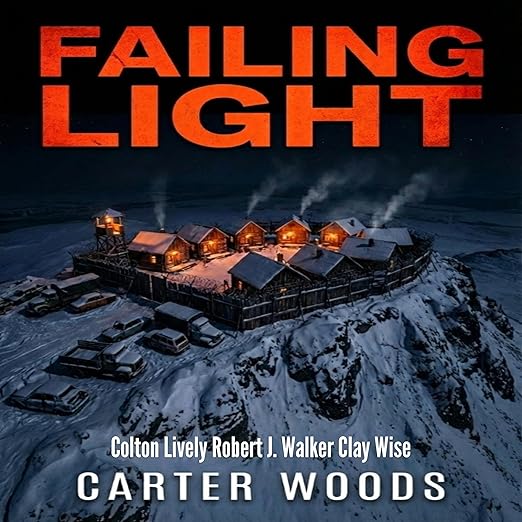
Clara’s Verdict
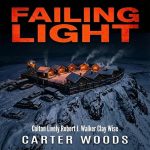
Twenty-eight hours of Arctic survival horror with a science fiction spine – Failing Light is the kind of ambitious genre hybrid that either pays off handsomely or becomes exhausting over its considerable runtime. Carter Woods, in what appears to be their Audible debut, mostly manages to sustain the tension across all twenty-eight hours and twenty-one minutes. The premise is deceptively simple: a solar flare kills the power at an Arctic research outpost, and what should be a containment and survival problem becomes something far more dangerous when something begins circling the perimeter in the dark. What starts as a plausible near-future disaster story gradually – and I mean gradually, in the best possible way – reveals itself as something stranger and more unsettling than its setup initially suggests.
It holds a 4.4 rating from 12 listeners, which is promising for a debut with niche crossover appeal across multiple genre categories.
About the Audiobook
Jenna leads the research team stranded at the Arctic outpost when the solar flare strikes. The initial crisis is practical: restore heat, maintain the food and water supply, make contact with the outside world. Woods handles this procedural phase with real skill – the logistics feel grounded, the team dynamics are established quickly and believably, and the isolation is rendered with a cold clarity that gets under the skin. The daylight question in the Arctic adds genuine dread to the atmosphere: when the light fails, and it fails for a very long time in that part of the world, whatever is outside the perimeter has every advantage.
The science fiction elements are introduced carefully rather than dumped in exposition. This is a story that earns its genre reveals rather than announcing them. There are thriller elements – the question of what is stalking them, and whether it is human, animal, or something else entirely – but they are handled within a literary framework that values character over pure shock. Jenna is a compelling protagonist: competent, frightened, stubborn in exactly the right ways. The supporting team is differentiated enough that when the narrative pressure builds, you have something at stake in each of them.
The novel’s willingness to take its time – building dread through accumulation rather than incident – is both its greatest strength and the quality most likely to divide readers. If you need narrative resolution within six hours, this is not your book. If you’re prepared to commit to the slow freeze, the payoff is substantial. Running time: 28 hours and 21 minutes.
The Narration
Cheryl May narrates, and the choice of a female voice for Jenna’s story feels instinctively correct. May’s delivery carries a controlled urgency that suits the survival register without tipping into melodrama. The cold of the Arctic setting – which any competent polar fiction needs to make its listener feel – comes through in her measured pacing of the more claustrophobic sequences. For a 28-hour production, maintaining listener engagement is a genuine technical challenge; May holds the atmosphere well across the full runtime, adjusting her register as the story shifts from procedural survival into its darker final movements. The ensemble cast is kept distinct throughout, which matters for a story where distinguishing individual voices in moments of high pressure is essential to following the action.
The science underpinning the setup – solar flares and their effects on power infrastructure – is handled with enough accuracy to satisfy scientifically literate readers without becoming a technical lecture. Woods has clearly done the research into what actually happens when you remove power from a polar research station: the cascade of failures, the timeline of deterioration, the specific vulnerabilities of a small team in an environment that is entirely inhospitable to human life without technological support. This groundedness makes the subsequent supernatural or quasi-supernatural elements more effective rather than less; they intrude into a world that already feels genuinely dangerous.
What Readers Say
The twelve ratings this title has accumulated are overwhelmingly positive, though the sample is small enough that individual responses carry significant weight. Listeners praise the atmosphere and the slow-burn tension structure, with several noting that the 28-hour runtime never felt padded or indulgent. The genre-blending – science fiction, survival thriller, horror – is cited as a strength by readers who came for one strand and appreciated finding the others woven in without friction. No reviews mention the ending negatively, which suggests the payoff delivers on the lengthy setup.
Who Should Listen?
If you read Jeff VanderMeer’s Annihilation and wanted more runtime to spend inside its atmosphere, this is your next listen. Fans of survival thriller with genuine scientific credibility – the approach to extreme environment fiction that takes the physics and biology of the setting seriously – will be well served. This is also a strong choice for listeners who enjoy horror that builds rather than shocks: Failing Light is patient and specific in its dread. Audiences who enjoy sci-fi with literary ambitions alongside their genre pleasures will find it rewarding. Not recommended for those who need narrative momentum sustained at thriller pace throughout – this earns its darkness slowly.
Listen to Failing Light on Audible UK: Find it on Audible UK. Also available via Kobo, Scribd, and Storytel.