Clara’s Verdict
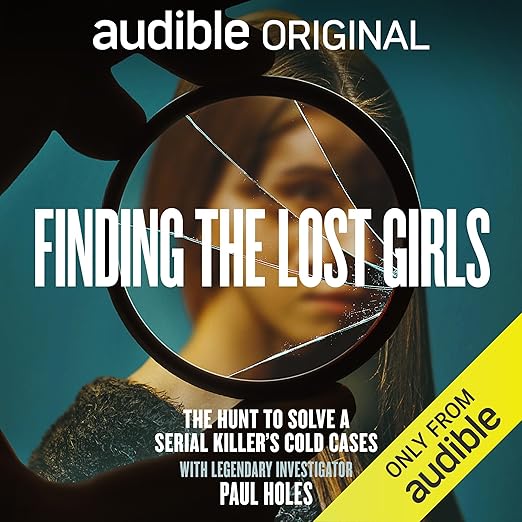
Paul Holes is something of a known quantity in true crime – the investigator whose decades of work on the Golden State Killer case brought him to wide public attention – and Finding the Lost Girls is a different kind of project from the retrospective accounts that usually follow an investigator’s career. This is an Audible Original recorded, written, and produced as events unfolded: Holes narrating a real investigation in near-real time as he comes out of retirement to reopen four cold case homicides connected to Joe Naso, a photographer and convicted serial killer now in his late eighties at San Quentin and in declining health. The window to solve anything before Naso takes his remaining secrets with him is actively closing as you listen.
The case itself is deeply unsettling. Naso was sentenced to death for six murders, but the list found in his home during a 2010 probation visit pointed to more – women who had gone to meet a photographer about modelling work and had not come back. The other cases on that list went cold. Holes was part of the original investigation team, and the work felt unfinished. What this audiobook documents is what happens when a detective who has been retired for six years decides that unfinished is not acceptable. The women on those cold cases – their names, their families, their decades of waiting – are the moral weight of everything that follows, and Holes is consistently alert to that weight.
About the Audiobook
Published by Audible Originals in March 2026, Finding the Lost Girls runs to 4 hours and 24 minutes and carries a 4.6-star rating from 14 Audible UK reviews – a meaningful signal of audience satisfaction for a recently released Audible Original. Holes narrates himself. The format is native to audio: this was not a book first, adapted for listening, but conceived and recorded specifically as an audio documentary. That distinction matters significantly to how you experience it – the pacing, the structure, and the way information is revealed are all calibrated for listening rather than reading, with the real-time uncertainty built into the form itself.
The Naso case dates to 1976, when a woman vanished after going to a restaurant to meet a photographer about a modelling job. Multiple murdered women in Marin County over subsequent years. A probation officer’s routine home visit in 2010 uncovering a disturbing handwritten list that pointed to ten murders. A death sentence for six of those murders, handed down in San Jose. Four cases still open, cold, and aging. Holes’s reentry into the investigation, six years into retirement and with no official standing, against a deadline imposed by biology rather than law – Naso approaching ninety, his health declining, the window narrowing.
The Narration
Self-narration is the only option here, and it is not a limitation but a strength. Holes is the investigator, and the first-person perspective is what gives the real-time format its authenticity and its tension. His voice is calm, measured, and forensically precise – the voice of someone who has spent decades in rooms where emotional control matters more than emotional expression. That register serves the material: you are following an investigation, not a performance of grief or outrage. Some listeners may wish for more inflection in the passages concerning the victims and their families, and that is a legitimate response. But there is a strong argument that Holes’s restraint serves those sections better than performed emotion would – it locates the weight where it belongs, in the facts, rather than in how the narrator sounds describing them.
What Readers Say
The 4.6-star rating from 14 Audible UK listeners is a reliable indicator of satisfaction for a title this recent – Audible Original true crime tends to attract listeners who already follow Holes’s work or who were drawn to his profile through the Golden State Killer investigation and his podcast collaborations. The real-time production format means the listener is tracking an active investigation rather than a resolved case, which is an unusual and involving experience. No written review text has been posted at the time of writing, but the rating distribution suggests a strongly positive reception among those who have listened.
Who Should Listen?
True crime listeners who have grown fatigued by the genre’s tendency to aestheticise violence – the dramatic reenactments, the killer-as-fascinating-subject framing – will find Holes’s approach notably different. The focus is on investigative process, on the families of victims, and on the institutional challenges of cold case work. The killer, Joe Naso, is present as a problem to be solved rather than as a figure of dark fascination.
The 4.5-hour runtime makes this an ideal single-sitting listen – a Sunday afternoon, a long train journey. Those with low tolerance for unresolved cases or narrative uncertainty should note that this is real-time investigation: not every question Holes asks will be answered in the way listeners conditioned by neatly resolved true crime expect. The format is honest about what investigation actually looks like.