Clara’s Verdict
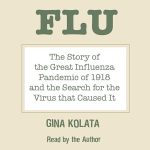
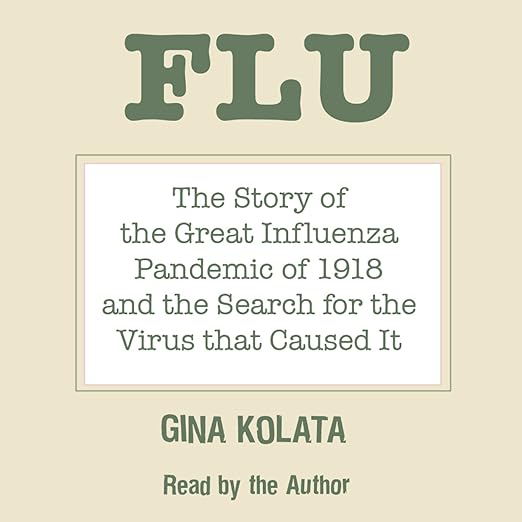
I first came across Gina Kolata’s Flu some years ago, sandwiched between heavier histories on a shelf in a second-hand bookshop in Bloomsbury. I bought the print edition on a whim and read it in two sittings. The audiobook – narrated by Kolata herself – is a different and arguably richer experience, because her voice carries the urgency of someone who genuinely could not believe, as she researched, that this story was not better known.
The 1918 influenza pandemic killed somewhere between fifty and one hundred million people worldwide. More than the entirety of the First World War. More than the Black Death, some historians argue, in sheer numbers. And yet, for most of the twentieth century, it barely registered in popular consciousness. Kolata’s book, first published in 1999 and issued on audio in 2001 with a later epilogue addressing avian flu concerns, asks a deceptively simple question: why did we collectively forget something this catastrophic? And what happens if it comes back?
About the Audiobook
Published by Random House Audio and running at just over six hours, Flu is narrative science writing at its most compelling. Kolata structures the book as something close to a detective story – the mystery being the identity of the 1918 virus itself, which scientists spent much of the twentieth century attempting to recover from frozen tissue samples and military records. The chase takes readers from a remote Alaskan village where flu victims were buried in permafrost, to the Norwegian island of Spitsbergen, to the corridors of the Centers for Disease Control and the competing laboratories of virologists who do not always behave collegially.
The science is accessible without being dumbed down. Kolata explains virology with the kind of clarity that comes from long practice as a science correspondent at the New York Times, and she has the storyteller’s instinct for knowing when a technical explanation will hold attention and when it will lose it. The human stories – the extraordinary mortality rates among young adults in the prime of life, the sheer speed with which communities were overwhelmed – give the epidemiology its proper emotional weight.
The edition on Audible includes a new epilogue addressing the threat of avian influenza, which adds considerable contemporary relevance. Published before the Covid-19 pandemic, the book now reads as genuinely prophetic in parts, and listeners returning to it after 2020 will find it a different kind of unsettling than first-time readers encountered.
A note on the epilogue: it was written well before Covid-19, and listeners coming to the book after 2020 will find it simultaneously prescient and, in certain specifics, overtaken by events. That it feels so relevant now is, in itself, a tribute to Kolata’s rigour as a science journalist.
The Narration
Kolata reads her own work, and self-narration is always a gamble. Scientists and journalists are not professional voice actors, and the results can be stilted. Here, however, the author’s familiarity with the material works strongly in the listener’s favour. She reads with the confidence of someone who has spent years explaining difficult ideas to non-specialist audiences, and the slight informality in her delivery – this is clearly not a polished studio performance in the conventional sense – actually heightens the sense that she is telling you something important rather than performing a text. The pacing is brisk, which suits the material well. At six hours and fourteen minutes, the book does not overstay its welcome.
What Readers Say
With a rating of 4.4 on Audible UK, Flu has gathered warm responses from listeners across two decades. One UK reviewer described the 1918 epidemic as "the disease that made SARS look like a sniffle" and noted the visceral shock of recognising its scale in a local churchyard near their home in South-East England – a graveyard "given over to the graves of Canadian servicemen, all of whom died in their late teens in the Winter of 1918/1919." Another listener, Clare O’Beara, praised the book’s balance of breadth and depth, noting that she read it "over a few sessions" to manage its cumulative weight. One reviewer raised a legitimate criticism – that the book focuses primarily on the American experience while largely overlooking the rest of the world – a fair observation that prospective listeners should bear in mind.
Who Should Listen?
Anyone with an interest in public health, epidemiology, or twentieth-century history will find this essential. It is equally compelling for those who arrived at the subject via the Covid-19 pandemic and are looking for historical context that goes deeper than what circulated on social media in 2020. It is not a comfortable listen – the mortality statistics are stark and the implications for modern pandemic preparedness feel, at moments, alarming – but Kolata never loses sight of the human stories underneath the data. Those seeking an accessible but rigorous account of one of history’s most overlooked catastrophes will struggle to find better.