Clara’s Verdict
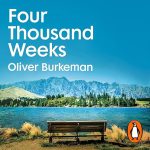
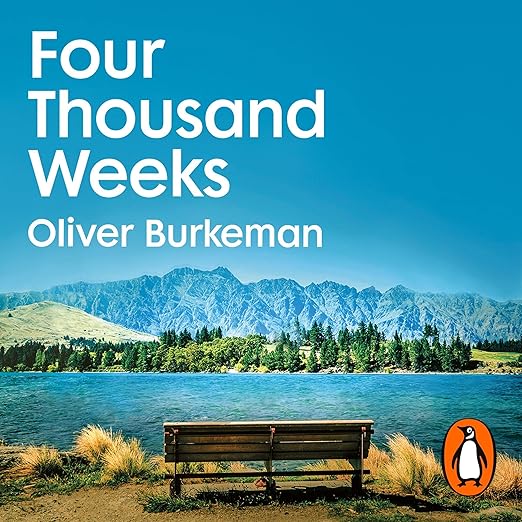
There are books that tinker at the edges of how you think, and then there are books that pull the ground from beneath your feet. Four Thousand Weeks belongs firmly in the second category. Oliver Burkeman spent years writing about productivity for the Guardian, dutifully testing every planner, app, and time-management system on the market – and in doing so, gradually realised that the whole project was built on a lie. This is the book where he says so, loudly and with enormous philosophical rigour.
What makes it stand out on Audible is the rare pleasure of hearing an author read his own work with genuine conviction. Burkeman sounds like a man who has been freed of something, and that lightness is contagious. At just under six hours it is a tight, dense listen that repays a second run-through. I have reviewed well over two thousand audiobooks in my time, and very few have made me stop mid-walk to sit down and think. This one did, more than once. It was a Sunday Times bestseller, a Financial Times Book of the Year, and an Observer Book of the Year – and for once, all three of those accolades seem appropriate rather than perfunctory.
About the Audiobook
The title is blunt arithmetic: if you live to eighty, you get roughly four thousand weeks. Not four thousand years, not four thousand months – weeks. Burkeman uses that number not to terrify but to liberate, arguing that our collective obsession with productivity is a form of magical thinking, a refusal to accept that we are finite creatures with finite time.
Drawing on thinkers as varied as Heidegger, the Stoics, Carl Jung, and the medieval mystic Meister Eckhart, Burkeman builds a case against what he calls “the efficiency trap”: the idea that if we could just organise ourselves better, we might eventually get on top of everything. We won’t, he insists. The inbox will never be empty. The to-do list will outlive us. And the sooner we accept that, the sooner we can start making genuine choices about the weeks we actually have.
The book is structured around a series of counterintuitive insights – on distraction, patience, rest, and what it really means to be present. Burkeman argues that distraction is not a failure of willpower but a feature of the human mind confronting its own finitude: we reach for our phones not because we’re addicted but because we’re afraid of fully inhabiting the moment in front of us. The chapter on patience is one of the most practically useful things I’ve encountered in years of reading the genre.
It is part philosophy, part memoir, and entirely honest. Burkeman includes himself in the indictment throughout, which makes the argument feel lived-in rather than preachy. Published in August 2021 by Penguin Audio, running 5 hours and 54 minutes.
The Narration
Oliver Burkeman reads his own work, and it shows in the best possible way. There is no distance between the ideas and the voice delivering them – he understands every hesitation, every pivot, every deliberately uncomfortable pause. His delivery is measured and conversational, never lecturing, occasionally self-deprecating in a way that perfectly suits the material. The prose itself is beautifully crafted, and Burkeman reads it as if he’s working through the argument in real time rather than reciting something already settled. For a book about slowing down and paying attention, this is exactly the right kind of narration.
What Readers Say
Four Thousand Weeks holds a rating of 4.4 out of 5 on Audible UK. Listeners consistently praise its philosophical depth alongside its practical honesty. One UK reviewer described it as “the antidote to the productivity, work smart, squeeze every moment philosophy” that has dominated self-help for decades, noting that Burkeman has written “the best and most thoughtful iteration” of an idea whose time has clearly come. Another called it “more of a philosophical book than a time management book” – a characterisation Burkeman himself would probably endorse – and said it “triggered an identity crisis” in the best possible sense. A third reviewer described the book as genuinely frightening: “my weeks were disappearing fast without me even noticing them. I wasn’t present.” Several readers noted that the language requires effort but rewards it, and that the book’s ideas continue to surface long after the last chapter. Mark Manson, bestselling author of The Subtle Art of Not Giving a F*ck, called it “a much-needed reality check on our culture’s crazy assumptions around work, productivity and living a meaningful life.”
Who Should Listen?
If you have ever found yourself managing your time more efficiently only to feel more overwhelmed than before, this audiobook is for you. It is essential listening for anyone caught on the productivity treadmill – whether you’re a habitual list-maker, someone who feels guilty taking a day off, or a professional who measures their worth in output. It will also appeal strongly to those with a philosophical bent who find pure self-help too shallow: Burkeman engages seriously with Heidegger and the Stoics without becoming inaccessible.
This is not a book that will tell you how to do more. It is a book that will make you question why you want to – and that distinction matters enormously. Available on Audible UK, Kobo, Scribd, and Storytel.
Listen to Four Thousand Weeks on Audible UK – and make the next few hours count.